
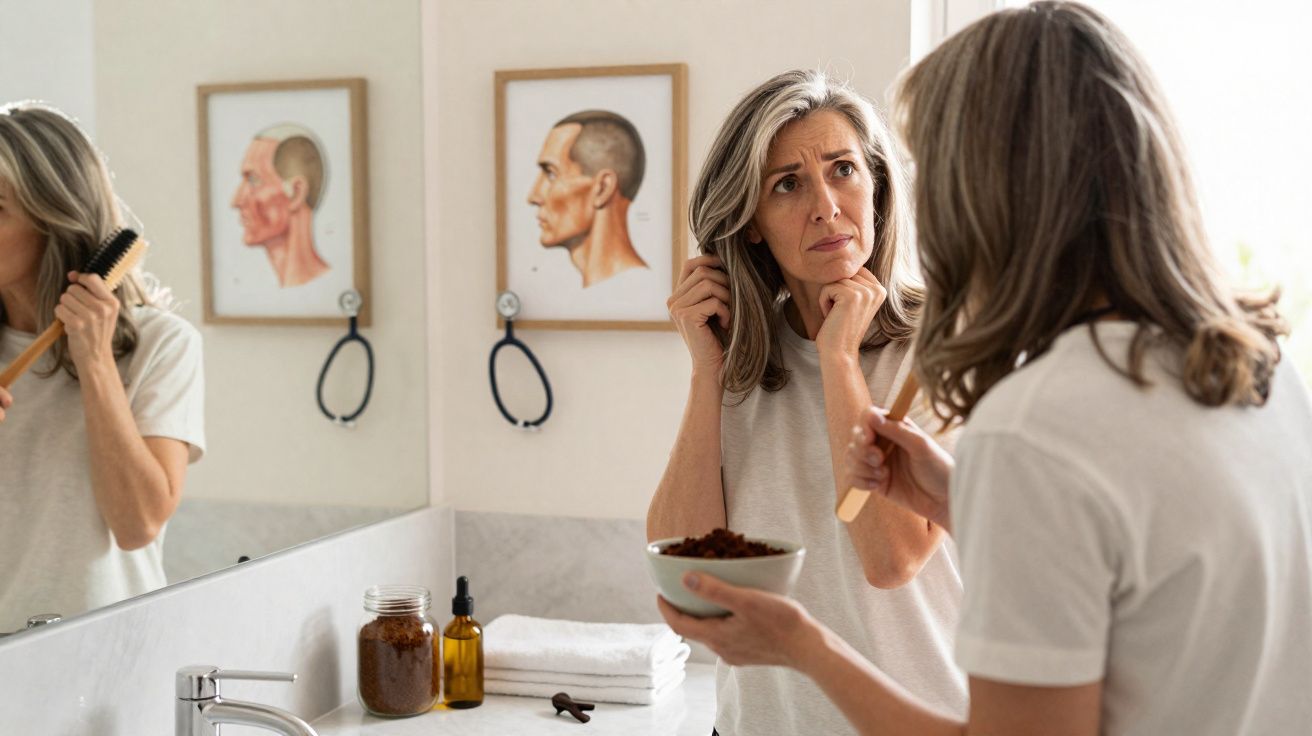
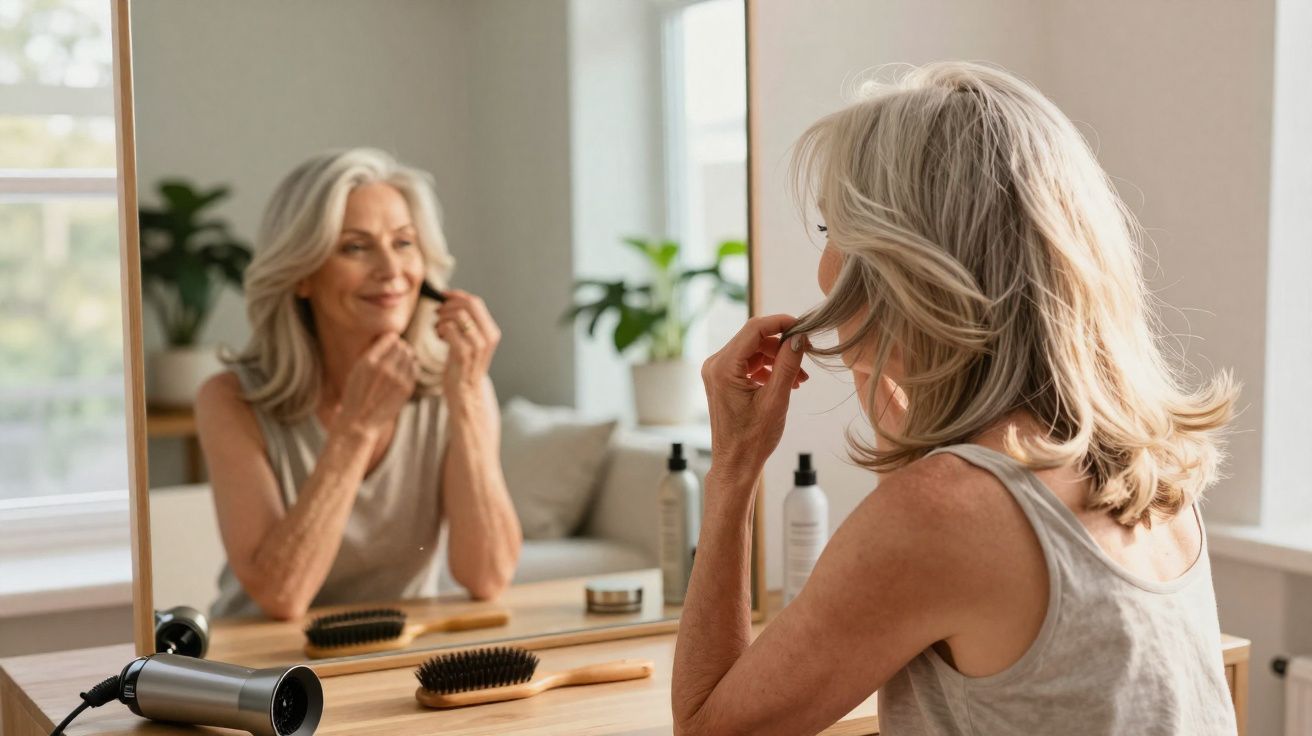
The woman leaning towards the bathroom mirror looks like someone you’d drift past in the supermarket without a second glance. A T-shirt, a messy bun, and a face that’s oddly hard to place in an age bracket because it transforms completely when she smiles. She moves closer, lifts a small section of hair, and spots it: a fine, stubborn silver line at the roots that somehow feels louder than the rest of her hair put together.
On her phone, YouTube plays a “miracle” clip on repeat: “Say goodbye to grey hair with this 2-ingredient homemade dye!” Two spoonfuls, a bowl, a bit of stirring, then a before/after image that looks almost suspiciously perfect. In the comments, hearts and “OMG it works!!!” stack up like confetti.
She pauses, suspended between belief and scepticism.
Then she opens the kitchen cupboard.
What’s really hiding in that “2-ingredient miracle” recipe for grey hair dye
Most viral two-ingredient “dyes” for grey hair tend to land in one of two broad camps. On the gentler end are the kitchen favourites: coffee, black tea, sage, rosemary, beetroot juice, cocoa, turmeric. On the harsher end are the more forceful blends: bicarbonate of soda mixed with hydrogen peroxide, or vinegar combined with salt or lemon, all sold as ways to “reactivate pigment”.
The pitch barely changes: no chemicals, no salon costs, a “natural” fix you can throw together with a spoon and a mug. Add a dash of drama, a pinch of pseudo-science, and a glossy thumbnail, and it’s ready for the algorithm.
At first glance, it sounds like a tiny revolution served up in a cereal bowl.
Spend enough time scrolling TikTok or Instagram and you’ll notice the formula. A hand tipping cooled coffee into a glass dish. A mound of bicarbonate of soda falling like snow into a “magic paste”. A woman in her 50s working a dark, gritty mixture into her scalp, smiling bravely at the camera.
The caption promises results in “just one use”. Some creators push it further: “This reverses grey hair permanently.” The comments fill with people pleading for exact ratios, asking whether it works on “stubborn grey”, or suggesting they’ll add coconut oil “for shine”.
These videos can pull in millions of views within days. The corrective posts from dermatologists? A few thousand, if they’re lucky.
Here’s the unvarnished truth: greying is largely about melanin, genetics, and time. Hair follicles contain pigment-producing cells that, over the years, gradually stop making colour. Once those cells have effectively clocked off, no kitchen concoction can genuinely send them back to work.
Coffee, tea, and herbal rinses can lightly stain the hair shaft, particularly if your hair is already light-coloured or porous. That can make greys look softer and less stark - a little more blurred. But it isn’t “reversing” greying.
The more abrasive combinations - like bicarbonate of soda and peroxide - can deliver a different kind of result altogether: damage.
Why some doctors describe it as a “dangerous illusion”
Mention these viral “2-ingredient dyes” to a dermatologist and you’ll often hear the same blend of frustration and concern. On paper, they seem mild, “natural”, even virtuous. In reality, people are smearing highly irritating mixtures straight onto their scalp and leaving them there for an hour because a video told them to.
Hydrogen peroxide can be safe when used in controlled, low concentrations, applied by professionals with appropriate aftercare. Mixed with bicarbonate of soda at home, used without a patch test, and left on sensitive skin? That’s a very different scenario.
Behind the soft filters are burns that never trend.
Dermatology clinics are quietly seeing the consequences. Scalps that are red and inflamed. Skin that feels tight, itchy, and then flakes days later. Contact dermatitis around the hairline after “natural” lemon-and-salt scrubs meant to “reactivate pigment”.
One 42-year-old teacher I spoke with followed a popular recipe: 3 spoons of baking soda, enough 3% hydrogen peroxide to make a paste, left for 30 minutes under plastic wrap. The promise was grey hair “gone in one session.” What she got instead was chemical burns on two areas of her scalp, small blisters near her ears, and hair that broke off into tiny, dry fragments as she rinsed it out.
Her grey roots didn’t budge. Her faith in “natural” hacks did.
Doctors call it a dangerous illusion for two main reasons. First comes the illusion of control: the belief that if you scrub, “clean”, or “boost” the scalp aggressively enough with pantry products, you can force pigment cells to switch back on. Biology doesn’t respond to viral optimism.
Second is the illusion of safety. Because it lives in your cupboard, it feels harmless. Lemon, vinegar, bicarbonate of soda, strong tea… all familiar, all “clean”. But pH, concentration, how long it’s left on, and individual skin sensitivity are what determine whether something is tolerable or damaging.
The body responds to these mixtures very differently from the way a trending post describes them.
If you still want to experiment with viral 2-ingredient grey hair recipes, do it like an adult, not like a reel
If you’re determined to try homemade colour, keep yourself firmly in the “stain, don’t strip” lane. That means gentle, plant-based rinses rather than caustic DIY chemistry. Think strong black tea or coffee rinses for darker hair, sage or rosemary infusions to blend greys more softly, and beetroot or hibiscus teas for a reddish tint.
The approach is straightforward: brew a very strong infusion, let it cool fully, then slowly pour it over clean, damp hair. Catch the liquid in a bowl and repeat the pour several times. Leave it on for 15–30 minutes, then rinse lightly - or not at all - depending on how much you can tolerate the smell and any residue.
You may get a hint of colour. You won’t get a miracle.
The common mistake is turning “natural” into “extreme”. Leaving mixtures on overnight. Wrapping hair in plastic to “increase penetration”. Dropping in a bit of peroxide or bicarbonate of soda “just to help”.
If your scalp tingles, stings, burns, or feels hot, that isn’t “proof it’s working” - it’s your body telling you to stop. Any recipe that relies on harsh exfoliation, claims it will “open the cuticle”, or promises to “lift old dye” using kitchen powders isn’t a gentle solution for greys; it’s DIY damage.
And let’s be real: nobody sticks to this every single day, no matter what the comments insist.
“People are so afraid of looking ‘old’ that they’ll happily believe a teaspoon of baking soda can rewrite their DNA,” a Paris-based dermatologist told me, half joking, half serious. “The dangerous part isn’t the gray hair. It’s the shame and the shortcuts.”
- Avoid harsh combos: No bicarbonate of soda + peroxide, no lemon-salt scrubs left sitting on the scalp, and no vinegar masks “to reactivate pigment”. These are irritants, not cures.
- Stay in the rinse zone: coffee, tea, herbs, and plant powders used as brief, gentle rinses can add a soft tint without attacking the hair fibre.
- Patch test everything: Try a small amount behind your ear or on your inner arm for 24–48 hours. If you get redness, itching, or burning, it’s not for you.
- Protect your baseline: if you already colour your hair, piling viral recipes on top of existing dye can trigger unpredictable reactions.
- Speak to real experts: A colourist or dermatologist can talk you through safer options, from demi-permanent dyes to medical routes when appropriate.
Maybe the real revolution isn’t in the bowl at all
If you listen closely to people chasing these two-ingredient “miracles”, the real question is rarely, “How do I dye my hair cheaply?” It’s more often: “How do I stay myself while my body changes in ways I didn’t choose?” That’s a far heavier problem than a spoonful of coffee can solve.
Some people opt for professional colour and feel sharper, more aligned, more visible. Others start easing off the dye and realise they like the silver streak at the temple, the lighter halo framing the face, the way grey can resemble built-in highlights. Both choices are legitimate. Both deserve honesty rather than illusions.
Most of us know that moment: a mirror or an unexpected selfie catches us off-guard, and suddenly we notice time. That sting is exactly where marketing slips in with “miracle” language and fake before/after shots. The quickest relief gets the click.
The quieter truth - less clickable, but more useful - is that gentle care, realistic expectations, and a bit of self-compassion age a face far better than any bicarbonate-of-soda paste. A scalp that isn’t burned, a hair fibre that isn’t stripped, and a mind that isn’t permanently at war with the mirror: those are long-term beauty tools.
The 2-ingredient recipes will cycle in and out. The person looking back at you from the mirror isn’t going anywhere.
| Key point | Detail | Value for the reader |
|---|---|---|
| Grey hair can’t be “reversed” by kitchen recipes | Melanin cells in the follicle stop producing pigment; rinses can stain, not reprogramme | Helps cut through unrealistic promises and avoid wasting time and hope |
| Some 2-ingredient mixes are medically risky | Bicarbonate of soda, peroxide, lemon and vinegar on the scalp can cause burns and dermatitis | Protects the reader’s scalp, hair fibre and long-term health |
| Gentle options and mindset shifts exist | Plant rinses, professional dyes, or embracing grey can all coexist without shame | Offers practical alternatives while reducing pressure around ageing |
FAQ:
- Question 1: Does any 2-ingredient homemade dye truly get rid of grey hair permanently?
No. You can lightly tint or camouflage grey, but you can’t permanently restore lost pigment cells with kitchen ingredients.- Question 2: Is a coffee or tea rinse safe for regular use on grey hair?
Yes, for most people a cooled coffee or tea rinse is relatively gentle, especially if you don’t leave it on too long and you hydrate your hair afterwards.- Question 3: What are the most dangerous “natural” grey recipes to avoid?
Anything mixing bicarbonate of soda with hydrogen peroxide, or strong lemon with salt or vinegar used directly on the scalp for long periods, carries a real risk of irritation or burns.- Question 4: Can a dermatologist actually help with grey hair, or is it purely cosmetic?
A dermatologist can check whether early or sudden greying has a medical cause, recommend safe products, and help you avoid harmful trends that may damage your scalp.- Question 5: Is embracing my grey the only “healthy” choice?
No. You can colour your hair safely with professional or well-formulated products, or you can go natural; the healthy choice is the one that respects your body and your peace of mind, not a viral rule.

Comments
No comments yet. Be the first to comment!
Leave a Comment