
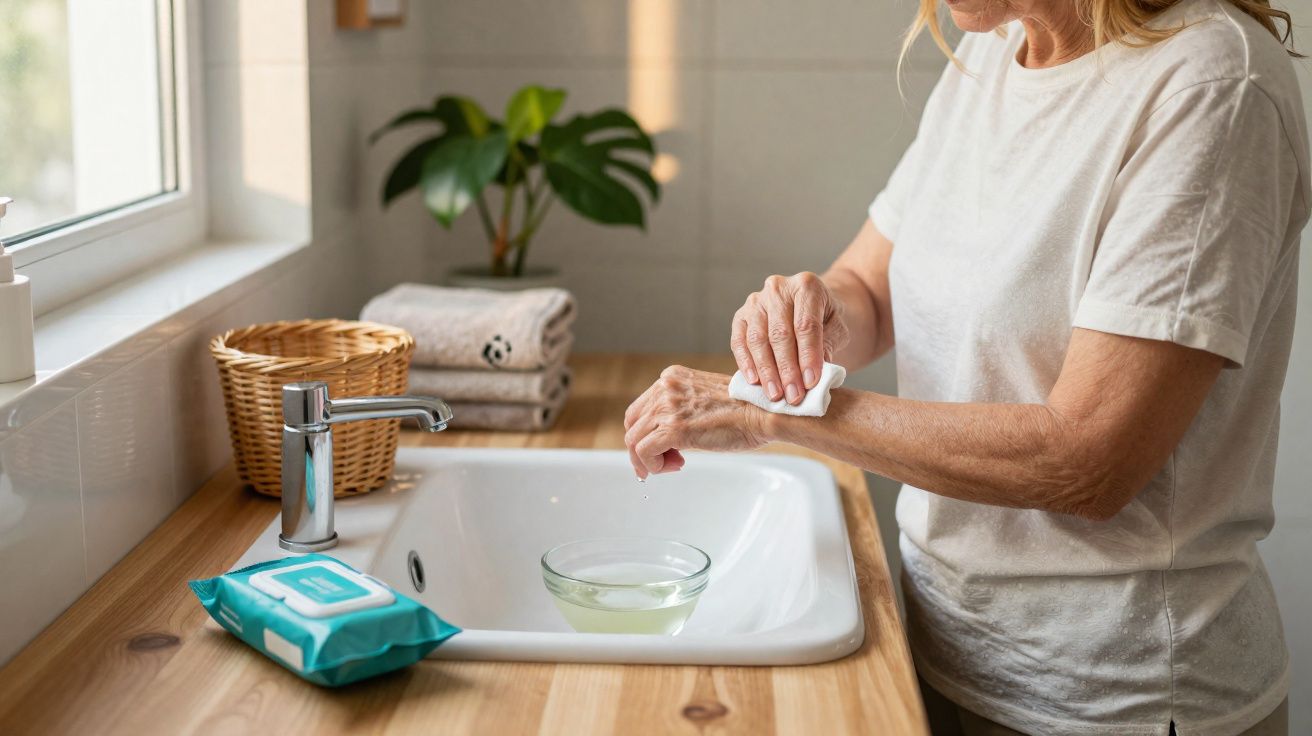
At the chemist’s counter, minutes before closing, a woman in her late sixties pauses. In one hand she’s holding a family pack of “intimate wipes for sensitive skin”; in the other, a bottle of fragrance-free cleansing oil. Her eyes flick to the bold, comforting claims on the wipe packet: “freshness”, “hygiene on the go”, “dermatologically tested”. It looks like an easy decision-nearly a habit.
And yet she hesitates.
Just behind her, a man with a walking stick rummages through his bag and produces his own travel pack of wipes, already half used. For many people, they’ve become second nature-like checking you’ve got your keys before you leave.
Except an increasing number of dermatologists are quietly warning that this automatic gesture may not be doing ageing skin any favours.
Somewhere in the “clean at all costs” narrative, something doesn’t quite stack up.
When “feeling clean” becomes too much cleaning
After 65, personal hygiene can become trickier than most families ever discuss over Sunday lunch. Skin often feels thinner, can be drier, and may tear or irritate more easily. You move more slowly; a shower can feel more exhausting; and, in the background, the worry about “smelling bad” can become louder.
That’s exactly where wet wipes slot in: fast, private, reassuring. One quick wipe and you feel fresh enough to pop out, greet visitors, or get into clean bed linen.
On bathroom shelves, packets of wipes now sit next to toothbrushes and deodorant-almost folded into the everyday routine.
Jean, 72, a retired mechanic living on his own, is a good example. After a minor fall two years ago, he’s felt uneasy about showering. So he’s built a workaround: a proper wash every other day, and on the “tired” days, a careful wipe-down with large body wipes-especially under his arms and around his intimate area.
“I don’t want people to say old folks smell,” he says, half-laughing.
And he’s far from the only one. A French survey on seniors’ hygiene reported that almost one in three uses wipes at least once a week, with a sizeable number reaching for them every day.
In other words, those small packets are quietly bridging the gap between what the body requires and what someone feels physically able-or safe enough-to do.
Dermatologists, however, see what can follow. Used once or twice a week, wipes are rarely a problem. Used daily on mature skin that’s already delicate, the story changes. Many formulas include surfactants, preservatives and fragrances that may disrupt the skin’s microbiome and weaken its protective barrier.
Over time, the outcome can be redness, stinging, irritation, itching in intimate areas, or repeated urinary and vaginal discomfort. That familiar “fresh” sensation can mask a low-level inflammation that never really gets the chance to settle.
The body is signalling-yet the signs can look like “just ageing”, so they’re often brushed aside.
Wet wipes and gentler ways to stay clean that still feel clean
Specialists who regularly treat older adults tend to come back to the same principle: fewer harsh products, steadier routines. One practical way to frame it is to think in two sets of areas. First are the “social” zones-face, hands, armpits, intimate area and feet-which generally benefit from daily attention. Then there’s the rest of the body, which can often be washed with water and a mild cleanser every two or three days, depending on your lifestyle and how much you sweat.
For anyone who feels unsteady or worries about slipping, a sturdy shower chair and a handheld shower head can be transformative.
And on low-energy days, a soft flannel, lukewarm water and a tiny amount of gentle cleanser is usually far kinder to the skin than a fragranced wipe.
Many older people feel a quiet sense of guilt if they miss a full shower and “only” do a partial wash. That guilt can push them towards quick fixes-wipes included-to cancel out the feeling that they haven’t done enough.
In reality, different rhythms can still be completely healthy. The real priority is cleaning the skin folds where moisture and bacteria easily build up: under the breasts, the groin, the crease between buttocks, and neck folds. Then drying carefully-patting rather than rubbing.
If we’re being honest, hardly anyone manages a perfectly textbook routine every single day. What matters over the long term is something stable and realistic, not a set of rules that leaves you feeling as though you’re failing.
One geriatric nurse told me she often arrives at home visits with a simple “wash basket” for the bathroom: a large bowl of warm water, cotton flannels, a mild syndet cleanser and a soft towel.
“What they need isn’t more perfume on the skin,” she says, “it’s time, respect, and products that don’t attack their barrier. Wipes are handy in a pinch, but they’re not a lifestyle.”
For those who still want a fast back-up option, professionals often recommend keeping wet wipes as the exception rather than the rule:
- Pick fragrance-free wipes clearly labelled for very sensitive or atopic skin.
- Save them for travel, hospital stays, or genuine emergencies-rather than a daily routine.
- After repeated use, rinse the area with plain water when you can.
- Use a straightforward, non-perfumed moisturiser to soothe older skin.
- Speak to a GP, pharmacist or nurse at the first signs of burning, soreness or irritation.
Rethinking what “good hygiene” means after 65 for older skin
Underneath the whole wet-wipes question sits something more emotional: fear of judgement, fear of “smelling old”, fear of losing dignity. Relatives don’t always know how to talk about it, and professionals are often rushed. So wipe packets quietly multiply on bedside tables and bathroom shelves-like a small, private shield against embarrassment.
But caring for older skin can be understood less as a battle against odour, and more as a daily act of gentleness towards a body that has carried someone through decades.
Most people recognise the moment when a parent or grandparent admits-almost apologising-“I don’t manage so well with the shower anymore.” How we respond to that tells you a lot about how we view ageing.
| Key point | Detail | Value for the reader |
|---|---|---|
| Wipes as occasional helpers | Use unscented, sensitive-skin formulas for travel or specific situations, not as a permanent substitute for washing. | Reduces risk of irritation and preserves the skin’s natural balance. |
| Gentle, realistic routine | Prioritise daily care for folds and intimate zones, with showers adapted to energy and mobility. | Maintains good hygiene without exhausting or guilting the person. |
| Conversation and support | Talk openly with relatives and professionals about fears, difficulties, and alternatives to wipes. | Restores dignity and allows tailored solutions instead of default shortcuts. |
FAQ: wet wipes, hygiene, and seniors
- Question 1 Are wet wipes unsafe for seniors when they’re used every day?
- Question 2 What’s the best alternative to wipes for intimate hygiene after 65?
- Question 3 How often should an older person shower to remain healthy?
- Question 4 My parent won’t shower and relies only on wipes-what can I do?
- Question 5 Are “biodegradable” or “natural” wipes genuinely better for older skin?


Comments
No comments yet. Be the first to comment!
Leave a Comment