
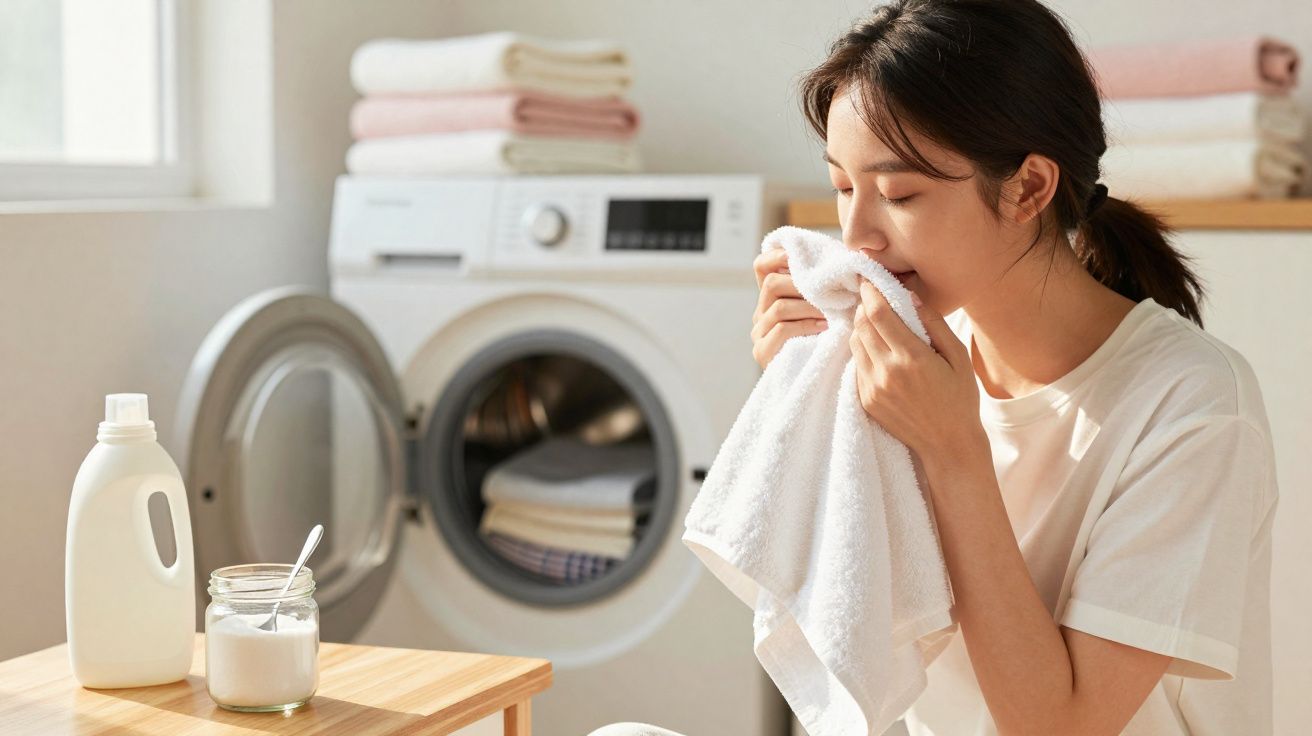
You step out of the shower, skin still glowing with heat, reach for a plush towel… and then you catch it: that faint, sour edge in the air. It’s not outright bin-day awful, but it’s definitely not “spa clean” either. You press the towel to your face and sniff again, baffled. It has been washed. Yet somehow it smells like damp gym changing room with a hint of lavender detergent. Not the mood you were after.
You glance over at the towel rail. The fabric looks perfectly fine - even bright - but that dull, stale odour just won’t shift. Your mind starts offering excuses: an ageing washing machine, bargain detergent, a bathroom with no window. Anything except the possibility that it’s your own routine.
Then the uncomfortable thought lands.
What if the problem is how you’re washing them?
The hidden grime your washing machine never warns you about
Here’s the awkward reality: plenty of towels that seem “clean” aren’t genuinely clean at all. They can be packed with unseen layers of body oils, shed skin, leftover product, and detergent that never fully rinsed away. Because you can’t see any of it, it’s easy to ignore - until the smell turns up as the only clue.
Each time you dry yourself, you work that mixture further into the fibres. Afterwards the towel sits there, slightly damp, folded over a rail or scrunched on a hook, and bacteria get a cosy little playground. The next wash disguises it with fragrance for a short while. Then, the moment the towel gets wet again, that funky smell springs back to life.
That’s how a towel can look spotless yet still reek like wet dog in a cellar.
I once spoke to a woman who battled exactly this in her small city flat. She blamed the old radiators, the cramped bathroom, the “stale air”. She bought premium detergent, swapped to a hypoallergenic softener, and even tried the bright scent beads from the adverts. The towels emerged smelling like tropical flowers… for about half an hour.
By the next morning, after a single shower, the same sour note was back. She began rewashing load after load - sometimes two or three cycles - chasing that “hotel towel” freshness. Her electricity bill rose, her patience evaporated, and the irritation started to feel oddly mortifying. A clean person with smelly towels isn’t exactly a brag.
When she adjusted one tiny part of her washing routine, the odour was gone within a week.
The reason is simple (and slightly grim). Towels behave like magnets for sebum, dead skin, and soap scum. As that build-up accumulates, it coats the fibres so water can’t penetrate far enough to rinse everything out. Detergent tries to cut through the grime, doesn’t quite manage it, and leaves behind yet another layer.
Then mildew and bacteria join in. Damp, warm, low-light fibres are ideal for them. They feed on that residue and release volatile compounds that read to us as “musty” or “sour”. Add extra fragrance and you’re effectively spraying perfume on an unwashed body. That weird smell is evidence your towels are slowly steeping in their own past.
And here’s the twist: the most common washing mistake doesn’t break the cycle - it fuels it.
The one mistake: you’re using too much of the wrong things
The blunt (and slightly annoying) truth is that many people use far too much detergent and fabric softener on towels. That’s the mistake. Not using too little - using too much. You see a thick pile of towels, assume it’s a “heavy load”, and pour with confidence. Sometimes you even add a bit more, “just to be safe”.
The problem is that dense towel fibres cling to that excess like it’s personal. Any detergent that fails to rinse away can turn tacky once it’s heated in the tumble dryer. That sticky film traps moisture and bacteria. Fabric softener can do something similar: it coats the fibres to make them feel smooth, but gradually suffocates the towel’s ability to absorb water and air-dry properly.
The result? Towels that look lovely, feel soft, smell odd, and don’t dry you very well. Great on Instagram. Awful in real life.
Picture a familiar routine. It’s Sunday laundry day and there’s a towering stack of towels. You load the drum, pick a long programme, then fill the detergent drawer nearly to the brim. Maybe you add a cap and a half of softener for that “hotel” vibe. The drum looks full, the suds look reassuring, and it feels like you’re being thorough.
The cycle finishes. The towels come out heavy, nicely scented, slightly warm from the spin. You chuck them in the dryer or hang them up quickly while you rush to the next task. Everything seems fine - until a couple of showers later, when that faint damp smell is back. You sigh, repeat the process, and sometimes pour even more detergent because clearly they must be “really dirty”.
And let’s be real: almost nobody checks the tiny dosage marks on the cap every single time.
What your nose is detecting is product build-up mixed with lingering humidity. Overdosing detergent means the rinse can’t flush it all away. Hot water will dissolve some residue, but not all of it. Softener is designed to leave a coating - and that coating is the opposite of what towels need to stay fresh. It blocks the fibres, holds on to sweat and water, and reduces airflow while the towels hang.
Eventually the washing machine can start smelling too. The drum, rubber seal, and detergent drawer all collect that same sticky brew. So each new towel load is effectively being washed in slightly tainted conditions. The odour becomes part of the whole system, not just the fabric.
That’s why a small shift in products and dosage can feel almost like a magic trick.
The routine that actually gets your towels fresh again (towels reset)
The solution begins with a reset: one proper “detox” wash, followed by a simpler ongoing routine. For the reset, wash your towels on the hottest programme they can safely take, using no fabric softener and far less detergent than you think you need. Add 1 cup of white vinegar straight into the drum or the softener compartment. Vinegar helps break down residue and neutralise smells rather than merely covering them up.
If your towels are especially sour-smelling or feel stiff, follow with a second cycle: add a scoop of baking soda to the drum and use no detergent at all. This helps loosen whatever build-up is still clinging on. When the wash ends, dry the towels immediately - either in a tumble dryer on medium heat or outside in genuine sunlight. Speed matters here. Don’t leave them sitting in a damp heap.
From then onwards, think of towels as “low product, high air” laundry.
For everyday loads, keep it minimalist. Use roughly half the detergent the bottle recommends for a full load of towels. Skip softener entirely - or save it for occasional towels if you truly can’t live without that feel. Wash towels separately from clothes so they’ve got enough space to move and rinse thoroughly. When the drum is packed, fabrics tend to come out only half-cleaned.
As soon as the cycle finishes, take them out straight away. Hanging them “for a few minutes” on a door nearly always turns into hours. Prioritise airflow: spread towels out, don’t fold them while they’re still warm, and don’t stack them damp in a cupboard. At least once a week, make sure bathroom towels dry fully on a wide rail rather than crumpled over a hook.
And be kind to yourself about it: smelly towels don’t mean you’re “gross”. It usually just means you’ve picked up the same habits as everyone else - and nobody ever taught us to question them.
“People assume bad smells mean dirt, so they throw more soap at the problem,” explains a domestic hygiene specialist I spoke to. “What towels usually need is the opposite: less product, more rinsing, more drying time. Freshness comes from clean fibers and moving air, not perfume.”
- Use less detergent - Half the usual dose is often enough for towels.
- Skip or reduce softener - Especially on everyday bath towels you want to stay absorbent.
- Wash hot, rinse well - Choose a hot cycle and, if possible, an extra rinse.
- Dry fully, and fast - No sitting in the machine, no bunched-up heaps on chairs.
- Deep-clean sometimes - Run an empty hot cycle with vinegar to freshen the machine itself.
Once this becomes your normal routine, the “old towel smell” fades away instead of returning every week.
Fresh towels, lighter mind
There’s a quietly satisfying feeling in grabbing a towel that smells like… nothing. Not artificial sea breeze, not overpowering florals - just clean, dry cotton. It subtly changes the tone of your morning, much like a made bed makes a room feel calmer. Small domestic wins can have outsized effects.
Smelly towels are one of those minor daily annoyances we learn to live with, like a dripping tap or a door that squeaks. We put up with them until the day we can’t. When you fix the underlying cause rather than battling the symptoms, the relief can feel oddly bigger than the issue itself. That’s the beauty of low-effort upgrades: when they work, you barely notice them.
Maybe your next towel wash won’t be completely on autopilot. Maybe you’ll use a smaller dose, avoid letting wet laundry sit, and give towels more breathing space on the rail. You may even spot other tiny household routines that quietly irritate you in the background. Change just one, and your whole day can feel a notch easier.
| Key point | Detail | Value for the reader |
|---|---|---|
| Residue causes smells | Oils, skin cells, and excess detergent coat towel fibres and trap bacteria | Helps you understand why towels stink even when they “look” clean |
| Too much product is the mistake | Overusing detergent and softener leads to build-up and poor rinsing | Shows what to change in your routine without buying expensive products |
| Simple reset, lasting results | Hot washes, vinegar or baking soda, full drying, and lighter dosing | Gives a clear, doable method to restore fresh, absorbent towels |
FAQ
- Question 1 Why can my towels smell bad straight after washing?
- Answer 1 Because bacteria and residue are still lodged in the fibres. Detergent fragrance covers it briefly, but once the towel becomes damp again, the underlying odour shows up.
- Question 2 Is it better to stop using fabric softener on towels?
- Answer 2 For everyday bath towels, yes - or at least keep it to rare use. Softener coats the fibres, which reduces absorbency and makes musty smells more likely.
- Question 3 What temperature should towels be washed at?
- Answer 3 Follow the care label and choose the hottest option it allows, often 60°C (140°F). Higher heat helps kill bacteria and break down oils and product build-up.
- Question 4 Will vinegar harm my washing machine?
- Answer 4 Using small to moderate amounts of white vinegar occasionally is generally fine for most machines and may help with limescale and odours. If you’re unsure, check the manufacturer’s guidance or begin with a smaller amount.
- Question 5 How frequently should towels be replaced?
- Answer 5 If you care for them well, good-quality towels can last for years. If they remain smelly, thin, or rough even after a deep clean, it’s a sign the fibres have worn down and it may be time to replace them.






Comments
No comments yet. Be the first to comment!
Leave a Comment