
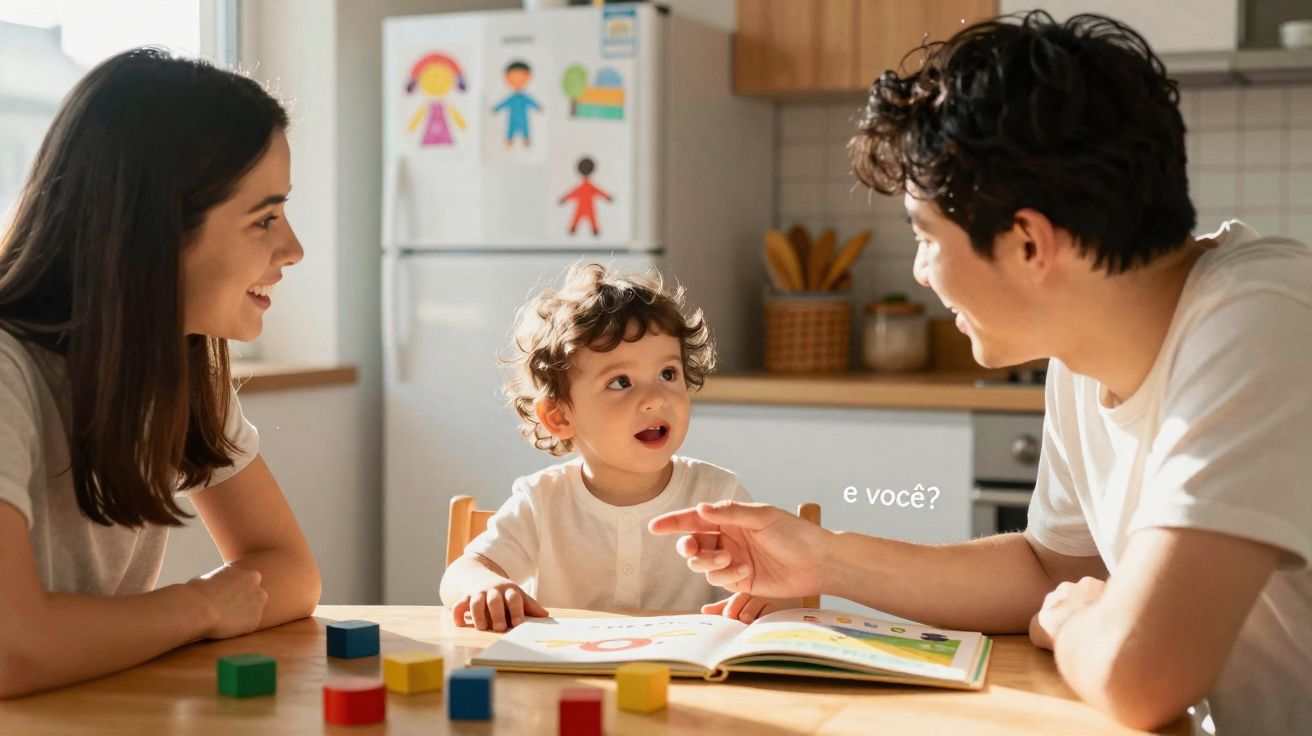
Adults often underestimate just how closely very young children follow what is said around them. While parents may assume their toddler’s reactions are mostly random, eye movements tell a different story: even two-year-olds pick up on subtle linguistic cues and can predict, remarkably well, who will speak next.
How toddlers track conversational turn-taking
In the study, toddlers watched brief animated clips in which two characters chatted to each other. The dialogues were deliberately easy to follow, built from short sentences and plenty of questions. An eye-tracking system recorded precisely where each child was looking throughout.
The key question was whether toddlers merely look after the fact-or whether, while a sentence is still unfolding, they already anticipate who will respond next.
"Children often shifted their gaze to the person who was about to speak next before the sentence had even finished."
This showed that the children were not simply waiting politely for a pause. Instead, they were using linguistic signals to forecast the next speaker.
Questions steer attention-statements do so less
Questions had the strongest pull. As soon as an utterance sounded like a question, children were far more likely to look away from the person asking and towards the character being addressed.
- With questions, the likelihood of a “predictive look” was more than five times higher than with straightforward statements.
- Often, the opening of the sentence alone was enough for the child to look towards the person expected to answer.
What makes this particularly striking is that the toddlers did not wait until the “questionness” was unmistakable, nor until the speaker stopped talking. They reacted mid-sentence-clear evidence of anticipatory listening.
One small word, a big effect: the “you” signal in toddler turn-taking
The effect was even stronger when a question began with a pronoun aimed at the other person-essentially starting with “you” rather than “I”. In those cases, it seemed immediately obvious to the children who would be required to respond.
The analysis found that when children heard a question directly addressed to the conversation partner, the chance of a targeted gaze towards the next speaker increased by several multiples. A single small word at the beginning of a sentence was often enough for them to foresee the handover in the conversation.
"Even nursery-age children use subtle linguistic nuances such as pronouns to anticipate the flow of a conversation."
This underlines that children are not only learning vocabulary; very early on, they are also acquiring the structure of social interaction-including the rule of “Who goes next?”.
How this ability changes with age
In a further experiment, the researchers followed children aged between one and four years over a longer period. The aim was to pinpoint when this predictive ability begins to emerge.
The results:
| Age | Response to conversational cues |
|---|---|
| 1 year | Hardly any systematic prediction; looks were more random |
| 2 years | Much clearer predictions, especially when hearing questions |
| 3 years | More confident use of cues signalling a speaker change |
| 4 years | Very rapid, well-matched gaze shifts, similar to older children |
Put simply, between a child’s second and fourth birthday, the ability to anticipate turn-taking develops rapidly. During this window, children are not only adding new words-they are also honing the timing required for social communication.
When language develops more slowly: children with Developmental Language Disorder (DLD)
The study also included children with what specialists call Developmental Language Disorder (DLD). These children struggle to process and use language, even though their hearing and intelligence are within the typical range.
A central issue was whether these children grasp the basic principle of conversational turn-taking at all-or whether that rule is missing for them.
"Children with DLD recognise the rule ‘someone must answer’-they are simply slower to process it."
In broad terms, three-year-olds with DLD showed the same pattern as their peers without a language disorder: they too used cues such as question form and direct address to anticipate the next speaker. The difference lay in speed:
- Typically developing children often shifted their gaze before the sentence ended.
- Children with DLD tended to react after the utterance had finished.
That delay costs time when producing an answer and, in everyday life, can come across as uncertainty or lack of interest-even though the child’s basic understanding of the conversational exchange is there.
Why speed matters so much in conversation
Everyday talk moves faster than many people realise. Pauses of just half a second can already feel awkward or “stilted”. Adults instinctively try to avoid long gaps and avoid interrupting. To do that, they have to plan their reply before the other person has finished speaking.
The new data suggest that very young children use comparable strategies. They are not only listening; they are also working ahead-tracking who is speaking, whether an answer is expected, and whether they themselves might be next.
For children who process language more slowly, every millisecond gained is valuable. If a cue that signals a speaker change arrives sooner, there is more time to organise the words they want to say.
Thinking before speaking: what parents can do in practice
Not every child finds responding equally easy. Research indicates that short, simple questions usually produce quicker responses than complex, multi-part sentences. Longer answers demand more planning, and that planning happens in parallel with listening-an intense cognitive task for a small brain.
This is where parents and professionals can help. Clear conversational cues make it easier for children to time their turn. The researchers offer several practical suggestions:
- Ask questions more often rather than only making comments.
- Begin sentences with a clear verb, such as “Do you like…”, “Do you want…”, “Can you…”.
- Address the child directly with “you” so it is obvious who is being spoken to.
- After asking, leave a short, noticeable pause-without immediately filling it yourself.
"Targeted questions work like an invitation: ‘It’s your turn now.’"
Particularly for children with language difficulties, this more deliberate way of talking can reduce pressure. When a child senses that an answer is expected-and is given a moment of space-they are more likely to attempt speaking.
What the study still leaves unanswered
The experiments took place in a controlled setting using cartoon scenes and clearly separated dialogues. That is a long way from the messy noise of a family meal, where several people talk at once, cutlery clatters, and someone puts music on in the background.
The sample was also relatively small, and different eye-tracking systems were used. The researchers argue that large screens and clearly defined target characters reduce the risk of systematic measurement errors, but they also explicitly call for more studies in everyday contexts.
It remains particularly interesting to see how children respond when several people speak over one another or when speakers abandon sentences mid-way. It is also still unclear how culture, parenting style, and parents’ language levels influence children’s conversational timing.
What parents can take away from the findings
When you talk with toddlers, you are shaping more than their vocabulary; you are also building their feel for the back-and-forth of dialogue. Each moment of eye contact, every small pause, and every clear question sends a signal: “Your view matters, and you’ll have a turn too.”
Practical examples for daily life:
- At dinner, ask purposeful questions: “How was your day?” rather than only talking yourself.
- Play role-switching games, such as “I ask-you answer”, then swap over.
- Read short stories and pause regularly: “Who do you think speaks next?”
- Wait patiently, even if the answer takes a few seconds.
This patient approach is especially worthwhile for shy children or those whose language seems atypical. Many children who appear “slow” understand more than adults assume-they simply need a little more time to find their moment in the conversation.
Above all, the new research highlights one thing: toddlers are far less passive than their limited vocabulary might suggest. Behind every brief “yes” or “no” is a finely tuned sense of timing-and of who, exactly, is meant to speak next.






Comments
No comments yet. Be the first to comment!
Leave a Comment