
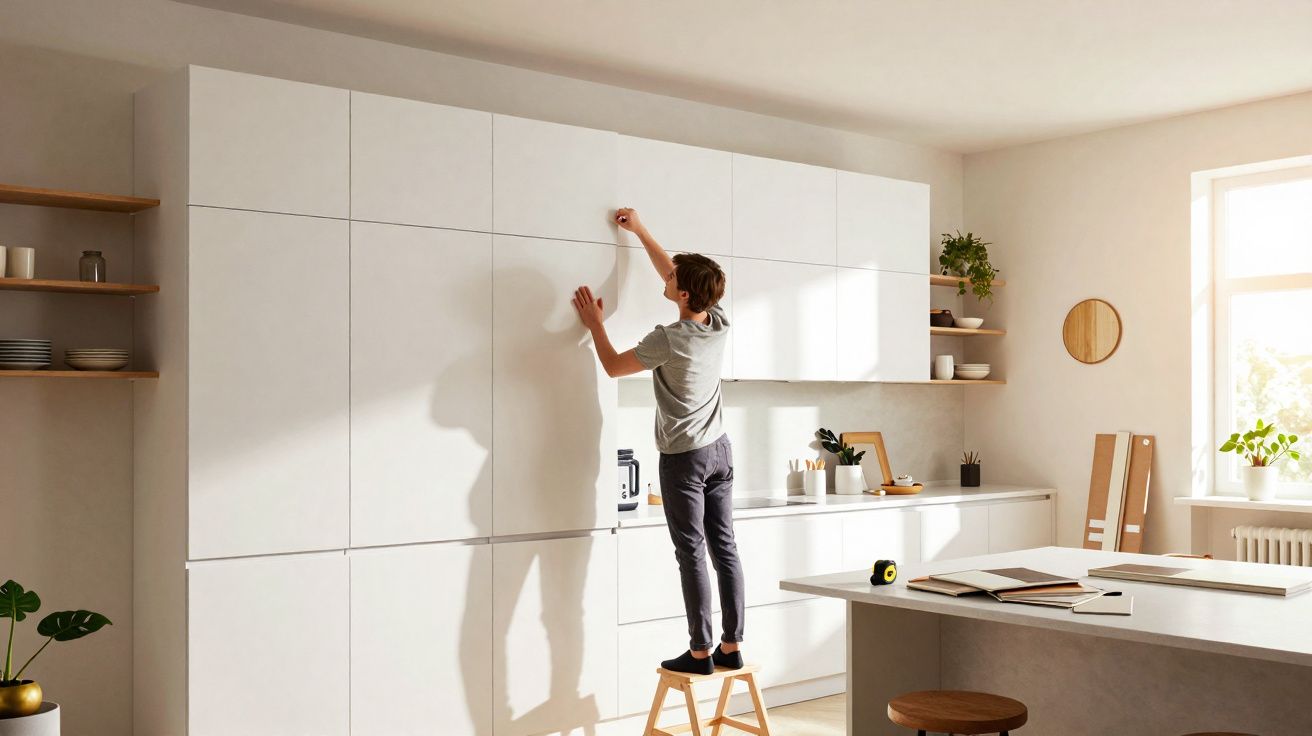
The first time I properly noticed my kitchen cabinets wasn’t the day I paid for them - it was the day I tried to clean the tops. I’d climbed onto a flimsy chair, sponge in one hand, gripping a handle with the other, peering into a dusty void where half-empty pasta packets go to disappear. The cabinets ran all the way up to the ceiling, a row of beige slabs like teeth. They were meant to look “elegant” and “practical”. In reality, they just felt… oppressive.
In that moment, a small but uncomfortable thought landed: this style hadn’t come from me. It had been packaged and sold.
And once I’d clocked that, those towering boxes started to feel less like a choice - and more like a con I’d bought into.
How Ikea sold us the wall-to-ceiling kitchen dream
Spend a Saturday walking an Ikea showroom and you can almost feel the tall kitchen idea settling into your head. The route steers you past cheerful families and spotless islands until you reach the scene: a bright white kitchen with cabinets that rise neatly to the ceiling. No awkward gap. No dust-catching ledge. No “wasted” space. The lighting is cosy and flawless. The worktops are empty in a way real worktops never are.
You don’t simply admire it - you drop your future self into it.
Display after display repeats the same message in Scandinavian tones: if you stack storage upwards, you’re living smarter. There’s always a “small flat” vignette where every centimetre has been conquered. A 38-square-metre studio somehow contains a full-height fridge, an oven, and ranks of upper cabinets standing in perfect formation. A sweet little sign says “More life per square metre”, and your mind quietly rewrites it as: more cabinets equals more life.
You take a photo, ping it to a mate, and without noticing when it happened, that tall, stacked wall becomes your benchmark for what a “proper” kitchen should look like.
Designers will tell you none of this is accidental. Full-height cabinetry allows brands to ship more product within the same footprint, nudge you towards extra modules, and sell a particular idea of tidiness and status. Our parents often lived with shorter cupboards and a strip of breathing space above them. We grew up watching marketing teams turn that gap into a “problem” that needed fixing.
So empty air became failure, while a vertical wall of doors became “refined”. That’s the quiet psychology behind a wall-to-ceiling run of cabinets.
Why designers now say wall-to-ceiling kitchen cabinets were a massive mistake
Ask an interior designer off the record what they truly think about wall-to-ceiling kitchen cabinets and you’ll often get the same response: a long sigh, then the honest version. The complaints repeat themselves - they look too heavy, they’re too high to use comfortably, and in smaller homes they feel weirdly domineering. What reads as crisp and “premium” in a showroom can turn into a looming storage monolith in a normal flat with a standard or low ceiling.
The room stops feeling like somewhere you can breathe and starts feeling like an archive.
I spoke to a designer in London who’d recently removed a ten-year-old Ikea kitchen from a narrow terraced house. The first owners had installed tall cabinets proudly “for resale value”. Up in the top cupboards they’d put Christmas plates, a broken blender, and three sets of glasses they’d forgotten they even had. To reach any of it you needed a step stool - and the right temperament.
When those towers were replaced with a single, straightforward run of cupboards and one open shelf, the owners walked in and said, “We had no idea this room was this big.”
The reasoning is simple. Tall cabinets create one uninterrupted vertical block that visually slices a room in two. Light doesn’t bounce as well. Corners read gloomier. Your gaze hits a hard stop at the cabinet fronts instead of travelling around the space. That’s why so many newer “high-end” kitchens you see online lean into lower horizontal lines - and leave calm, empty space above.
Designers aren’t arguing that storage is the enemy. They’re warning that converting every wall into a floor-to-ceiling cupboard quietly wrecks proportion, mood, and the everyday feeling of being at home.
What to do if your kitchen is already a tower of cabinets
You don’t have to gut the entire kitchen to undo the spell of the tall-cabinet wall. Begin with one area. Pick the most overbearing stretch of upper units and picture a different use: an open shelf, a piece of art, a small zone of visual breathing room. In plenty of Ikea-style systems, it’s possible to take down two doors and the cabinet boxes behind them, then make good the wall.
All at once you reintroduce a horizontal line to the room - as if the kitchen has finally been able to exhale.
If ripping anything out feels like too much, try a gentler “edit”. Empty the very top shelves and put the contents into one clearly labelled box stored elsewhere for a month. Pay attention to whether you actually miss anything. If you don’t, that cabinet was only adding visual weight.
Most of us recognise the moment: you realise a huge chunk of the kitchen is basically a museum for back-up items you’d forgotten existed. And realistically, nobody climbs a ladder twice a week just to lovingly rotate the special glassware.
One interior architect I spoke with didn’t sugar-coat it:
“Upper cabinets are like overstuffed inboxes. The more you have, the more clutter you feel allowed to keep.”
She suggests three straightforward, low-risk changes:
- Remove or shorten one run of upper cabinets to create a visual “break.”
- Swap a couple of doors for glass fronts or open shelves to introduce a lighter rhythm.
- Paint the remaining uppers the same colour as the wall to reduce the block effect.
None of this needs a full renovation - just a few small acts of rebellion against the vertical wall you were taught to admire.
Rethinking what a “good” kitchen looks like now
Once you step away from the Ikea showroom fantasy, something slightly strange happens: your actual kitchen starts giving you feedback. It reminds you where you stand when you cook, what you can reach without stretching, and where the light lands naturally at 5 p.m. It quietly asks whether you want to live inside a storage unit - or in a room where people might actually linger.
Designers pushing back on tall cabinets aren’t trying to make anyone feel foolish about earlier choices. They’re offering a different question instead: what if “enough” storage is already enough?
Some homeowners are keeping lower cabinets and islands spacious, then halving the uppers - or leaving one wall with no upper cabinets at all. Others are opting for a single tall pantry “column” and letting the rest of the kitchen stay visually calm. This isn’t minimalism as self-denial. It’s modern homes reclaiming softness, horizontality, and that quiet line where the wall meets the ceiling.
Once you notice how those giant towers took over our sense of what a “finished” kitchen should be, it’s difficult to unsee it. The blank strip above a modest cabinet starts to look less like unused space and more like a kind of luxury: emptiness you don’t have to fill just because a catalogue told you to.
| Key point | Detail | Value for the reader |
|---|---|---|
| How Ikea shaped the tall cabinet norm | Showroom layouts and slogans turned vertical storage into a status symbol | Helps you see your kitchen choices as influenced, not inevitable |
| Why designers now push against ceiling-high walls | They visually shrink rooms, trap unused stuff, and kill light and rhythm | Gives you a clear reason to question or modify existing layouts |
| Small, doable fixes | Remove a section, lighten fronts, or relocate rarely used items | Offers practical, low-cost ways to reclaim space and calm |
FAQs:
- Are tall kitchen cabinets always a bad idea? Not always. In very high-ceilinged spaces or genuinely tiny studios, a few tall units can be smart. The problem starts when every wall is fully packed and the room feels boxed in.
- What height of upper cabinets do designers prefer now? Many aim to leave 30–60 cm (12–24 inches) between the top of the cabinets and the ceiling, or skip uppers on at least one wall to keep the eye level open.
- Will removing some upper cabinets hurt my resale value? Most buyers react emotionally to light and space. A kitchen that feels bigger and calmer can be more attractive than one crammed with hard-to-reach storage.
- What can I do if I rent and can’t change the cabinets? Use styling and colour: keep the top shelves nearly empty, store dense items below, paint the wall and cabinets close in tone, and use open, airy décor to soften the block.
- Is open shelving really practical for everyday life? Used sparingly, yes. Keep everyday plates and glasses there, wash and rotate them often, and let closed cabinets handle the messy, mismatched pieces you don’t want on show.






Comments
No comments yet. Be the first to comment!
Leave a Comment