
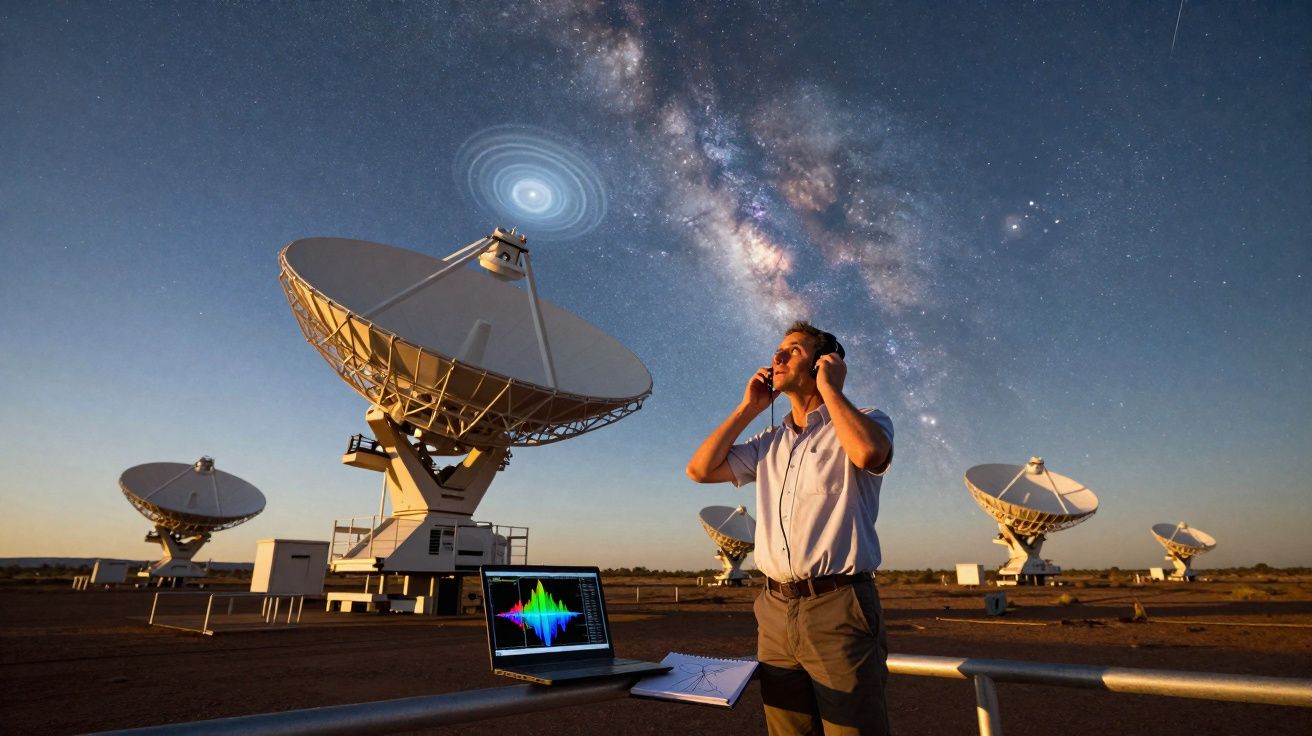
A radio telescope in South Africa has picked up an extraordinarily powerful signal that has been travelling for more than eight billion years. Behind this “scream” from the Universe’s early era lies a colossal collision between two galaxies-made observable only because a fortunate cosmic alignment amplified the emission.
A radio signal crosses more than half the observable Universe
At the centre of the observation is an object with the matter-of-fact label HATLAS J142935.3-002836. The designation refers to a pair of galaxies that crashed into one another around eight billion years ago. At that time the Universe was roughly five billion years old-no longer in its infancy, but still a long way from today’s cosmos.
The radio emission covered more than half the distance across the observable Universe before it reached the antennas of the MeerKAT radio telescope in South Africa’s Karoo Desert in April 2025. At such a range, radio waves would normally be far too faint to measure from Earth.
“Only an exceptional interplay of three celestial bodies made the record signal measurable at all.”
Gravitational lensing around HATLAS J142935.3-002836: nature builds a telescope
A third galaxy sits between the source and Earth. Its mass bends space around it-an effect described by general relativity. That curvature acts like an enormous cosmic magnifying glass, known as a gravitational lens.
The intervening galaxy is positioned so precisely along the line of sight that it gathers and boosts the radio waves from the colliding pair. Astronomers refer to this as a “lensing effect”:
- The mass of the foreground galaxy distorts space.
- The radio waves are deflected as they travel.
- The signal appears brighter and more intense than it would without the lens.
This amplification can multiply the apparent brightness by a large factor. Without it, the radio glow from HATLAS J142935 would simply have been impossible to find from Earth. A research group led by astronomer Marcin Glowacki at the University of Pretoria identified this rare three-object configuration in data from a major MeerKAT sky survey.
The team analysed observations from the MeerKAT Absorption Line Survey and encountered a standout detection straight away: unusually bright, unusually distant, and clearly traceable to a specific physical mechanism.
When galaxies collide, a “laser” in space is created
The discovery hinges on a hydroxyl megamaser. Despite the cumbersome name, the idea is strikingly simple: a kind of cosmic laser that emits radio waves rather than visible light.
In the collision zone, vast quantities of gas and dust are present. When two galaxies plunge into one another, their gas clouds are violently compressed. Temperatures, densities and radiation levels soar, and star formation ramps up dramatically.
In this turbulence, hydroxyl molecules (OH, a compound of oxygen and hydrogen) become excited. Under the right conditions, many of these molecules begin emitting identical radio waves-at the same frequency and in the same direction. The result is a maser, technically the radio counterpart to a laser.
“This hydroxyl megamaser is so bright that researchers want to place it in a new class: as the first confirmed ‘gigamaser’.”
Glowacki and colleagues argue that the measured intensity exceeds all previously known hydroxyl megamasers by a clear margin. For that reason, they propose the label gigamaser-a still more energetic category of radio “laser” in space.
Star formation in overdrive
The merger drives star birth to an extreme rate. Estimates suggest that several hundred solar masses of new stars form there each year. By comparison, the Milky Way produces roughly one to two solar masses annually.
For the researchers, this stellar “baby boom” is a crucial clue. It indicates that such powerful maser signals are likely to occur preferentially in highly active, gas-rich galaxy mergers: more gas means more excited molecules, and more excited molecules mean a stronger maser.
| Property | Hydroxyl megamaser | Gigamaser (like HATLAS J142935) |
|---|---|---|
| Typical distance | Hundreds of millions of light-years | Several billion light-years |
| Luminosity | Very high | Significantly higher |
| Environment | Colliding galaxies | Extremely gas-rich, massive merger |
MeerKAT as the forerunner to a giant radio telescope
MeerKAT itself is made up of 64 dishes spread across the Karoo Desert. Working together, they form a virtual giant telescope with high sensitivity to radio waves. The system monitors wide areas of the southern sky and searches specifically for regions where gravitational lenses are likely to appear.
MeerKAT also has a second mission: it is a technical and scientific pathfinder for the Square Kilometre Array (SKA). This international flagship project is expected to unite thousands of antennas across South Africa and Australia in the coming years. The SKA is set to increase radio sensitivity by about a factor of ten.
“The gigamaser signature measured now is a signpost-it shows what will soon be possible on a much larger scale.”
Researchers anticipate that the SKA will uncover thousands of previously hidden maser sources. Especially promising are sky regions containing large galaxy clusters: their combined gravity can generate multiple lensing effects, boosting background objects one after another.
Hunting for hidden “lasers” in the Universe
That leads to a clear observing strategy. Future surveys will deliberately target areas that host such massive clusters. In effect, the clusters act as naturally distributed amplifiers that lift faint signals out of deep space.
The aim is to compile the most complete possible catalogue of distant maser sources. With such a dataset, scientists can tackle questions such as:
- How often do galaxies merge over cosmic history?
- How strongly do these collisions drive star formation?
- How is molecular gas distributed in early galaxies?
In a few years, combined datasets from MeerKAT and the SKA are expected to deliver a much sharper view of the radio-bright distant Universe than has been possible so far. Optical telescopes quickly hit limits in this regime because dust and immense distances absorb large amounts of light-radio waves, by contrast, pass through comparatively well.
What terms like megamaser and gravitational lens mean
To many readers, words such as “megamaser” or “gravitational lens” may sound like science fiction. In reality, they describe well-established physics.
A maser (Microwave Amplification by Stimulated Emission of Radiation) is, in engineering terms, a device that amplifies microwaves, much as a laser amplifies light. In space, the same principle can arise naturally: if enormous numbers of molecules occupy the same excited energy state, they can emit identical radio waves simultaneously. A megamaser is simply a particularly powerful cosmic version of this phenomenon.
Gravitational lenses stem from Einstein’s idea that mass curves space. Light-or radio waves-follows that curvature much like cars follow a bend in the road. If a massive galaxy sits precisely between us and a background object, its light can appear focused and amplified, sometimes even forming arcs or rings on the sky.
Together, these two effects make the current detection remarkable: a natural maser, boosted by a natural magnifying glass, captured by a modern radio telescope. In the end, this eight-billion-year-old signal arrives as an unassuming line in a data file-yet it recounts a story of galactic destruction, star birth and the sophistication of human instruments.






Comments
No comments yet. Be the first to comment!
Leave a Comment