
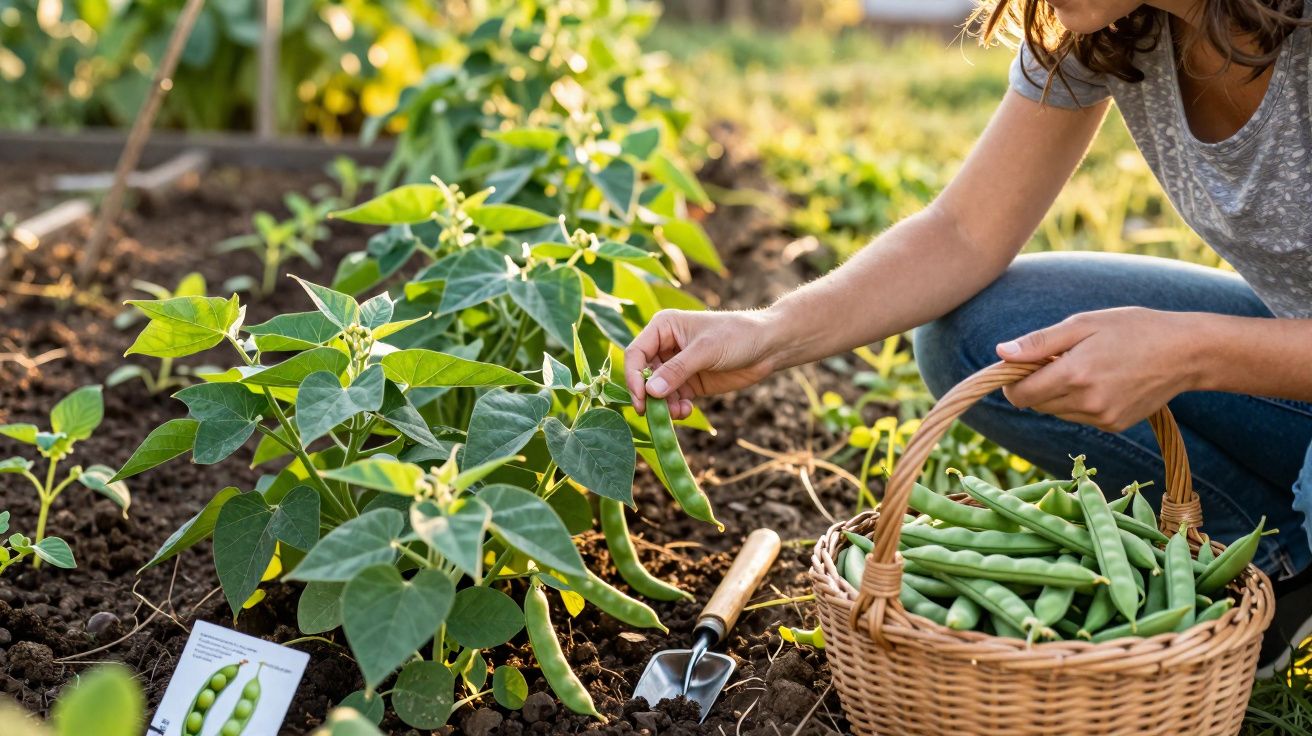
Fresh, crisp beans picked straight from the garden have a flavour that’s hard to beat - and they’re among the quickest vegetables to grow. From sowing to your first bowlful of beans is often only two months. The keys are choosing the right sowing date, paying attention to soil temperature, and using a few simple tricks when sowing outdoors in open ground.
Why timing is everything for bush beans
Bush beans love warmth. In cold, wet soil the seeds may swell, but instead of sprouting they often rot. Sowing too early doesn’t just slow you down - it can wipe out the entire batch.
"Only sow bush beans once the soil genuinely feels warm - rule of thumb: at least 12 °C, ideally 15 °C soil temperature."
Whether you reach that temperature depends heavily on your region, altitude and soil type. Sandy soils warm up quickly, while heavy clay soils take noticeably longer.
The right outdoor sowing date by region
Rather than following the calendar blindly, it pays to consider your garden’s climate and position. Broadly, Germany and the Alpine region can be grouped like this:
| Region / location | Earliest outdoor sowing date (open ground) | Latest sensible sowing |
|---|---|---|
| Mild wine-growing areas, warmer south, sheltered urban sites | Late April | Late July |
| Central areas, typical lowland locations | Early to mid May | Late July |
| Cooler northern and eastern areas, Alpine foothills, higher ground | Mid to late May | Early August |
A soil thermometer is the most reliable guide. If you don’t have one, use a simple garden test: push your hand into the soil to a depth of 10 cm. If it feels distinctly cold, wait. If it feels pleasantly lukewarm, it’s time to sow.
How to sow bush beans outdoors in open ground
Prepare the soil well - but don’t overwork it
Beans form shallow roots and prefer soil that’s loose and well aerated. As legumes, they partner with specialised soil bacteria that create nodules on the roots and supply the plants with nitrogen.
- Loosen the soil deeply with a digging fork or cultivator, without turning big clods over.
- Remove stones and coarse root debris.
- Don’t dig in fresh manure, as it encourages fungal diseases.
- If needed, lightly rake in a little well-rotted compost - that’s more than enough.
Heavy soils can be improved with sand or fine, dry compost. The aim is a crumbly tilth that lets delicate seedlings push up easily.
Mark out rows and choose the correct spacing for bush beans
For bed sowing, the row method works particularly well. It keeps plants well ventilated and makes routine care much easier.
Proceed as follows:
- Use a hoe or the end of a handle to draw drills 3 to 5 cm deep.
- Leave 40 to 50 cm between rows so you can comfortably walk through later.
- Within the row, choose either:
- one seed every 5 to 10 cm, or
- small groups (4–6 seeds) spaced about 30 cm apart.
- Cover with fine soil and press gently so the seeds make good contact with the soil.
Practical tip: water the drill thoroughly once before you close it. That puts moisture exactly where the seed germinates. After covering, water only carefully from above or directly along the row.
Water, warmth and care: how bush beans get off to a fast start
Once soil temperatures rise, bush beans move quickly. In suitable conditions, the first seed leaves often appear after just five to ten days.
"If you keep moisture even and avoid waterlogging, you’ll see your beans push through the soil in record time."
For rapid, healthy growth, focus on these points:
- Germination phase: keep soil evenly moist, but don’t allow puddles to form.
- After emergence: water less often but more deeply, encouraging roots to grow downwards.
- Water at ground level only, never over the leaves - this reduces the risk of fungal issues.
- When plants reach 15 to 20 cm tall, lightly earth up along the rows and mulch between them (e.g., with grass clippings or straw).
Earthing up helps steady stems, especially in windy conditions, while mulch conserves moisture and suppresses much of the weed growth.
When to expect your first bean harvest
With warm soil and vigorous plants, the whole cycle is surprisingly fast. That’s why bush beans are ideal if you’re an impatient gardener.
Planning guide:
- Germination: 5–10 days after sowing.
- First flowers: around 30–40 days after sowing.
- First harvestable pods: usually 50–60 days after sowing.
So, if you sow in early May, you’ll typically harvest in early to mid July. A mid-July sowing will usually still produce plenty of beans in September - provided an early cold spell doesn’t intervene.
Higher yields with succession sowing and a mix of varieties (bush beans and climbing beans)
If you want more than a single week of beans - and would rather keep them coming all summer - it helps to plan deliberately. Two approaches work particularly well:
Succession sowing every two weeks
Instead of using all your seed at once, many home gardeners sow a new row every 14 days. That staggers harvest times, pushing each crop slightly later. From late April or early May through to late July, you’ll end up with several generations whose picking windows overlap.
Combining bush beans and pole beans (climbing beans)
Bush beans get going sooner but stop cropping earlier. Climbing pole beans take a bit longer to reach the first harvest, yet then produce for weeks, often right into autumn.
"Sow early bush beans first, then follow with pole beans - that way the bed stays productive all season."
In a small garden, it’s easy to pair the two: a row of bush beans at the front, with a frame of poles behind for climbing varieties. Good ventilation matters so moisture doesn’t linger between rows.
Common mistakes when growing beans - and how to avoid them
When people grow beans for the first time, the same problems crop up again and again. Checking these classics saves both time and frustration:
- Sowing too early: cold soil leads to rotting seeds. Solution: wait an extra one to two weeks.
- Compacted soil: water sits on the surface and roots get too little air. Solution: loosen deeply and avoid walking on the beds.
- Watering over foliage: fungal diseases such as greasy spot disease or rust spread more easily. Solution: always water at soil level.
- Harvesting too late: pods become stringy and the seeds harden. Solution: pick more often, while pods are smaller.
The earlier you pick, the more tender the beans remain - and the more vigorously the plant produces new pods. If you walk the bed every two days, you’ll get far higher yields from a single row.
Using soil temperature and microclimates to your advantage for bush beans
A calendar only offers a rough guide. Every garden has warmer and cooler corners. Dark, free-draining soil against a south-facing wall heats up much more than an exposed, windy patch - and beans can often be sown there about a week earlier.
Another way to gain time is short-term covering. A simple horticultural fleece over freshly sown rows lifts the temperature slightly and protects against heavy rain or birds. As soon as seedlings look sturdy and nights remain consistently mild, remove the fleece so plants don’t grow soft and vulnerable.
What many people miss: beans improve the soil
Beans aren’t only crop plants - they also support soil fertility. The root-nodule bacteria mentioned earlier capture nitrogen from the air and make it available in the soil. After the season, it’s therefore best to leave the roots in the bed. Put the above-ground growth on the compost; the roots rot down in place and release the captured nitrogen gradually.
In a well-planned rotation, gardeners often follow beans with heavy feeders such as cabbage, squash or celeriac. This reduces the need for fertiliser and helps keep the soil healthy over the long term.
So, if you want to grow bush beans outdoors in open ground and reach harvest quickly, it pays to listen to the soil rather than the calendar. With warm earth, a loose structure, targeted watering and a sensible sowing plan, a few unremarkable seeds can turn into a dense ribbon of rich green in remarkably little time - and the bowl of fresh beans will be on the table far sooner than many expect.






Comments
No comments yet. Be the first to comment!
Leave a Comment