
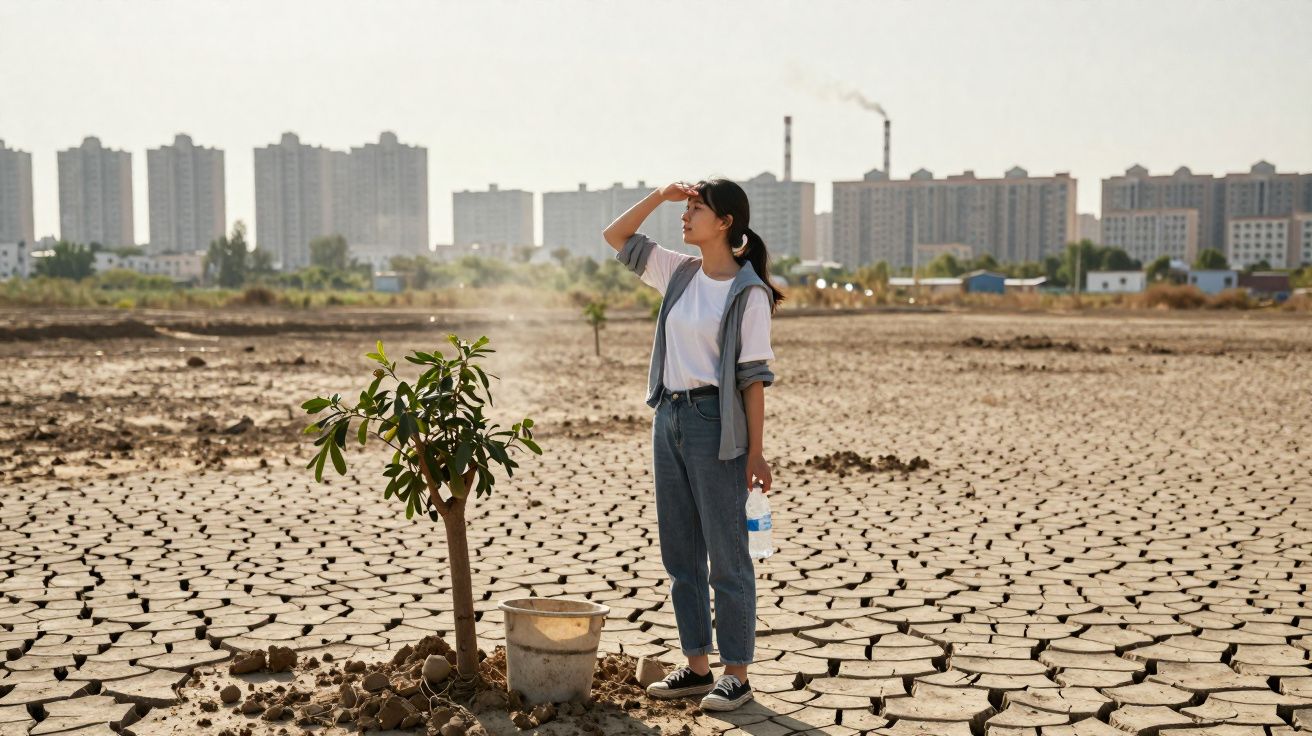
Dry heat is where climate extremes turn especially dangerous: heatwaves and droughts do not merely coincide - they amplify one another. Parched soils allow near-surface air to warm more readily, while intense heat draws yet more moisture out of the land.
When these hazards arrive together, the fallout can hit simultaneously: failed harvests, strained water supplies, heightened wildfire risk, and unsafe conditions for people working outdoors.
A new study warns that this kind of compound hot-dry climate extremes is likely to become much more frequent.
If the world largely continues with today’s climate policies, a substantial proportion of humanity could face the most severe forms of these events far more often by the late 21st century.
“In compound hot-dry extremes, they lead to water restrictions and unstable food prices,” said Di Cai, a climate scientist at the Ocean University of China and lead author of the study. “For outdoor workers, it is dangerous.”
Hot-dry events are already occurring more often
To quantify what is shifting, the researchers broke up Earth’s land surface into a grid and tallied how frequently each grid cell experienced hot-and-dry conditions.
They calculate that, between 2001 and 2020, global land areas averaged around four hot-dry events each year - about twice the rate seen in the preindustrial period (1850–1900).
In this analysis, a “hot-dry event” is defined as a day when temperatures fall within the top 10 percent (relative to historical records) while drought reaches at least a moderate level, measured against a 1961–1990 baseline.
Forecasting the future is not straightforward
To examine what may lie ahead, the team assessed 152 simulations from eight climate models, alongside multiple future pathways for warming and population growth set out in the IPCC’s Sixth Assessment Report.
Although it can sound routine on paper, this type of assessment is technically demanding: it involves handling enormous volumes of climate data and then converting projected changes into estimates of human exposure - not merely producing maps.
“The more chaotic the climate becomes, the more difficult it becomes to make forecasts,” said senior author Monica Ionita, a climatologist at the Alfred Wegener Institute. “It’s very difficult to keep up with what’s going on now.”
What the projections indicate
Under the scenario the authors describe as most consistent with the direction the world is currently taking, the findings become deeply alarming.
In the 2090s, 28 percent of the global population - about 2.6 billion people - would be living with “heightened” hot-dry climate extremes. On any given day, such events would be more than five times as likely as they were during 1961–1990.
By comparison, the researchers estimate that just 6.6 percent of the global population experiences that level of exposure in the 2030s.
“When you get to almost 30 percent of the global population affected by this, it’s very critical. It should make us consider much, much more deeply our actions in the future,” Ionita said.
She had anticipated the figure might land nearer 10 to 15 percent. “By the end or middle of the century, maybe my children will not be able to experience the life that I have now.”
More frequent and longer-lasting compound hot-dry climate extremes
The outlook is not limited to a simple increase in “days like this”. The study suggests hot-dry climate extremes could become a near-regular feature of everyday life across many regions.
Worldwide, the team estimates that compound hot-dry events could average nearly 10 times per year by the end of the century.
They also estimate the longest episodes would persist for around 15 days. Relative to the last 25 years, that amounts to roughly a 2.4 times rise in frequency and a 2.7 times increase in duration.
The authors contend that the pattern cannot be explained away as natural climate variability. In simulations driven only by natural factors (excluding human greenhouse gas emissions), they did not observe meaningful long-term shifts in either the frequency or duration of hot-dry conditions.
In their assessment, the rise is linked to human-driven warming.
The countries hit hardest are not the biggest emitters
One of the study’s most striking conclusions is about where the impacts fall.
Across the simulations’ risk patterns, lower-income tropical nations - particularly those close to the equator - are expected to see the sharpest intensification in hot-dry climate extremes. This includes island states such as Mauritius and Vanuatu.
Yet these are often places with limited capacity to adapt: less access to air-conditioning, infrastructure that is less robust, and fewer safety nets when water supplies fail or food prices surge.
“For lower-income countries, there is a huge unfairness here,” Cai said. “It’s hard to fund air conditioning. It’s hard to fund health care. There is no backup if water runs out. It’s not just a climate science issue; it is about basic, daily life.”
The paper also provides a stark way to conceptualise the link between emissions and impacts. The authors estimate that the lifetime emissions of about 1.2 average U.S. citizens could, in effect, add sufficient climate pressure to increase risk.
That added pressure could leave one additional person exposed to heightened hot-dry climate extremes by late century.
Cutting emissions lowers the risk
The study does not argue that this future is inevitable. The researchers conclude that stronger climate action could avert a sizeable share of the exposure they project.
If nations fully deliver on their Paris Agreement plans and follow through on longer-term pledges, the projections improve.
By late century, the proportion of the global population facing heightened hot-dry exposure falls from 28 percent to about 18 percent.
Even then, the scale remains vast - around 1.7 billion people - yet it is close to one-third fewer than under the “current trajectory” case.
“The choices we make today will directly affect the daily lives of billions of people in the future,” Cai said.
What this could mean on the ground
This is not merely an exercise in climate statistics. The findings point to a future in which, across many places, hot-and-dry extremes could translate into some blend of water restrictions, losses in crops and livestock, volatile food prices, and dangerous heat exposure.
Because these extremes are “compound”, the impacts can cascade. Drought weakens crops. Heat intensifies damage. Wildfires become more probable. Communities may find themselves responding to several crises at the same time.
The implication is difficult to dismiss: if the world broadly maintains today’s pace of policy, exposure to compound heat-and-drought conditions could become a defining feature of life for billions - with the most severe consequences falling on countries that contributed least to the cause.


Comments
No comments yet. Be the first to comment!
Leave a Comment