
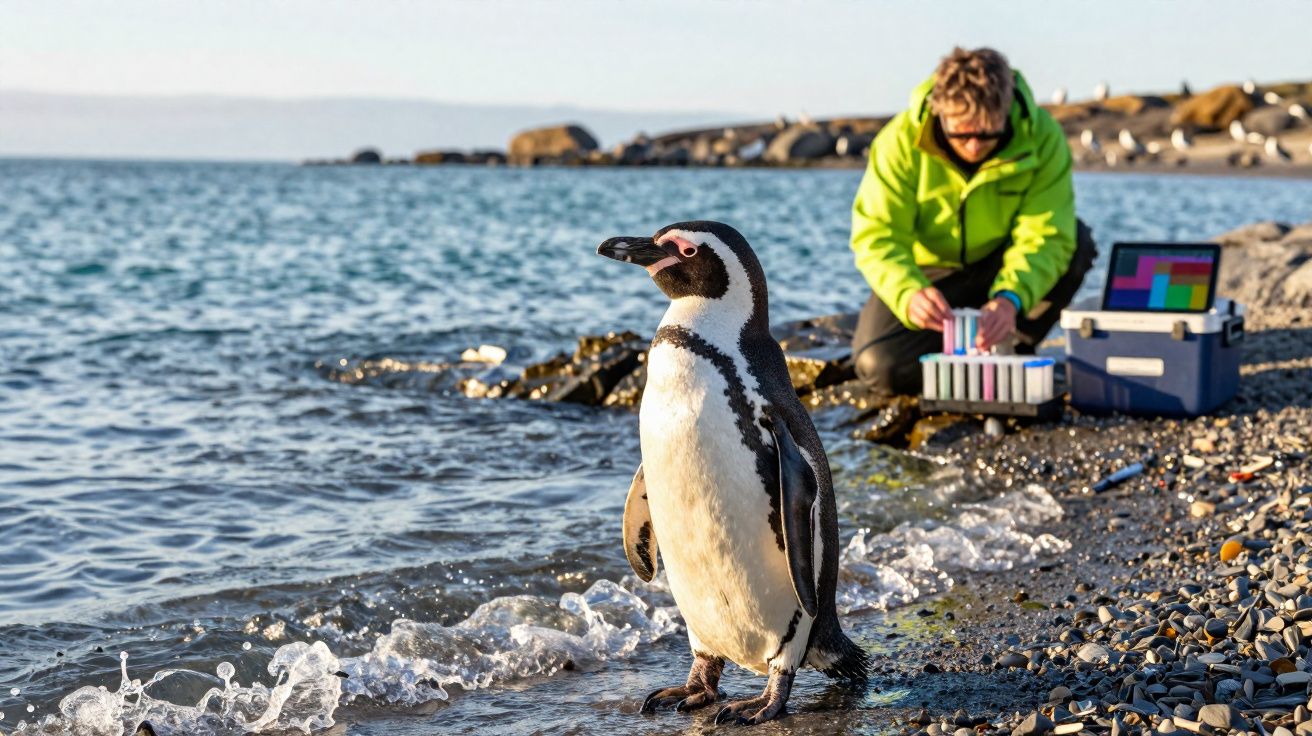
Magellanic penguins on Argentina’s Patagonian coast fill their days with the usual penguin routine: diving and swimming offshore, bringing food back, tending chicks, and shuttling between beach and sea.
Researchers have now shown that this everyday behaviour can double as environmental surveillance - without the need to repeatedly restrain birds to collect blood or feathers.
In a proof-of-concept project, a team from UC Davis and the University at Buffalo (SUNY) equipped 54 Magellanic penguins with silicone leg bands designed to function as miniature passive chemical samplers.
Worn loosely for a few days during the 2022–2024 breeding seasons, the bands absorbed faint chemical traces from the water, air, and surfaces the penguins encountered while they foraged.
Afterwards, the team removed the bands and sent them to Buffalo for testing. The results were striking: PFAS (“forever chemicals”) appeared in over 90% of the samplers, despite Patagonia’s reputation for being comparatively remote.
Magellanic penguins chose the sampling sites
A key benefit of the approach is that the animals themselves do the difficult work. Rather than researchers trying to predict which coves, currents, or feeding areas are most important, the penguins naturally pass through the places that matter most to their survival.
“The only way we’ve had of measuring pollutant exposure in the past is by getting blood samples or feathers,” said co-corresponding author Ralph Vanstreels, a wildlife veterinarian at UC Davis.
“It’s exciting to have something that is only minimally invasive. The penguins are choosing the sample sites for us and letting us know where it’s important to monitor more deeply.”
“As the animals go about their business, they’re telling us a lot about the environment they’re experiencing.”
The underlying concept is straightforward: treat a top predator as a roaming, real-world sensor in a region where standard sampling can be costly, difficult to organise, or simply limited in coverage.
Not just old chemicals
The laboratory analysis went beyond a simple yes/no for PFAS. The findings indicated a blend of older “legacy” pollutants alongside newer replacement PFAS introduced after some of the most well-known compounds were phased out.
“By using a non-invasive sampling approach, we were able to detect a shift from legacy PFAS to newer replacement chemicals in the penguins’ environment over time,” said study senior author Diana Aga, a professor at the University at Buffalo.
“The presence of GenX and other replacement PFAS – chemicals typically associated with nearby industrial sources – shows that these compounds are not staying local but are reaching even the most remote ecosystems.”
“This raises important concerns that newer PFAS, despite being designed as safer alternatives, are still persistent enough to spread globally and pose exposure risks to wildlife.”
That matters for the wider PFAS narrative. These substances do not behave like pollutants that remain neatly confined to an industrial perimeter.
Instead, they can travel via air and water, move through food webs, and ride long-distance currents - with wildlife effectively becoming the “receipt” that reveals where contamination has reached.
A tool that could scale up fast
The researchers argue this is not merely a Magellanic penguin novelty. If the technique works in this species, it may be modified for other seabirds and marine animals already covering large areas as part of their daily lives.
They also highlight a clear use in rapid response scenarios. The same method could assist in following contamination after oil spills, shipwrecks, or industrial accidents - particularly in places that are hard to access quickly.
“Moving forward, we’d like to increase our environmental detectives by expanding to different species,” Vanstreels said.
As a next step, the team intends to trial the approach with cormorants, which are capable of diving to depths greater than 76 metres.
There is also a wider conservation dimension: contaminants can influence more than individual animals, affecting reproduction, immune function, and the long-term resilience of populations.
Species already under pressure from shifts in climate and changes in food availability may be especially susceptible to pollution.
“By turning penguins into sentinels of their environment, we have a powerful new way to communicate issues relevant for wildlife health and more broadly for the conservation of marine species and our oceans,” said study co-author Marcela Uhart from UC Davis.
Broader implications of the study
The authors are not suggesting that penguins should replace fixed monitoring stations, laboratory testing programmes, or regulation.
What the research does provide is something often missing from marine pollution tracking: a way to measure real-world exposure in real habitats, at the locations and times animals actually use.
And the headline outcome - PFAS detected in the great majority of samplers in a place many assume is distant and “clean” - underscores how rarely chemical pollution stays as localised as we might hope.
The research is published in the journal Earth: Environmental Sustainability.
Image Credit: UC Davis





Comments
No comments yet. Be the first to comment!
Leave a Comment