
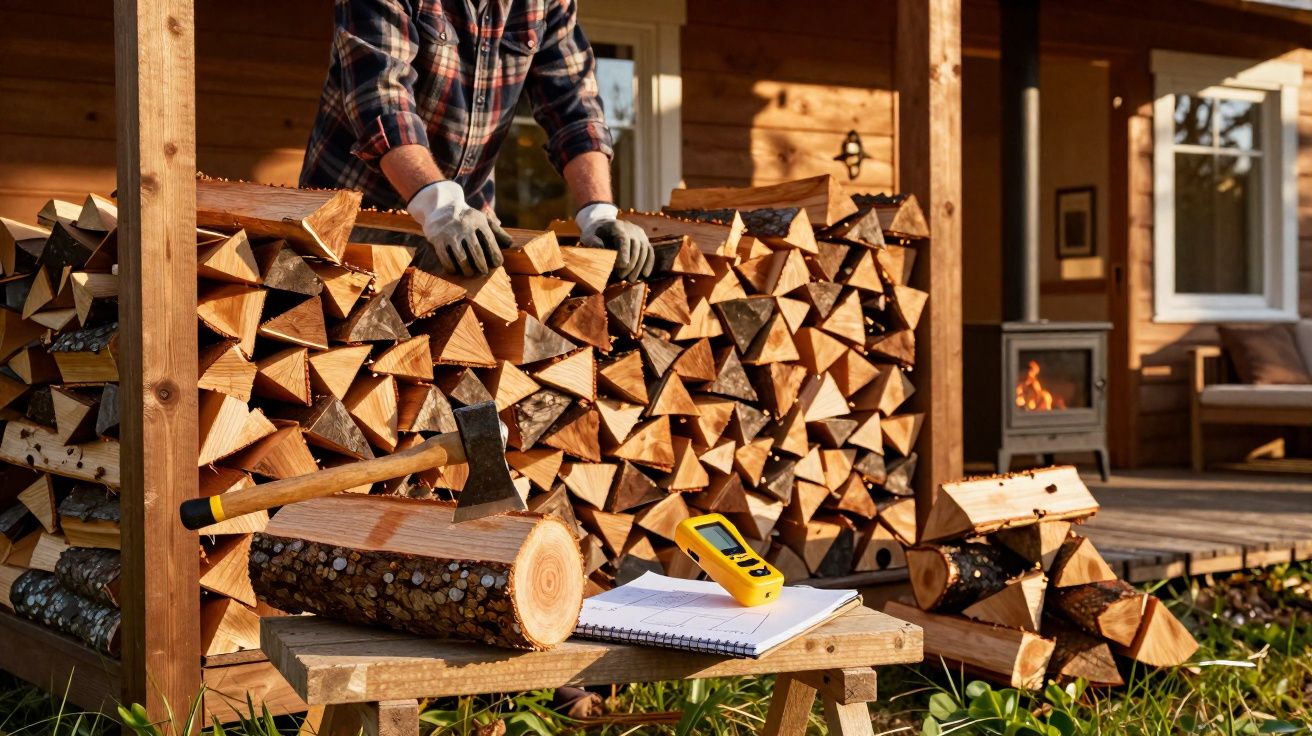
If you budget too tightly, you can find yourself sitting in a freezing living room in January.
Anyone planning to heat a flat or house of around 80–120 m² with logs soon runs into a practical question: how many stacked cubic metres of firewood do you actually need to make it through to spring? The honest answer depends on far more than floor area alone - insulation levels, the appliance you use, the timber species and even how warm you like to keep the house all play a part.
What really drives firewood consumption in an 80–120 m² home
Before placing an order, it pays to assess your own set‑up realistically. Two properties with the same square metreage can burn through completely different amounts of wood.
- Floor area: 80 m² will typically need less heat than 120 m², but the difference is not always proportional - especially in older properties.
- Insulation: Well‑insulated homes retain warmth for longer. Poorly insulated buildings can end up “heating” the outdoors with a portion of every load.
- Heating appliance: A modern wood burner, a closed fireplace stove, an inset fire with a closed cassette, or an open fireplace - efficiency varies hugely between these options.
- Region and climate: In snowy uplands or the Alps, the stove tends to run for far longer than in milder lowland areas.
- Wood species and quality: Hardwoods burn longer and provide more usable heat than softer conifers. Moisture content matters just as much.
- How you use it: Are you heating the whole property or mainly the living room? Is the stove on all day, or only in the evenings?
"For a well‑insulated house of about 100 m² with a modern wood burner, many households get through winter on an average of 4 to 6 stacked cubic metres."
How many stacked cubic metres of wood are realistic for 80–120 m²?
The figures below are not lab results; they are practical rule‑of‑thumb ranges that many households in Central Europe use for planning.
Typical consumption ranges by appliance type (firewood)
- Modern wood burner / fireplace stove: For roughly 100 m² of living space, most winters come out at 4–6 stacked cubic metres.
- Inset fire (closed cassette): For 100 m², plan on 6–8 stacked cubic metres.
- Open fireplace: Extremely inefficient; 12–15 stacked cubic metres per 100 m² is not unusual.
These ranges assume average insulation and typical winter temperatures. In draughty period homes or during prolonged cold snaps, consumption can rise noticeably.
Worked examples for 80, 100 and 120 m²
| Floor area & condition | Heating system | Expected requirement |
|---|---|---|
| 80 m², poorly insulated | Open fireplace | 10–12 stacked cubic metres, sometimes more |
| 100 m², well insulated | Modern wood burner | 4–6 stacked cubic metres |
| 120 m², average insulation | Inset fire (closed cassette) | 7–9 stacked cubic metres |
| 150 m², well insulated | High‑output wood burner | 8–10 stacked cubic metres |
If you’re torn between two estimates, it’s sensible to add at least half a stacked cubic metre as a buffer. Few things are more frustrating than needing an emergency top‑up during the first cold spell in March - usually at a higher price.
Why insulation often matters more than the stove itself
Plenty of people prioritise an attractive stove with a glass front, while paying far less attention to the building fabric. That’s often where the biggest savings are hiding.
In a well‑insulated home, the temperature stays comfortable for hours even after the fire has died down. In an older, poorly insulated building, the structure cools rapidly. In practice, that shows up in two ways: you need to refuel more frequently, and you end the season with a far larger wood pile missing.
"If you invest first in new windows, roof insulation or external wall insulation, you can sometimes cut firewood use by several stacked cubic metres per year."
Even modest tweaks can make a difference: sealing draughts around doors, closing shutters at night, putting rugs on cold floors, and using heavy curtains over windows that lose heat. These measures reduce demand without committing to a major renovation.
Choosing the right timber: hardwood beats softwood
Not every log produces the same heat. The key variables are the calorific value of the species and the moisture content.
Recommended firewood species for winter use
- Oak: Very high heat output, burns slowly and leaves long‑lasting embers.
- Beech: A go‑to choice for living spaces; attractive flame, plenty of heat, easy to control.
- Ash and hornbeam: Also premium hardwoods with strong heat performance.
Softer conifers such as spruce or pine burn quickly and tend to give “fast heat”. That can work well in autumn when you just want a quick boost, but for long winter evenings they usually require noticeably more volume.
Just as important is moisture content. Logs should be well below 20% residual moisture. Freshly cut wood typically needs two to three years to season properly.
"Wet wood wastes energy, creates smoke, soots up the stove and increases the risk of expensive chimney problems."
Storing, splitting and stacking: how to get firewood properly dry
Even excellent hardwood is disappointing if it’s stored badly - and this is where many people make their biggest mistake.
- Always store logs split, not as whole rounds.
- Stack loosely so air can circulate rather than packing it tight.
- Keep wood off the ground - use pallets, battens or a dedicated log base.
- Cover the top to keep rain off, but leave the sides open.
- Choose a spot with sun and wind, not a damp cellar or a sealed garage.
Ordering extra wood now for use in two years often means better pricing, but it also virtually guarantees ideal seasoning - and therefore more usable heat per log.
How households plan their firewood needs more accurately
People new to heating with logs often misjudge how much they’ll get through. A simple, practical routine helps:
- In your first winter, order with a bit of generosity (for example, 1–2 stacked cubic metres above the guideline figure).
- Over the whole heating season, keep a rough note of how much you actually burn.
- At the end of the season, check what’s left - that remainder becomes your reserve for the next winter.
After two or three winters of tracking, most households can estimate their typical requirement very accurately. At that point, buying larger quantities can be worthwhile, and discounts for volume are common.
Common mistakes that push firewood consumption up
A lot of “we’re burning too much wood” complaints come down to familiar issues:
- Refuelling too late, so the stove repeatedly has to be lit from cold.
- Draughts caused by leaving windows on vent in the room being heated.
- Radiator thermostats elsewhere set too low, leading to constant switching between systems.
- Overloading the firebox instead of maintaining a steady, even burn.
- Flue gas paths not cleaned and dirty stove glass - both reduce efficiency.
A modern stove with clean glass, a chimney swept regularly, and properly seasoned hardwood not only saves fuel, it also feels far more comfortable day to day.
A note on safety and combining wood with other heating systems
Heavy log use puts far more strain on both chimney and stove than the occasional “ambience fire”. An annual inspection by a chimney sweep, and strict compliance with clearance distances to combustible materials, are essential.
It can also make sense to pair wood with another energy source, such as a heat pump, gas heating or a pellet boiler. Many households use the stove to cover peak demand on very cold days and take pressure off the central heating. That can reduce overall energy use and create a particularly pleasant indoor climate - especially in older buildings where low‑temperature systems sometimes struggle.
If you assess your home, comfort expectations and appliance honestly, you can calculate your wood requirement with surprising accuracy. With dry hardwood, correct storage and an efficient stove, it’s entirely possible to heat 80–120 m² so the winter can be long - without the house being cold.





Comments
No comments yet. Be the first to comment!
Leave a Comment