
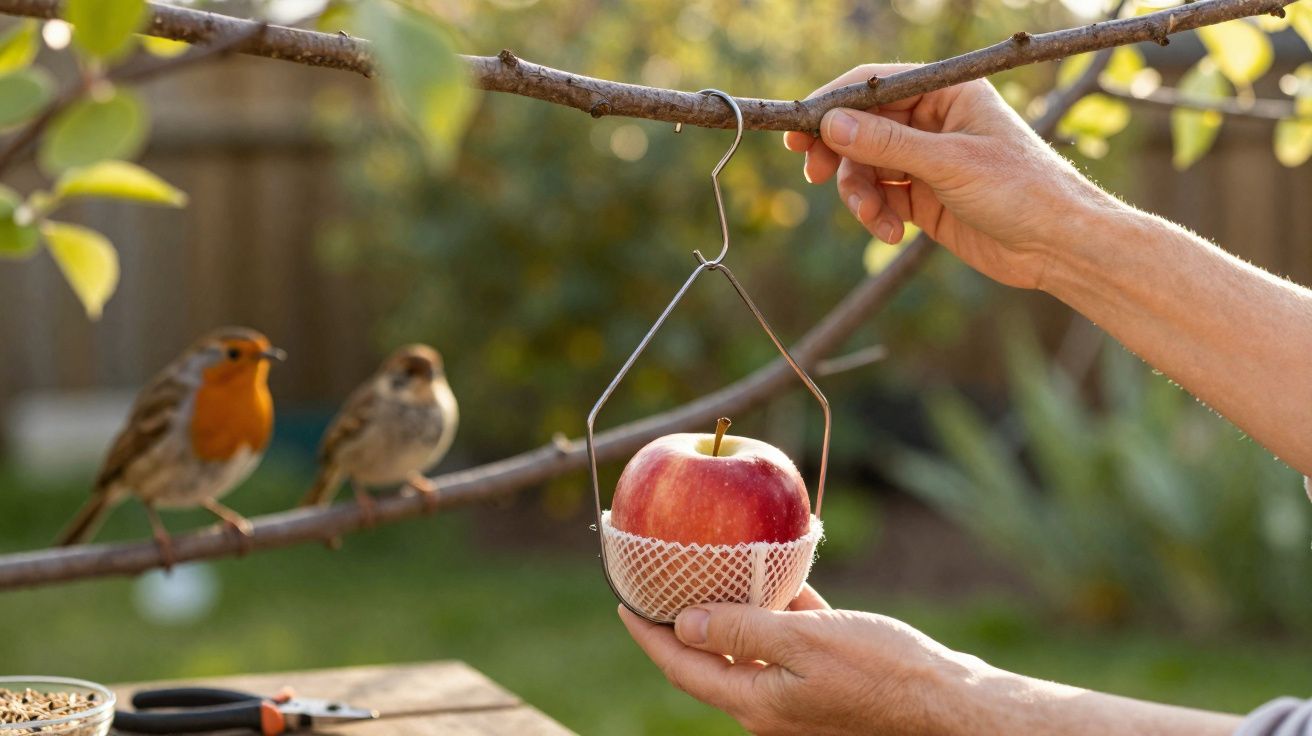
Many garden enthusiasts would like to help songbirds, but are put off by pricey shop-bought feeding stations. In reality, the materials for a sturdy, practical and completely free feeder are often already sitting in a wardrobe: an ordinary metal coat hanger. With just a few quick bends, it becomes a small “open-air beer garden” for birds-tough, long-lasting and easy to stock with different foods.
Turning a coat hanger into a bird buffet
The concept is straightforward: a thin wire coat hanger can be shaped with pliers to create a holder for half an apple or a fat ball. The hanger does double duty as both the hanging hook and the food support-about as minimal as it gets.
"In three minutes, an old wire hanger becomes a functional feeding station that specifically supports small garden birds."
What you need for the £0 method (metal coat hanger bird feeder)
The big plus: you don’t need to buy anything. Almost everything is likely already in your home or toolbox.
- 1 metal coat hanger (ideally the thin type from the dry cleaners)
- 1 combination pliers or flat-nose pliers
- 1 wire cutters (optional, if you want to shorten the wire)
- 1 apple (whole or halved) or 1 plant-based fat ball for birds
Thin hangers work particularly well. They’re strong enough to hold fruit or a fat ball, yet soft enough to shape by hand with a pair of pliers. That means you can create a custom feeder frame with very little effort.
Step-by-step: your own feeding station in three minutes
Step 1: Reinforce the hanging hook
Start by preparing the top section. Keep the hanger’s hook intact, as it will later be used to hang the feeder from a branch.
- Place the hanger on a solid surface.
- Using flat-nose pliers, carefully undo the twist directly beneath the hook until you have a long, straight run of wire.
- Squeeze the hook firmly with the pliers once more so it won’t spring open if a bird lands or the wind knocks the hanger.
This gives you a reliable base: hook at the top, and a straight section of wire below that you can shape freely. The neater this foundation, the easier the remaining steps become.
Step 2: Shape the holder for apple or fat ball
Now for the flexible part. Choose the shape according to the food you want to offer.
Option A: Holder for an apple or other fruit
If you prefer using fruit-such as a whole or halved apple-form a U-shaped cradle or a pointed support at the bottom:
- Bend the lower end of the wire sharply upwards.
- Create either:
- a wide, sturdy U-shape that a halved apple can sit inside, or
- a pointed, slightly curved spike that you can push the apple onto.
- Make sure the apple sits securely and can’t drop off.
If you have more than one hanger available, you can try different fruits-such as pear or a piece of dried rosehip-and see what goes down best in your own garden.
Option B: Holder for a fat ball
For classic fat balls (ideally without a net, so birds don’t get tangled), wind the wire into a small basket or spiral:
- Use the pliers to coil the lower third of the wire into a tight spiral.
- Leave a little space in the centre so you can press the ball into place.
- Push any sharp wire ends inwards to prevent injuries.
"Important: Always bend open, sharp wire ends inwards. That way, birds can land safely without injury."
Simply push the fat ball into the spiral. It should sit firmly enough to cope even in blustery weather.
Choosing the right spot: safe for birds, great for watching
Protection from cats and birds of prey
Even the best feeder is pointless if it turns into a trap, so positioning matters.
- Hang the hanger from a sturdy branch at around 2 to 3 metres high.
- Avoid locations with easy climbing routes for cats nearby (e.g. walls, shelving, low branches).
- Pick a spot where birds can approach from several directions and also escape quickly.
A slightly isolated tree or a larger shrub is often ideal. Birds can spot danger early and have enough clear flight paths to get away.
Keep distance from windows and walls
Glass brings its own hazard: birds may not see it in a panic and can collide. A few simple rules help:
- Keep at least 10 metres away from large windows or patio doors.
- Don’t hang it right next to exterior walls, so birds don’t get cornered.
- Where possible, use anti-collision stickers or curtains on very large glass panes.
Placing the hanger outside the direct line of sight of glass noticeably reduces the risk of impact-while still allowing you to observe the feeder easily from indoors.
Why small garden birds love this feeding station
Ideal for tits, sparrows and robins
The slim, lightweight build of a hanger tends to suit smaller species best. Great tits, blue tits, house sparrows, tree sparrows, greenfinches and robins are often among the first visitors.
A wire coat hanger offers several practical advantages:
- Narrow perches are easy for agile, climbing birds to grip.
- Larger, heavier birds such as pigeons are more likely to be deterred.
- The height above the ground makes access harder for cats and martens.
This helps ensure the food is used more by the species that support a healthy garden ecosystem-for instance by eating insects or contributing to pollination.
More than feeding: a small eco project
The benefit doesn’t end with food. Regular feeding encourages birds to spend more time close to your garden. That can also increase their presence during nesting and while hunting insects. Many species help reduce aphids, mosquitoes and caterpillars as a natural side effect.
"A simple wire construction can noticeably strengthen biodiversity in your own garden-without plastic waste and without extra costs."
Practical tips for long-term use
What food actually makes sense
Even a free feeding station depends on good-quality food. Especially suitable options include:
- unseasoned fat balls without nets
- sunflower seeds (hulled or unhulled)
- halved apples or small fruit pieces (ideal in frosty weather)
- specialist seed mixes for wild birds
Avoid salted nuts, seasoned leftovers or bread. Many of these can swell in a bird’s stomach or contain ingredients they don’t tolerate well.
Cleaning, rust and safety
Metal coat hangers usually last a long time. A little care can extend their life further:
- Remove leftover food or fruit regularly to prevent mould.
- Once a week, rinse briefly with hot water and allow to dry.
- Replace the hanger if rust becomes heavy, so sharp edges don’t develop.
If you like, you can lightly sand the wire beforehand and coat it with a thin layer of non-toxic metal paint. This slows rust and makes the feeder look a bit smarter.
Upcycling ideas: what else you can shape from hangers
Variations for more experienced tinkerers
If you enjoy the approach, you can try more experiments with additional hangers:
- a double spiral for two fat balls stacked vertically
- a cross-frame made from two hangers to hold several apple pieces
- a small “parking spot” for millet spray by bending out a side support
With a little practice, you can build an entire “bird buffet” purely from leftover materials that might otherwise have ended up in the bin-or forgotten at the back of a cupboard.
Why this idea fits the moment
Many people are trying to cut waste and use resources more thoughtfully. This small project combines several goals at once: upcycling instead of throwing away, supporting local wildlife, less plastic, and zero additional cost. It’s also a quick craft activity that can introduce children to nature conservation. They can see straight away whether birds take to what they’ve made-and learn, at the same time, how sensitively a garden ecosystem responds.
When you glance out of the window and watch the steady traffic of birds around a repurposed coat hanger, you quickly realise just how much impact a modest three-minute action can have.





Comments
No comments yet. Be the first to comment!
Leave a Comment