
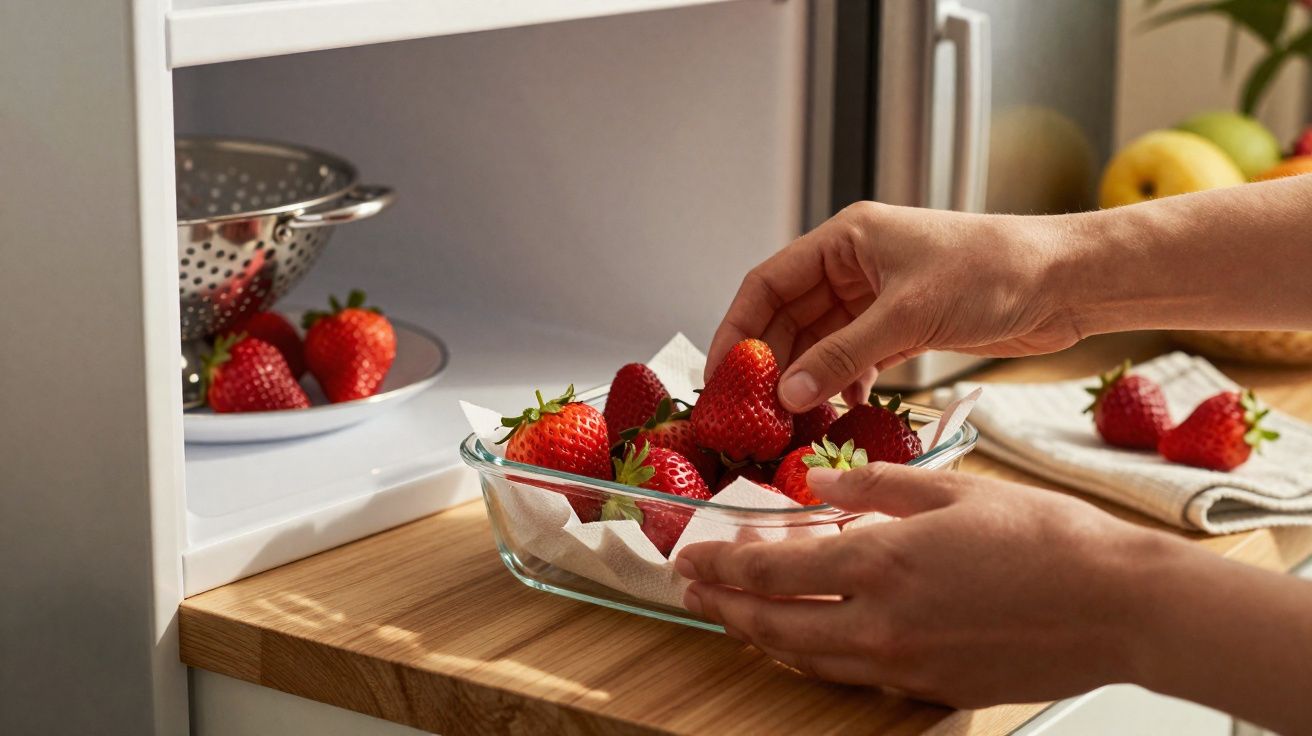
Anyone who has picked up a punnet of perfectly ripe strawberries at the supermarket or local market knows what often happens next: by the following day in the fridge, the fruit is soft, bland or already showing spots. A lot of people end up binning them half-eaten. Yet with one simple change of storage place and a few small handling habits, you can often extend the life of these delicate berries by several days.
Why the fridge spoils strawberries so quickly
Most people put strawberries straight into the fridge as soon as they get home. It feels sensible, because cold temperatures usually slow spoilage. With strawberries, though, that rule only partly applies.
Once temperatures drop to roughly below 4°C, the berries’ structure starts to change. The flesh contains a great deal of water, and the cells are easily damaged. The result is familiar: the fruit turns limp, the skin looks slightly wrinkled, and the crisp bite disappears. At the same time, flavour fades because ripening is effectively put on hold, so the characteristic aromas don’t continue to develop.
“Strawberries are sensitive to cold: temperatures that are too low make them watery, bland and more vulnerable to mould.”
Humidity inside the fridge makes things worse. In a tight plastic punnet, condensation builds up, creating ideal conditions for mould. If the berries are still sitting in a closed original pack, one small mouldy patch can quickly spread through the whole punnet.
There’s another drawback: strawberries readily absorb nearby odours. Stored next to onions, garlic, cheese or reheated leftovers, they can pick up a faint “off” taste. For that reason, the fridge is only really suitable if you plan to eat them within 24 hours.
Leaving them on the worktop isn’t much better
A common alternative is to keep strawberries in a fruit bowl or simply on the kitchen counter. It may seem more natural, but in warm rooms-or in direct sunlight-their condition declines extremely quickly.
Heat speeds up the fruit’s respiration. The surface softens, the berries lose firmness, sugars begin to ferment and the flavour turns. Temperature swings add to the problem too-say, sunshine warming the kitchen at lunchtime and cooler air returning in the evening. These fluctuations put extra strain on the fruit’s tissues and make damage more likely.
For strawberries you’re eating the same day (or the next), room-temperature storage can be fine. But after around 24 hours, the risk of mould rises sharply. If you leave them on the counter “for later in the week”, you should expect noticeable wastage.
The overlooked sweet spot for strawberries: cool, dry and dark
Strawberries typically last far better for several days in a place many households barely use: a cool, dry, dark area with gentle airflow. Good examples include:
- a larder cupboard or storage cupboard with no radiator nearby
- a well-ventilated cellar
- a clean, not-too-cold section of the garage
The most suitable temperature range is about 10–14°C. That’s clearly cooler than a living room, but much warmer than a typical fridge shelf. In these conditions, the berries stay firmer, continue to ripen slowly and build flavour-without going off as fast.
“In a slightly cool, dry and dark side room, fresh strawberries usually keep for three to five days with full flavour.”
Darkness helps slow oxidation processes-so the surface browns and ages more slowly. A moderate, stable temperature prevents the fruit’s tissues from being stressed. And circulating air reduces the chance of damp pockets forming in the container, which is a big advantage when you’re trying to avoid mould.
How to prepare strawberries properly for storage
The right location helps, but it’s not the whole story. If you want strawberries to stay fresh longer, a few handling rules make a real difference.
Key rules to follow
- Don’t wash them too early: moisture on the skin creates perfect conditions for mould. Rinse only just before eating.
- Keep the stalks on: the little green tops protect the fruit at the cut point. Remove them shortly before you eat.
- Store in a single layer: stacked berries squash each other and bruise; one layer minimises pressure marks.
- Use an absorbent base: kitchen paper or a clean cloth in the container helps soak up excess moisture.
- Check daily: remove any soft or mouldy berry immediately, or it can quickly contaminate the rest.
A shallow container with ventilation holes-or a small basket-is ideal. Airtight tubs are usually a poor choice for strawberries because moisture gets trapped inside. If you’re picking from a field or garden, place the berries straight into a breathable container where possible, and avoid piling heavy layers on top.
If you’ve bought too many: preserve them instead of binning them
In peak season it’s easy to come home with several kilograms-supermarket deals, pick-your-own trips, or a gift from a neighbour’s garden. Before a big haul starts to go mouldy, it pays to decide quickly what to do.
One traditional approach is to get the saucepan out: strawberry jam, conserve or a quickly made fruit spread can extend enjoyment for weeks or months. If you don’t want to deal with jars, softer berries can be turned into a purée or fruit coulis (a “fruit mirror”) and either kept in the fridge for a few days or frozen.
Freezing strawberries: how to protect shape and flavour
For longer-term storage, the freezer is the best option. With the right method, the berries won’t clump into one solid icy block:
- Wash the berries gently and let them drain thoroughly.
- Remove stalks and discard any bruised fruit.
- Arrange the strawberries in a single layer on a tray or board.
- Freeze uncovered until completely solid.
- Tip into freezer bags or containers and seal.
Frozen this way, the berries stay separate and are easy to take out individually-ideal later for smoothies, shakes, cake toppings or sorbet. After defrosting they will be softer to bite into, but the colour and aroma are largely preserved.
Why strawberries are so quick to deteriorate
Strawberries are among the most pressure-sensitive fruits you can buy. Their skin is thin, and the flesh is soft and water-rich. Even small temperature changes or a little physical pressure can injure the tissues. Exactly at those damaged spots, rot and mould take hold fastest.
On top of that, strawberries continue to “breathe” after harvest. They take in oxygen and release carbon dioxide. The warmer the surroundings, the faster that process runs-and the quicker the fruit ages. A slightly cool, steady storage place slows this metabolism without shocking the berries.
Everyday ways to make it work at home
If you only have a small balcony and no cellar, you can still improvise. A cardboard box with ventilation holes placed in the coolest part of the home-well away from radiators and windows-often works better than the standard fridge compartment. In ground-floor flats, the hallway is often suitable; in top-floor flats, a shaded storage cupboard tends to be the better option.
You can also adjust how you shop. Buying small punnets two or three times a week is often better than purchasing one large batch that ends up in the bin on day three. And for last-minute dessert plans or visitors, it’s worth keeping a small stash of frozen strawberries at home.
“With a few small changes-different storage place, less moisture, a daily check-short-lived strawberries become a supply that lasts several days.”
If you take these points on board, you’ll notice the difference quickly: the fruit stays firmer, the flavour is more intense, and the berries look appetising for longer. Less ends up as waste-and more makes it onto the plate, into muesli or into a cake.





Comments
No comments yet. Be the first to comment!
Leave a Comment