
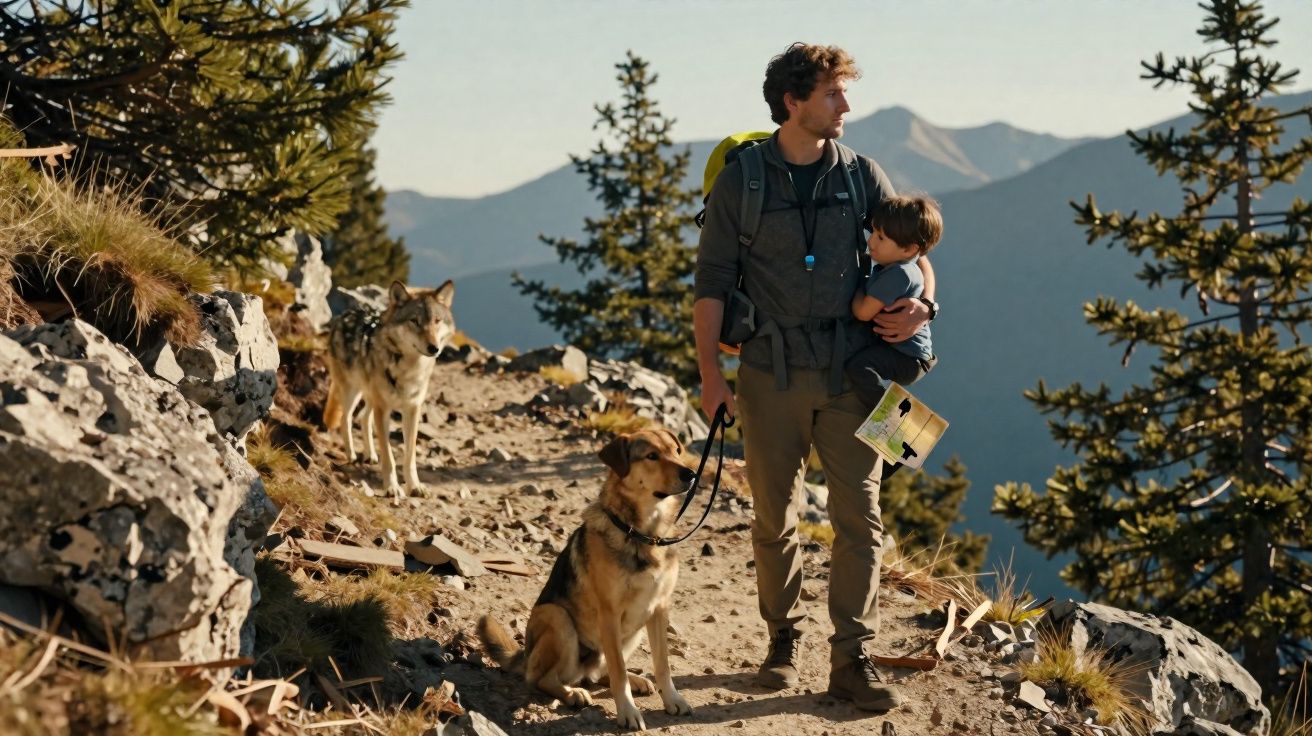
If you respond the wrong way in a moment like this, you make the situation worse.
Wolves are returning in greater numbers to the Alps and Europe’s uplands. Walkers can suddenly find themselves facing something they previously only knew from fairy tales, social media clips and headlines. That’s precisely why the greatest risk often isn’t the animal itself, but our snap reaction: bolting, shouting, filming in a panic. Those instincts can turn an otherwise uneventful encounter into something far more tense.
The wolf is back: what a wolf encounter means for hikers
Across many parts of Europe - including Germany, Austria and Switzerland - wolves have been expanding their range again since the 1990s. They follow wild prey, find enough undisturbed habitat and adapt surprisingly well to very different landscapes, from high mountains to wooded lowlands.
Even so, meeting a wolf on a mountain path remains unusual. Most of the time you only glimpse one briefly at a distance before it disappears again. Wolves avoid people whenever they can. Data from several countries indicates that attacks on humans are extremely rare and are almost always linked to exceptional circumstances - for example, sick animals or animals that have lost their natural wariness because they have been fed.
"The biggest real danger in the mountains is not the wolf - it’s a panicked, unthinking human reaction."
Starting out with the wrong mental picture makes it harder to see clearly when it matters. The stereotype of the “bloodthirsty predator” runs deep, shaped by old stories and dramatic videos. Out on the trail, that can prompt people to do exactly what needlessly escalates the situation.
The most important rule: never run away
The reflex most people have is to turn and sprint. That is the worst possible choice. A fleeing back can trigger a chase response in wolves - as in many predators. Even if the animal was only curious at first, it may suddenly follow.
Instead, aim for a response you can remember under stress:
- Don’t run - avoid sudden, frantic movements.
- Stand upright - you appear larger and more in control.
- Keep the animal in view - without a hard, aggressive stare.
- Step back slowly - create space without turning your back.
- Speak calmly but clearly - a firm human voice signals: this is a person, not prey.
Handled like this, you send two simple messages: I’m not prey, and I’m not looking for a fight. In the vast majority of cases, the wolf turns away after a short time and moves on.
Breathing control: bringing panic down in seconds
In the mountains, the immediate issue is often less the wolf and more the shock: adrenaline surges, your heart races, and your body wants to flee. Right at that point, a few deliberate breaths can make the difference.
A straightforward technique you can memorise even on the train or in the car:
- Inhale through your nose for four seconds.
- Hold your breath briefly.
- Exhale slowly through your mouth for six seconds.
- Repeat several times until you can feel your body settling.
This slower breathing dampens the panic response and gives your mind the space to act deliberately - meaning you don’t run, you bring the group together, and you choose your next steps calmly.
What if children or dogs are with you?
Walkers are rarely out entirely alone. With children or a dog, the dynamic shifts - and so does your responsibility.
With children: stay calm and assign clear roles
Fear spreads to children instantly. If the adult panics, you’ve usually lost control of the situation. A better approach is:
- Speak calmly but firmly: "We are all going to stand still here."
- Place children behind the calmest adult.
- Don’t allow rushing about, screaming or running.
- Pick a solid nearby reference point (for example a boulder or a tree) and move back towards it together - slowly and as one group.
That creates a clear, protected unit rather than a scattered group that looks nervous and is hard to manage.
Keep dogs on a lead - truly always
Many wolf incidents don’t start with a person, but with a dog. The dog spots the wolf, charges forward barking, the wolf feels pressured and a clash follows. The dog then retreats and runs back to its handler - with the wolf potentially following.
So the rule is simple: in known wolf areas, keep dogs on a lead as standard, especially near grazing land with sheep or goats. If a wolf appears, bring the dog in close immediately, ideally on a short lead on the side facing away from the wolf.
The biggest mistakes during a wolf sighting
In many mountain areas, the same pattern now repeats: as soon as someone spots a wolf, phones go up. That is where the most dangerous habits develop - for people and for wildlife.
Avoid these behaviours strictly:
- Moving closer to film or take photos: approaching forces the animal into a choice - flee or defend itself.
- Throwing food or leftovers: feeding reduces the wolf’s natural wariness and increases the chance it will later seek out people.
- Chasing after the wolf: following a retreating animal makes you a threat in its eyes.
- Shouting aggressively at close range: hostile behaviour can confuse the wolf or, in the worst case, trigger defensive reactions.
"Wolves that learn food comes from people become a real problem - not because they are ‘bad’, but because they lose their natural caution."
If the encounter seems unusual - for instance, very close to a village, or involving an animal that shows strikingly little fear - it can be worth reporting afterwards to the relevant local authorities. Many regions have dedicated wolf coordinators or environmental agencies that log such observations.
Why the wolf feels more dangerous in our minds than in reality
Fear of wolves is deeply embedded in our culture. From childhood onwards, fairy tales cast the wolf as a cunning monster that swallows children and eats grandmothers. Those images don’t vanish just because you read a few sober statistics.
On top of that, social media is full of clips that sensationalise predators. Many of those scenes come from wildlife parks, from North America or Russia - or they are heavily edited. On mountain paths in Central Europe, day-to-day reality is usually far less dramatic.
If you take a moment before a hike to look at a few facts, it takes much of the force out of that old fear. Useful questions include:
- Where are confirmed wolf areas along my route?
- How do livestock guardian dogs behave, and how do I recognise them?
- Which emergency numbers apply in this region?
That kind of preparation may look minor, but in practice it creates calm. If you know what you’re doing, you’re less likely to feel helpless.
Wolves, grazing animals and hikers: a tension point
In many mountain regions there’s another factor: herds of sheep, goats or cattle. They attract wolves - and they also draw the attention of walkers. These herds are often accompanied by livestock guardian dogs that take their job very seriously.
If you pass a grazing area, keep a few basic rules in mind:
- Don’t cut across fields; stick to marked paths.
- Keep your distance from herding or guardian dogs; don’t laugh at them and don’t try to lure them over.
- Don’t offer food, and don’t take selfies right up close with sheep.
- If a livestock guardian dog barks and approaches: stop, stay calm, and slowly increase the distance again.
That makes coexistence between wildlife, livestock and mountain tourism noticeably less stressful.
Practical preparation for the real situation
Even though the chance of meeting a wolf at close range is low, a brief “mental check” before each walk is worthwhile. A kind of internal script helps you avoid reacting thoughtlessly if it happens.
Helpful routines include:
- Briefly agreeing within your group how you’ll behave around wild animals.
- Setting clear rules for children and dogs.
- Choosing one person to set the tone and keep everyone calm if needed.
- Practising the breathing technique once, consciously, before you set off.
All of this takes only a few minutes, but it can make a big difference. The mountain is the same - your mindset changes. Instead of a vague fear of the unknown, you have a matter-of-fact: "If it happens, I know what to do."
That way, the wolf ends up being what it usually is: a shy wild animal you might just make out in the distance - and something you talk about later over a beer at the mountain hut, rather than stumbling into a risky situation because of the wrong reflex.






Comments
No comments yet. Be the first to comment!
Leave a Comment