
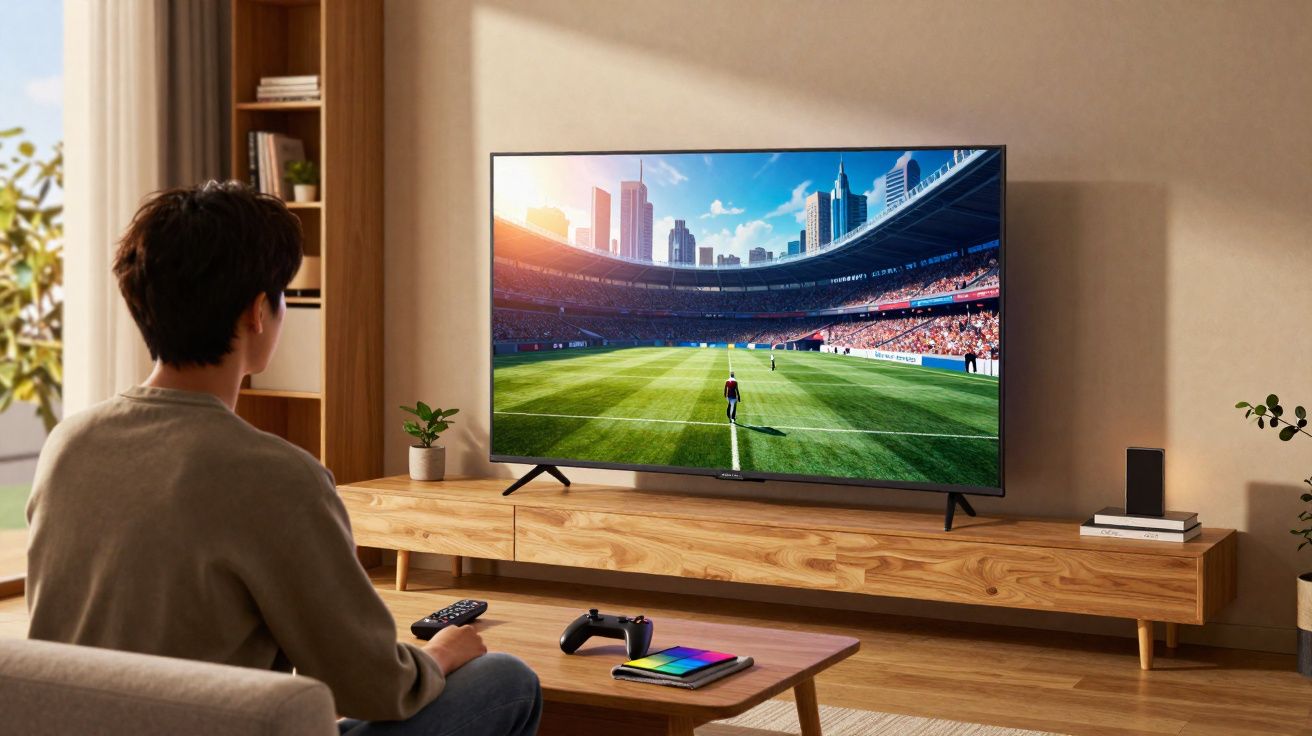
After years of bold claims about 8K and ever-sharper resolution figures, the television world is changing tack. Instead of chasing yet more pixels in 2026, brands are concentrating on getting more light, more accurate colour and cleaner motion from the pixels people already have. For most living rooms, that move is likely to improve day-to-day picture quality far more than stepping from 4K to 8K ever did.
Why the industry is moving on from 8K
For a long time, manufacturers positioned 8K as the obvious next upgrade. In real homes, though, it rarely delivered the “wow” moment the marketing promised.
At trade shows, 8K clips can look spectacular. But at home-sitting a couple of metres from the sofa-the gap between a strong 4K TV and an 8K model is often hard to spot, even on very large screens. At typical viewing distances, the eye simply cannot resolve all that extra fine detail.
Content availability has been the other major obstacle. True native 8K films and series are still vanishingly rare. In practice, most people watch 4K or even HD, leaving the TV to upscale. That is a tough sell when shoppers are weighing a steep price against the same familiar Netflix library.
"The industry has realised that what viewers really notice is not more pixels, but better pixels."
Elements such as contrast, peak brightness, faithful colour reproduction and stable motion are immediately obvious-unlike the jump from 4K to 8K. Crushed blacks in dark scenes, blurred fast sport, or blown highlights on bright days can break the illusion instantly. That is the gap 2026 televisions are trying to close.
HDR steps into the spotlight in 2026 TVs
High Dynamic Range (HDR) is not a fresh invention, but its 2026 implementation is being rethought. Rather than treating HDR as a set-and-forget mode, the next wave aims for scene-by-scene flexibility that responds to both the programme and the room.
Two competing standards sit at the centre of the shift: Dolby Vision 2 and HDR10+ Advanced. Both are designed to extract substantially more performance from 4K panels without changing the headline resolution.
"The race is no longer about how many pixels a TV has, but how intelligently those pixels are driven."
Dolby Vision 2: smarter tone mapping and motion control
Dolby’s latest approach is strongly creator-led. With Dolby Vision 2, the grading is intended to match what the display can actually achieve, rather than forcing a single master that fits every screen equally.
Its headline upgrade is a two-way tone-mapping workflow. Instead of the source merely shipping a peak-brightness map and leaving the TV to cope, the television reports back what it can do-how bright it gets, how low its black levels go, and how precisely it can render colour.
That feedback lets the same scene be tuned differently on a compact OLED in a typical living room versus a very bright Mini LED set in a sunlit lounge. In other words, one film can look purpose-built on each display, rather than compromised to suit the least capable option.
Motion is also part of Dolby Vision 2’s remit. A tool called “Authentic Motion” gives creators the ability to define how much motion smoothing is permitted (if any) on a frame-by-frame basis. The intention is to remove the shiny “soap opera effect” while still maintaining clarity when it genuinely helps-such as during quick pans.
"For the first time, motion settings can be baked into the HDR metadata instead of left entirely to aggressive TV algorithms."
Early CES 2026 hands-on reports described richer colour impact, highlights that feel better managed, and movement that more closely matches directorial intent.
HDR10+ Advanced: Samsung’s AI-driven answer
HDR10+ Advanced, backed by Samsung and its partners, takes a different route: more openness and more automation. It remains licence-free, which is attractive to manufacturers keen to avoid Dolby’s fees.
In this ecosystem, AI does much of the decision-making. The TV identifies what is being watched-drama, football, a live concert, a video game-and shifts HDR behaviour on the fly. Brightness, local dimming and colour mapping are adjusted in real time to keep detail visible without bleaching the picture.
A new “HDR10+ Bright” option targets extremely luminous televisions, especially premium Mini LED models reaching 4000 to 5000 nits of peak brightness. This is designed so small intense highlights-sun glints, sparks, reflections-remain detailed and controlled rather than flaring into harsh white.
Motion is managed via “Intelligent FRC” (frame rate control). Instead of applying interpolation broadly, the system uses metadata within the content to decide when extra frames should be created. The aim is to reduce artefacts and add crispness only where it is justified.
"Samsung is betting on a TV that figures everything out for you, with minimal manual tweaking and no licence costs."
What this means for 2026 TV ranges
These upgraded HDR formats are not just software badges; they come with clear hardware demands. A budget 4K panel will not suddenly gain full support through a simple firmware update.
In its complete form, Dolby Vision 2 is aimed at higher-spec TVs. Full implementations call for strong processing power and panels that can reach 12-bit colour depth, equating to more than 68 billion possible shades. No mainstream TV sold before 2026 can meet that full specification, so anyone chasing every feature is likely to be pushed towards the newest sets.
HDR10+ Advanced likewise assumes advanced backlighting. It is tuned for Mini LED and top-end QLED televisions with thousands of local dimming zones, allowing tight control of bright and dark areas simultaneously.
A number of manufacturers have already made their positions clear:
- Philips intends to include Dolby Vision 2 across multiple 2026 OLED models.
- Hisense is adopting Dolby Vision 2 for its premium sets.
- Samsung is prioritising HDR10+ Advanced and shows no signs of adding Dolby Vision support.
This divide is expected to appear on the content side too. Amazon’s Prime Video has already publicly backed HDR10+ Advanced, while Canal+ is collaborating around Dolby Vision 2. Services such as Netflix and Disney+ are likely to move once more titles are mastered to the new standards, but the transition may take months or years rather than happening overnight.
Should you upgrade your TV in 2026?
If you already own a recent 4K television, there is no need for alarm. Sets released in 2024 and 2025 with today’s Dolby Vision and HDR10+ are still very capable. For many homes-particularly without a large catalogue of compatible releases-the shift to 2026 formats will feel more like refinement than a revolution.
"For most people, a solid 4K HDR set bought recently will stay relevant for years, even as Dolby Vision 2 and HDR10+ Advanced roll out."
The calculation changes at the premium end. Anyone budgeting for a flagship model will encounter a more complicated decision, where HDR format support sits alongside screen size and panel technology as a core buying factor.
In effect, the market looks set to split into two ecosystems. Some brands and services will favour Dolby Vision 2 for its creator-focused control, while others will rally around HDR10+ Advanced for its licence-free, automated approach. Depending on where you watch most, your preferred streaming service may gently steer you towards one camp.
Key differences at a glance
| Feature | Dolby Vision 2 | HDR10+ Advanced |
|---|---|---|
| Business model | Proprietary, licensed format | Open, licence-free standard |
| Target hardware | High-end OLED / Mini LED, 12-bit capable | High-brightness Mini LED / QLED with strong local dimming |
| Tone mapping | Two-way TV–source communication for tailored scenes | AI-driven adjustments based on content type |
| Motion handling | “Authentic Motion” with creator-defined smoothing | “Intelligent FRC” adding frames only when metadata suggests |
| Positioning | Focus on artistic fidelity and control | Focus on automation and wide manufacturer adoption |
What HDR, nits and bits actually mean
If the terminology feels overwhelming, a few definitions help. HDR-High Dynamic Range-means the TV can display brighter highlights and deeper shadows at the same time. Picture a sunset shot where you can still make out facial detail in the foreground while the sky remains bright and colourful, rather than one area turning flat and grey.
“Nits” are a measure of brightness. An affordable TV may top out at roughly 300–400 nits. Premium Mini LED models quoted around 2000–3000 nits can keep HDR highlights visible even in a bright room. The “Bright” profile within HDR10+ Advanced assumes much higher peaks, up to 4000–5000 nits.
Bit depth describes how many shades of each colour the panel can show. Most current televisions are 10-bit, which already covers over a billion colours. Dolby Vision 2’s push towards 12-bit is aimed at reducing banding in smooth gradients-such as blue skies or gentle lighting fades.
Real-world scenarios for 2026 TVs
Imagine a Sunday afternoon Premier League match on a 2026 Mini LED TV. With HDR10+ Advanced, the set recognises live sport, pushes brightness upward, tightens local dimming so shirts stand out cleanly against the pitch, and tunes motion so the ball stays sharp without making the crowd look like a soap-opera video.
Now switch to a film graded for Dolby Vision 2 at night. With the room darkened, the TV and source can work together to reduce peak brightness, deepen black levels and apply the director’s chosen motion preferences. Dim scenes hold onto fine texture instead of collapsing into murky grey, and pans look filmic rather than unnaturally slick.
For gaming, both standards could matter even more. Faster response, lower input lag, and HDR that adapts instantly to gloomy interiors and bright explosions can materially change how a game plays. As consoles and PCs begin supporting these enhanced formats, gaming monitors may start adopting similar techniques pioneered in 2026 TVs.
Risks and trade-offs for buyers
The biggest downside is fragmentation. If your TV only supports Dolby Vision 2, you may not see the best version of HDR10+ Advanced titles mastered mainly for Samsung’s ecosystem-and the reverse is also true. Standard HDR10 will remain the shared baseline, but the top-tier experience will depend on which side wins each release.
There is also the familiar early-adopter issue. First-generation models typically cost more and may not ship with every promised function enabled immediately. Updates often close the gaps, but value-focused buyers may prefer to wait a year for prices to settle and for more compatible content to arrive.
On the positive side, the move away from resolution one-upmanship should benefit mid-range sets too. Even without full Dolby Vision 2 or HDR10+ Advanced support, improved tone mapping and motion processing are likely to filter down, delivering cleaner HDR and more consistent images on more affordable 4K televisions.






Comments
No comments yet. Be the first to comment!
Leave a Comment