
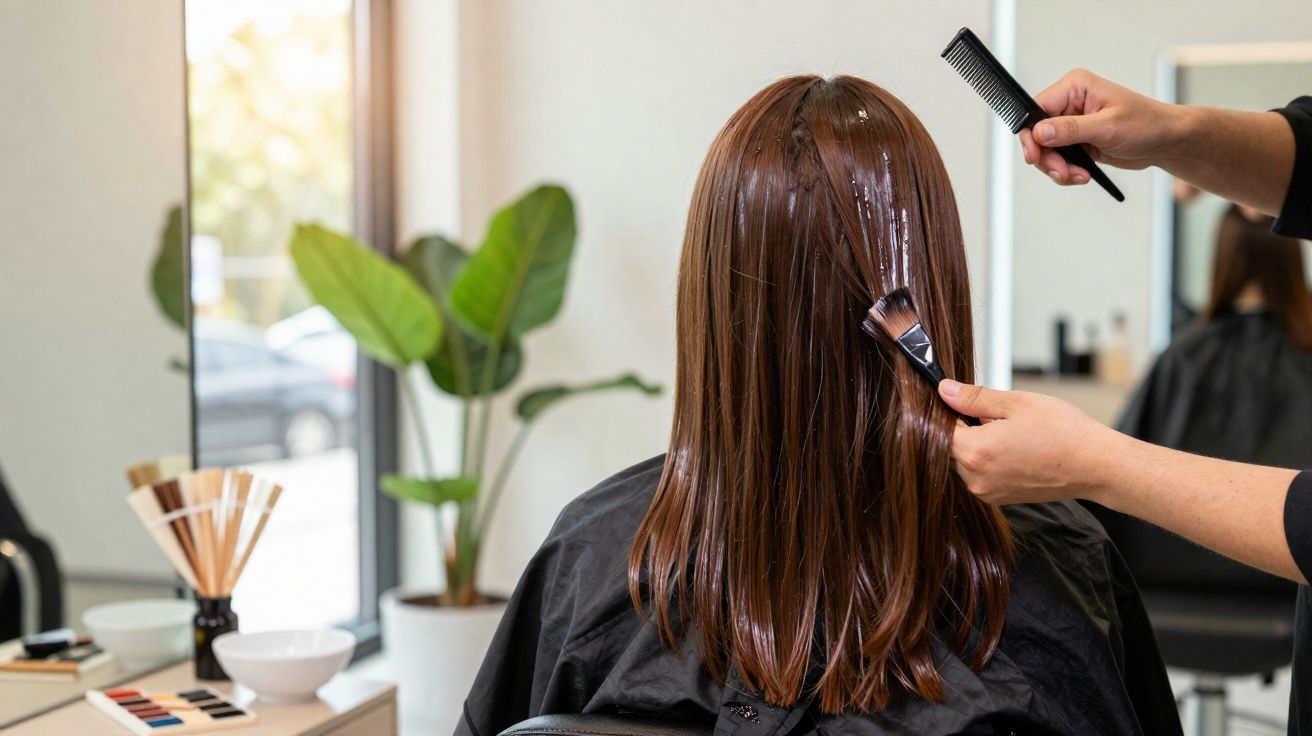
A classic colouring staple is making a powerful comeback.
If you’ve been to the hairdresser in the past few years, you’ll know the routine: face-framing pieces here, Highlights there, all designed to look as “sun-kissed” and effortless as possible. In spring 2026, that long-running look is facing serious competition. Salon professionals are reporting a clear shift towards an even, precise hair colour that feels surprisingly current.
The new star: completely solid, one-colour hair (one-tone colouration)
The trend’s name is plain, but the impact isn’t: one-tone colouration from roots to ends. No tricks, no contrasts, no “a few pieces here and there”. The concept is simple: a single continuous shade that makes the entire head of hair read like one smooth block of colour.
"Instead of complicated colour gradients, clean, saturated tones are taking centre stage - and that’s exactly what feels incredibly fresh right now."
Where Balayage leans on light reflections and soft transitions, the new solid colour look is all about line, calm and control. The finish is deliberately “done” rather than “natural”. Right now, these shades are showing up repeatedly in salons and across social media:
- Bright, but not harsh, light blonde
- Rich chocolate brown with no lighter pieces
- Deep black with mirror-like shine
- Warm copper or cinnamon-red as a statement
Here, the colour itself carries the style - not a complex game of dimension and shading. That’s why many hairdressers describe it as a kind of “back to basics” moment in colouring.
Why a smooth, solid colour reads as modern
Fashion and beauty tend to move in cycles. After years dominated by effects and “Instagram hair”, there’s growing appetite for something cleaner. One-tone colouration hits that desire perfectly: it communicates structure, calm and a hint of strictness - a combination that can look instantly premium.
It also pairs effortlessly with minimalist wardrobes: blazers, sharp seams, simple cuts. If you dress that way, you often don’t want a busy hair colour competing for attention; you want a single shade that frames the face like a neat frame around a picture.
Even colour = more shine
One of the biggest upsides is simple physics: when the surface is coloured evenly, it reflects light more consistently. Instead of a patchwork of light and dark, you get one unified sheen. The hair can look:
- shinier
- better cared for
- almost “polished”
That helps explain why TikTok and Instagram are full of the classic “hair flip” clips where hair drops like a glossy curtain. One-tone colouration makes that effect much easier to achieve.
Visibly thicker-looking hair: why the trick works
A lot of people want more fullness. Beyond layered cuts or volumising mousse, colour plays a bigger part than many realise. Lighter and darker pieces can add movement, but they often reduce the look of density because individual sections are easier to pick out.
"A continuous tone makes hair look like one solid mass from a distance - and that automatically reads as fuller."
For fine hair in particular, an even shade that’s slightly deeper can be transformative. Light distributes more evenly, the roots appear more substantial, and the ends look less see-through. Even mid-length bobs can seem “fuller” and less wispy as a result.
| Multi-tone colouration | One-tone colouration |
|---|---|
| Looks lively, but often feels visually busy | Looks calm, clean and structured |
| Can emphasise finer hair | Makes hair appear denser |
| More dependent on styling | Can look “finished” quickly in day-to-day life |
Less hassle: maintenance is noticeably easier
Another reason so many people are switching to clean, solid shades: upkeep is often far more relaxed than with intricate highlights techniques. Balayage relies on delicate transitions - once those fade, the colour can start to look patchy and needs correcting.
With a single shade, everything depends on a clean base colour. When roots grow out, you don’t necessarily get an immediate harsh line, especially if the chosen shade is close to your natural colour. For many, that means:
- fewer salon appointments across the year
- lower long-term costs
- less stress because root regrowth isn’t constantly annoying
This approach also suits spring and summer particularly well, when people are out and about more and don’t want to spend hours in a chair. Once the colour is applied properly, a Glossing treatment or a gentle refresh after a few weeks is often enough.
What’s especially popular right now
Looking at what’s trending in salons, a few favourites keep coming up. One-tone colouration isn’t “one-size-fits-all”; it still relies on subtle differences within a single tonal family.
Cool blonde instead of beachy Highlights
Rather than classic “beach blonde” built from lots of Highlights, many stylists are opting for cool, even blonde shades. The roots sit only slightly deeper than the lengths, creating an overall effect like a soft filter over the hair. It works particularly well with pale skin, defined brows and modern make-up with crisp lines.
Chocolate brown with mirror shine
If you’re tired of “bronde” and in-between blends, a saturated brown is an appealing move. Without lighter reflections, it immediately looks more luxurious. Boosting it with shine sprays or hair oil intensifies the effect further. Longer hair benefits most, as every movement shows deeper, richer depth.
Red shades as a deliberate statement
Red and copper are already enjoying a comeback. In a solid, single-shade version, the colour can feel like a fashion accessory in its own right. Commit to a bold copper and you’ll naturally draw attention - without needing elaborate styling every morning. The colour does the work.
Risks - and what to discuss in the salon
As straightforward as the idea sounds, execution matters. One-tone colouring is less forgiving, because nothing is “hidden” by blended transitions. Any uneven application shows instantly. And if you’re coming from heavily lightened hair, you may need multiple appointments to build a rich, lasting shade.
Before you start, it’s worth clarifying a few points with your stylist:
- Is the target shade realistic with your current base?
- How much pre-treatment or lightening is needed to get there?
- What at-home care will keep the shine?
- How will the tone shift after a few washes?
Very dark shades or an extreme black can look striking, but they may cause problems if you want to lighten later. If you’re not ready to commit long term, mid-browns or softer blondes are often the safer route.
Making the trend wearable every day
One-tone colouration doesn’t have to feel severe or rigid. If you want a gentler entry point, start with small adjustments: slightly intensify your natural shade, or choose a semi-permanent tint that fades gradually. That way, you can test whether the clean, solid look feels like you.
Styling matters too. Sleek hair emphasises the continuous block of colour most strongly, while soft waves break it up slightly without losing the overall effect. If you wear a fringe, it can add definition as well - a single shade makes the face-framing effect noticeably stronger.
It’s also worth pairing the colour with shine-boosting treatments such as Keratin-Treatments or specialised Glossings. Combined with a uniform shade, you get the exact “Healthy Hair” look that’s currently everywhere in feeds: simple, glossy, intentionally not playful - and precisely because of that, very much of the moment.


Comments
No comments yet. Be the first to comment!
Leave a Comment