
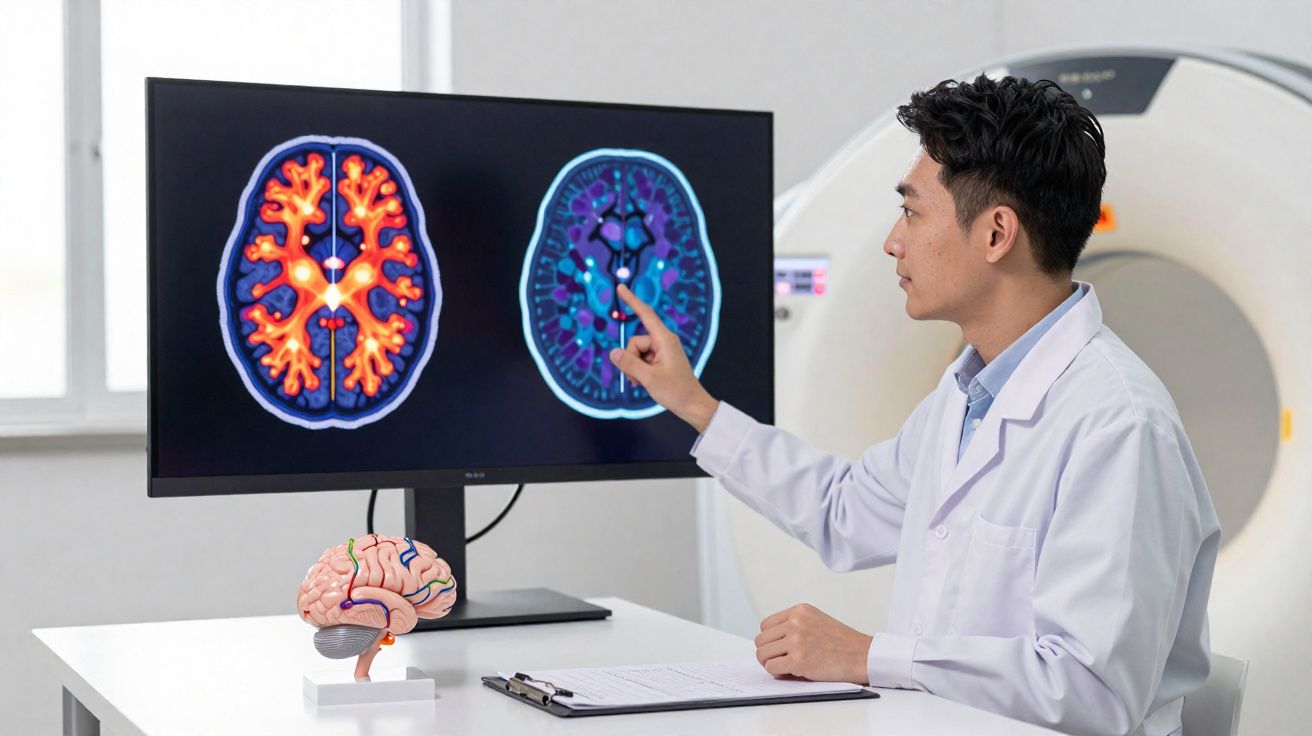
An international team of neuroscientists has analysed brain scans from men showing pronounced psychopathic traits. The researchers identified clear alterations in brain areas that would usually restrain impulses, regulate emotions and weigh up the consequences of actions. That offers a fresh perspective on why some people act without scruples - and why others, despite similar predispositions, live outwardly unremarkable lives.
What the study examined in practice
To carry out the research, the scientists used high‑resolution MRI scans. In total, 39 men took part; they were either in psychiatric institutions or living in the community under supervision. Every participant was assessed using an established psychopathy test that captures a range of characteristics, including impulsivity, aggression, lack of remorse and superficial charm.
The team then compared the men’s brain structure across high and low psychopathy scores. Their focus was deliberately placed on regions linked to decision‑making, emotional processing and self‑control.
"The more pronounced the impulsive and antisocial traits, the smaller certain brain areas were."
This specific link between behaviour and brain structure is what makes the findings so striking. It supports the idea that, for many people with psychopathy, the issue is not simply a “character flaw”, but a deeply rooted biological difference.
The affected brain regions in detail: psychopathy and the fronto-subcortical network
Several areas within the so‑called fronto‑subcortical network showed reduced volume. In particular, these included:
- Orbitofrontal cortex: plays a pivotal role in judging consequences and rewards.
- Thalamic nuclei: key relay stations that pass information between different brain regions.
- Brainstem: involved in basic response patterns and activation of the nervous system as a whole.
Under normal circumstances, these regions work together to hold us back when we are about to do something dangerous, antisocial or morally questionable. They help us gauge risk and suppress inappropriate impulses.
"Disruptions in these circuits can mean that the internal 'stop mechanism' is less effective."
If someone has less brain volume in these areas, they may respond more rashly, seek stronger stimulation and be more prone to aggressive or reckless behaviour.
Two faces of psychopathy: impulsive versus cold
One particularly notable result was that not every aspect of psychopathy mapped onto brain structure with the same strength. The researchers broadly separated traits into two clusters:
- Impulsive, antisocial traits - such as unreliability, rule‑breaking, aggressiveness and a tendency towards criminal offending.
- “Cold” personality features - including low empathy, minimal guilt, shallow emotions and a manipulative interpersonal style.
For the first cluster - the impulsive, antisocial side - the relationship with structural differences in the brain was clear. The stronger these behavioural patterns, the more pronounced the volume changes found in fronto‑subcortical networks.
By contrast, the second cluster - the emotionally “cold” traits - was much harder to read from brain structure. Here, the researchers did not observe an equally clear and robust association with specific regions.
"‘Rash action’ leaves a clearer trace in the brain than ‘ice‑cold calculation’."
This split suggests psychopathy is not a single, uniform phenomenon. Different components appear to rest on different biological foundations - or may be shaped more strongly by environment, upbringing and learning experiences.
Brain differences do not automatically mean criminal behaviour
A particularly sensitive question follows: does a changed brain inevitably mean a person will become dangerous? The answer offered by the researchers is explicitly nuanced. They stress that brain scans do not allow a straightforward “crime prediction”.
They even point directly to the idea of so‑called “successful psychopaths”. This refers to people who show strong emotional or manipulative traits yet move through society in a socially adapted way. They are not in prison; instead, they are often found in high‑pressure, high‑power roles - for instance in management, finance, or high‑risk service jobs.
Such individuals may present as cool, calculating and charming while largely staying within legal boundaries. In that sense, the study supports the view that risk and real‑world behaviour depend on many factors, including:
- individual brain structure
- upbringing and early childhood experiences
- social environment and role models
- intelligence and education
- overall life circumstances, such as stress, poverty or drug use
What neuroscience can (and cannot) say about people with psychopathy today
Modern imaging gives researchers an increasingly detailed view of the human brain. In psychopathy research, a recurring pattern is often discussed: an imbalance between “emotional alarm centres” and the controlling regions in the frontal lobes.
Put simply, in many affected individuals the part of the brain that registers looming punishment and signals fear appears to function differently. At the same time, the frontal “brake” can be less strongly expressed. This combination may make rules less deterrent and short‑term gains more tempting.
At the same time, specialists caution against overly simple conclusions. A smaller brain area does not automatically indicate a disorder. The brain compensates for many things through other networks, and a great deal of variation is entirely natural. Only by combining imaging with behavioural testing, personal history and environmental context does a meaningful overall picture emerge.
What this kind of brain insight could mean in everyday life
For society, the findings raise uncomfortable questions. If some people carry a higher baseline risk for reckless behaviour, what is a fair response? Criminal justice, psychiatry and ethics have debated for years how far biological factors should influence sentencing decisions and treatment approaches.
One clear advantage of this line of research is that it may help tailor interventions more precisely. If it is known which brain networks are weaker, training programmes for impulse control, emotion regulation or perspective‑taking can be designed more specifically. Early approaches - for example, cognitive training or specialised psychotherapy - aim directly at these functions.
Prevention also comes more sharply into view. Marked impulsivity and early behavioural problems in children are seen as warning signs. If families receive support early - through parenting guidance, help at school or therapeutic services - the risk of later offending can be reduced substantially.
Key terms explained briefly: psychopathy and brain networks
The term psychopathy describes a personality pattern combining emotional coldness, egocentricity, superficial charm and, in some cases, serious rule‑breaking. Not everyone with these traits becomes criminal, and not every offender is a psychopath.
Fronto‑subcortical networks connect frontal brain regions with deeper nuclei inside the brain. They are central to:
- planning and thinking ahead
- evaluating reward and punishment
- inhibiting spontaneous impulses
- adapting to social rules
Disruptions in these networks are not unique to psychopathy; they also appear in other conditions, such as ADHD or certain addictive disorders. However, the precise patterns differ depending on the condition.
In the end, one sober but important point remains: an unusual brain does not automatically make anyone a monster. It indicates, rather, that some people move through life with a more difficult “starting package” - and that society and research should use this knowledge responsibly.






Comments
No comments yet. Be the first to comment!
Leave a Comment