
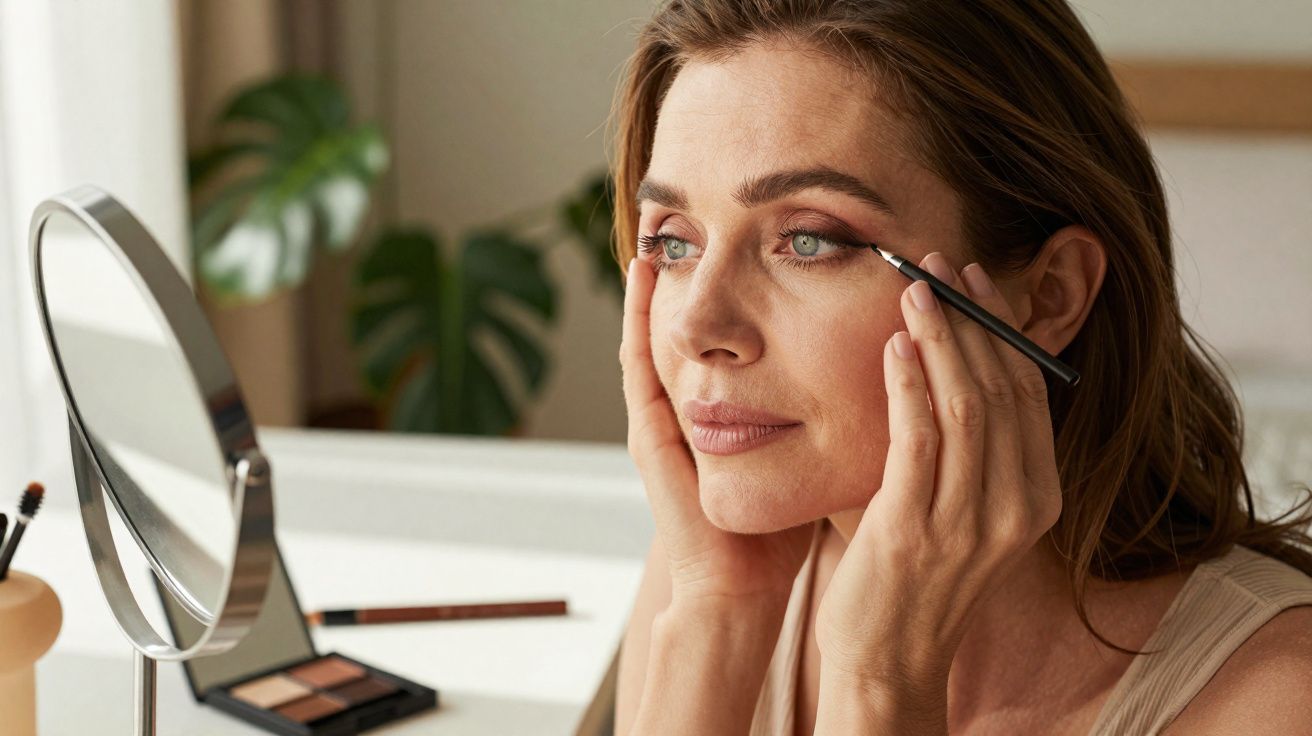
Many women notice, around the age of fifty, that the upper lid starts to feel heavier and the mobile lid all but disappears. Suddenly, the make-up routine that used to work no longer behaves: eyeliner transfers, eyeshadow settles into fine lines, and the whole look can feel less polished. With a handful of easy, pro-level tweaks, you can make drooping eyelids look visually lifted and your overall expression appear fresher - without going anywhere near a scalpel.
Why eyelids start to “droop” after 50
As the years pass, skin loses elasticity and collagen. The change tends to show first in the finest areas - especially around the eyes.
- The skin on the upper lid becomes thinner and softer.
- The fixed (upper) lid can fold over the mobile lid.
- The lash line can look shorter and less visible.
- Your gaze may appear tired, sometimes even “sad”.
If you continue applying make-up exactly as you did at 30, it often (unintentionally) emphasises the issue: eyeshadow creases, eyeliner “kinks” where there’s extra skin, and mascara can stamp onto the upper lid.
“Targeted make-up adapts the technique to the new eye shape - and can visibly lift drooping eyelids.”
Trick 1 for drooping eyelids: prep the upper lid with a matte base before anything slips
This step may sound basic, but it largely determines whether your look lasts two hours or all day. Drooping eyelids usually mean more creasing - and often a little more oil on the skin.
Prepare your lids like this:
- Apply a tiny amount of eyeshadow primer or concealer in a thin layer across the entire upper lid - up to the brow bone.
- Set it with a translucent powder or a matte, skin-toned eyeshadow.
- Powder especially well where creases form when your eye is open.
This makes the surface look smoother. Eyeliner and eyeshadow grip better and are less likely to gather in lines. The upper lid also appears a touch “lighter”.
Trick 2: rethink eyeliner - adapt the line to your creases
The classic youthful “wing” is often barely visible after 50 because the skin simply bends the liner out of shape. A technique developed by a well-known make-up artist for very hooded, drooping eyelids helps here.
No pulling, no stretching - keep the eye relaxed
Many people tug the skin at the outer corner upwards to make the line look “straighter”. Going forward, it’s better to avoid this. The moment you let go, the skin drops back and the liner can look broken or jagged.
Instead:
- Keep your eye naturally open and look straight into the mirror.
- Tilt your head slightly back so you’re looking directly at the upper lid area.
- Don’t tighten the skin - work with how your eye looks in real life.
The dot just below the crease: a small tweak with a big effect
Rather than placing the wing right into the crease, position it a fraction underneath. The eye looks lifted, and the liner doesn’t disappear into the excess skin.
Step-by-step:
- Using a soft pencil liner or gel liner, draw a thin line close to the upper lash line - stopping just before the outer corner.
- Keep one eye naturally open and add a small dot at the outer end of the line, placed just below the crease.
- Connect the dot back to the lash-line liner, creating a short, slightly upward “mini wing”.
- If needed, soften the join with a fine brush so the transition stays smooth.
“The trick: the tip of the eyeliner sits under the crease and doesn’t get kinked - the eyes look brighter, even though the line is very subtle.”
If you’re not confident doing it in one stroke, use several short strokes and join them up. Small mistakes are easy to correct with a cotton bud and a little cream.
Trick 3: place eyeshadow with intent, rather than painting over everything
With drooping eyelids, a heavy block of colour rarely helps - in fact, it can make the eye look smaller. A few well-placed zones are far more effective.
A simple, everyday approach:
- Light, matte shade on the mobile lid and slightly above it - this opens the eye.
- Mid-tone, neutral shade slightly above the natural crease, blended out towards the temple. This creates a “new”, visually higher crease.
- Deeper shade kept close to the outer lash line and smudged gently upwards - don’t drag it down.
Key point: glitter right in the crease highlights fine lines. Matte or lightly satin finishes are more flattering. Keep blending soft so the lift looks gentle rather than harsh.
Trick 4: eyebrows as a natural mini-lift for drooping eyelids
This is the factor many people underestimate: brow shape has a huge impact on how open the face looks. One experienced make-up artist puts it plainly: “A large part of the work with drooping eyelids is in the brows.”
A lifting effect by creating more space under the brow
The aim is to create as much “air” as possible under the brow without making it look artificial. Here’s how:
- Brush the brows downwards first - this shows you exactly where the gaps are along the top.
- With a fine brow pencil, sketch in only the missing hairs along the upper area (don’t colour in a solid block).
- Brush the brows upwards again to reveal the natural lower edge.
- Fill only where there are genuine gaps, and do it lightly.
If you draw brows too strongly and too low, you visually “push” the eye down. Slightly lifted, naturally filled brows act like a small lift.
Finish with a clear brow gel to softly set the hairs upwards. This automatically creates more space between lid and eyebrow, making the eyes look clearer and more youthful.
Which products make sense for mature eye areas
If your skin is more sensitive and mature, it’s worth paying close attention to texture and finish.
- Eyeliner: Gel or cream liners are often easier to control than very stiff felt-tip pens. Dark brown reads softer than deep black.
- Eyeshadow: Matte or satin tones flatter fine lines more than chunky shimmer. Light, cool shades can help neutralise redness.
- Mascara: Curling lashes before mascara adds extra lift. Waterproof formulas help prevent transfer onto the upper lid.
- Brow pencil: Choose a fine tip, long-wearing formula, and lean towards ashier shades so it doesn’t look “drawn on”.
If your eyes water easily, it’s best to trial new products at home first. That way you can see whether they truly stay put without smudging.
Risks and limitations: what make-up can do - and what it can’t
Make-up creates optical illusions, but it doesn’t replace medical treatment. With very pronounced excess skin, eyeshadow may still collect in the crease, and eyeliner can remain visible only from certain angles.
A few things to keep in mind:
- Avoid rubbing your eyes - it irritates delicate skin and can speed up fine-line formation.
- Remove make-up gently using an oil-based cleanser or balm instead of vigorous rubbing.
- Introduce new products in small amounts first to reduce the risk of irritation.
If you’re struggling with severely drooping eyelids that encroach on your field of vision, you may also want advice from an ophthalmologist or dermatologist. For many, though, a smarter make-up approach is enough to feel more comfortable again when looking in the mirror.
How to combine the four tricks in everyday life
These techniques can be mixed and matched depending on how you feel and what the day calls for. On a rushed work morning, two steps are often enough: a mattified lid and slightly lifted brows. For an evening plan, add a soft mini-wing eyeliner plus a touch of deeper shadow at the outer lash line.
If you feel unsure at first, practise on a quiet afternoon with no time pressure. After a few attempts, most people work out exactly which angle suits the eyeliner tip and which brow shape gives the strongest lifting effect. Taking quick before-and-after photos can help you judge the result realistically and refine your routine step by step.




Comments
No comments yet. Be the first to comment!
Leave a Comment