
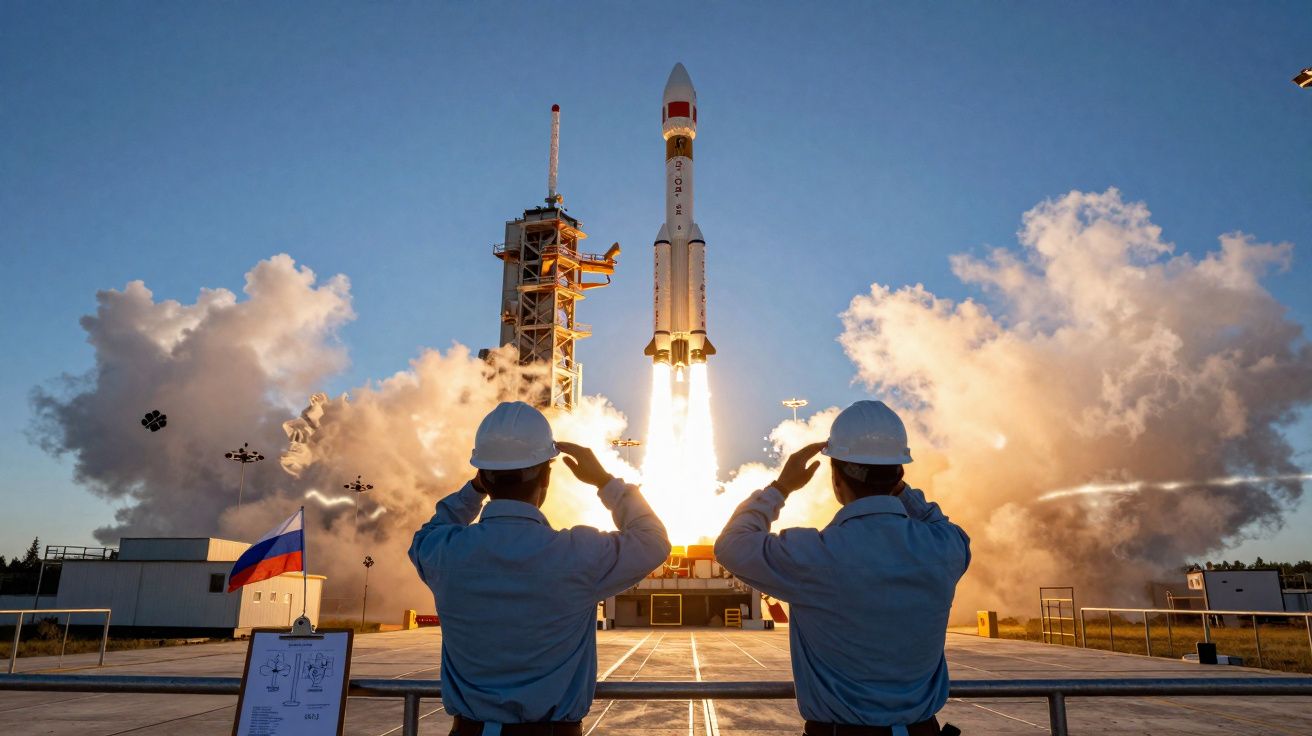
First launch from Baikonur in three months
A Soyuz-2.1a launch vehicle lifted off successfully from the Baikonur Cosmodrome, carrying the Progress MS-33 cargo spacecraft bound for the International Space Station (ISS). The launch took place on 22 March at 15:00 Moscow time. Separation of the first stage occurred as planned, and the payload fairing also detached normally.
The mission was carried out from the Site No. 31 launch complex following extensive refurbishment. The Soyuz-2.1a, developed by the Progress Rocket Space Centre, uses kerosene and liquid oxygen. Its launch mass is approximately 306–310 tonnes, and its height without the head section is 33.9 metres.
Progress MS-33 is scheduled to deliver 2,509 kg of supplies to the ISS. This includes 1,211 kg of dry cargo for the crew and station systems, 828 kg of fuel for refuelling, 420 kg of drinking water, and 50 kg of oxygen to replenish the station’s atmosphere. The spacecraft is also carrying equipment for the scientific experiment “Sun–Terahertz”.
The trip to the station will follow a two-day flight profile and will last 49 hours 35 minutes. Over this period, Progress MS-33 is expected to complete 34 orbits of Earth. Docking with the ISS is planned for 24 March at 16:35 Moscow time, with the spacecraft set to berth at the Poisk module.






Comments
No comments yet. Be the first to comment!
Leave a Comment