
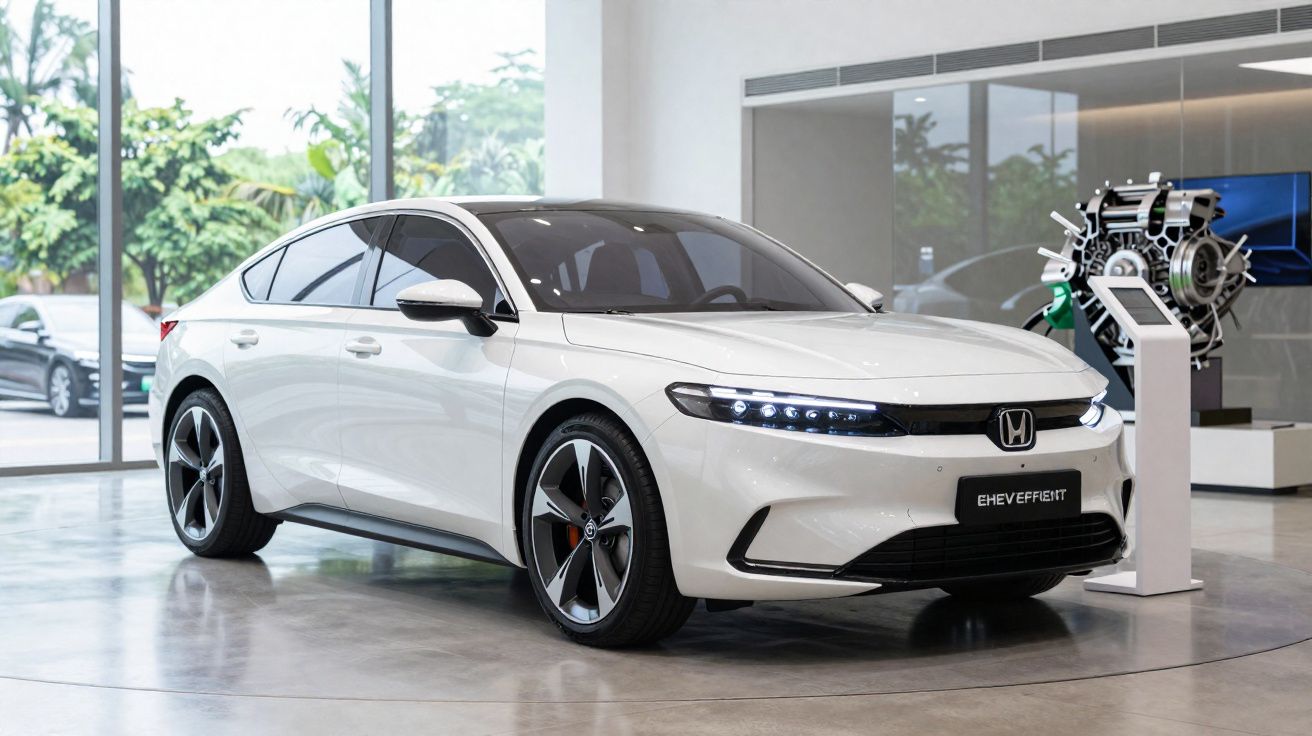
Fully electric vehicles are not getting the reception many expected. Honda is the latest manufacturer to take a step back and adjust its strategy, shifting investment towards the technology that is gathering momentum: hybrids.
Between 2027 and 2030, the brand will introduce 13 new hybrids which, it says, will help it get through this transition period on the road to 100% electric mobility. Even so, Honda continues to believe that electric cars are the ideal solution for achieving long-term carbon neutrality.
This new generation of hybrids is not a complete surprise - it had already been announced - but we now know they will feature what Honda describes as the “most efficient combustion engine in the world”.
More efficient e:HEV system, with Honda at the centre
There are still plenty of unknowns, including which model will debut the new powertrain. What is confirmed is that it will be offered in two versions: 1.5 litres and 2.0 litres - the same displacements found in today’s Jazz and Civic.
It remains unclear whether these are entirely new engines or evolutions of the current units, but Honda is unequivocal about one point: they will be significantly more efficient.
If we focus purely on petrol engines, efficiency is hardly a unique selling point. Toyota’s Dynamic Force engine family - 2.0 litres and 2.5 litres - currently claims the highest thermal efficiency, at 40% or 41% when used within a hybrid system. The manufacturer is already working on a new generation of engines that should be even more efficient, while also delivering stronger performance.
Nissan, meanwhile, is developing a petrol engine with 50% thermal efficiency - well above that of today’s diesel engines - but it will operate only as a generator in hybrid systems, meaning it is not connected to the wheels. That specialised role, which confines operation to a narrow (and most efficient) rev range, is one of the keys to reaching 50%.
Honda’s approach is different. Its hybrid setup is series-parallel, which means that, in certain driving scenarios, the combustion engine provides propulsion - will that continue in the next generation?
To improve efficiency, Honda says these engines will be able to operate at peak efficiency across a wider range of engine speeds. As an example, the Japanese brand says the 1.5-litre unit will deliver its maximum torque over a rev band expanded by 40%, without harming performance. Honda also promises it will have “the best thermal performance on the market”.
Cost reduction is guaranteed
Alongside the more efficient petrol engine, Honda says the electric drive unit within the hybrid system will also be lighter and more compact than current versions. In addition, the new hybrid system will debut on a new platform, which should cut vehicle weight by 90 kg. Taken together, Honda is targeting a 10% reduction in fuel consumption.
There are further assurances on the manufacturing side. Honda says the 13 models planned for 2027 to 2030 will be cheaper to build, helped by sharing at least 60% of their components and by cutting production costs of the new hybrid system by 30%.
Although it has revised down its planned investment in electric vehicles, Honda still views 100% electric cars as an essential part of its future strategy.
For now, however, the brand intends to rely on hybrids to navigate this “transition period” until full electrification becomes a reality.
As Toshihiro Mibe, Honda’s Chief Executive Officer, stated, the aim is to offer a broad, competitive hybrid line-up while simultaneously preparing the ground for electric vehicles to become truly mainstream.






Comments
No comments yet. Be the first to comment!
Leave a Comment