
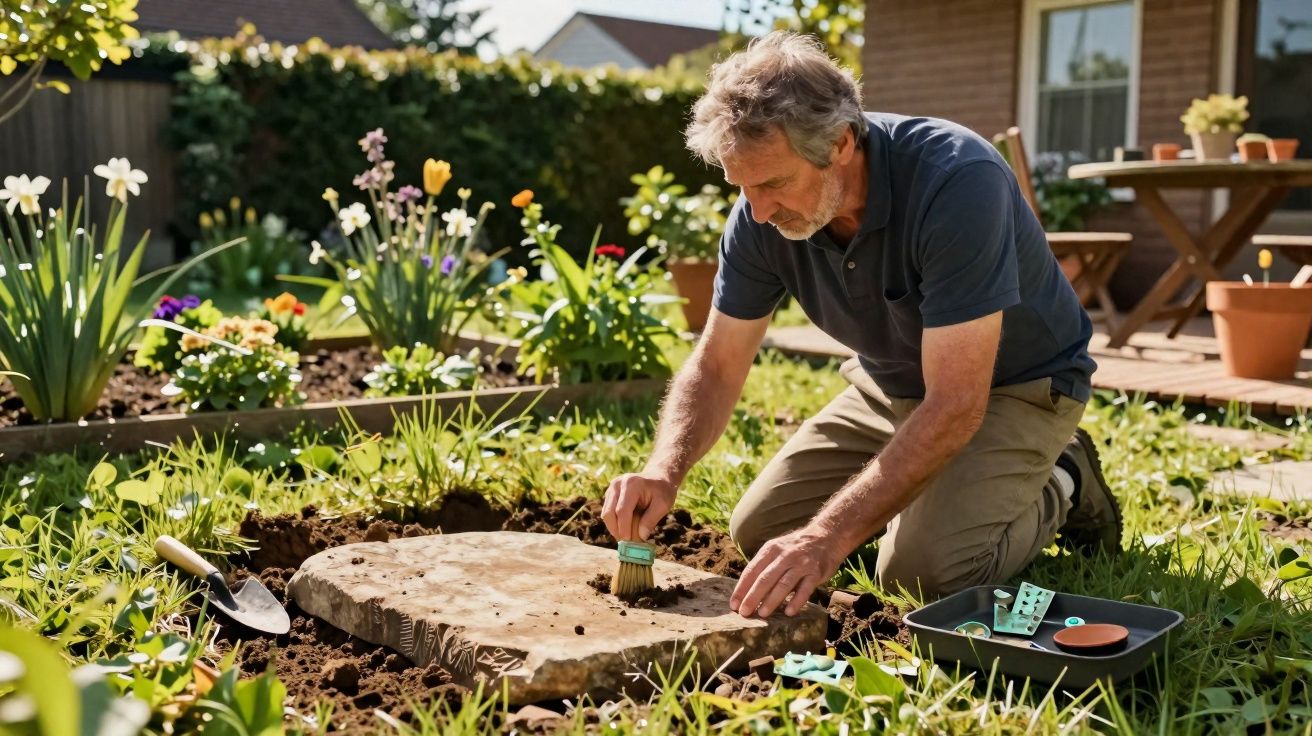
What a farmer in South Moravia used as a practical base stone for his barn has turned out to be an archaeological rarity. The unremarkable slab dates to the late Bronze Age, is around 3,300 years old, and offers a window into a dense web of trade, technology and warfare in Central Europe.
Village-garden discovery in Morkůvky: from barn stone to research treasure
The story starts in 2007 in the small village of Morkůvky in South Moravia, in what is now the Czech Republic. A local resident notices a rectangular, grey stone slab protruding slightly from the ground in his garden. It has been there for years, helping to steady the foundations of his barn.
Its precise shape and crisp edges strike him as unusual. He lifts the slab out and keeps it-without any idea what he is holding. It is not until 2019 that he takes the piece to the Moravian Museum in Brno.
There, archaeologist Milan Salaš examines the stone more closely. It quickly becomes clear this is not an ordinary building stone or fieldstone. The surface bears a carefully carved recess: the silhouette of a bronze spearhead, sharply defined.
The supposed barn slab turns out to be an exceptionally well-preserved casting mould stone for bronze spears from the late Bronze Age.
The slab is about 23 centimetres long, weighs roughly 1.1 kilograms, and is made of hard volcanic rock. For a long time it remained a locally known curiosity, until a research team investigated it systematically and published a detailed study in 2025.
How this stone was used to cast weapons 3,300 years ago
The find represents only one half of what was originally a two-part casting mould, also known as a matrix. Normally, two mirror-image stones are fitted tightly together so that a cavity forms between them, defining the shape of the weapon.
Analyses by Salaš’s team-including macroscopic inspection and measurements using X-ray fluorescence-provide a clear reconstruction of the working process:
- Both halves of the mould were set upright.
- A copper wire held the stones tightly together.
- Molten bronze was poured into an opening from above.
- The flow of metal completely filled the spearhead cavity.
The carved recess shows what is known as a “leaf-shaped spearhead with a socket”. In other words, the base of the point has a hollow tube so it could be fitted onto a wooden shaft. Longitudinal ribs run along both the blade and the socket. These reinforcements increased strength and improved penetration into the target.
Clear traces of intense heat and small chips are visible on the stone’s surface. This kind of damage occurs when a mould is repeatedly exposed to molten bronze. The researchers believe that “several dozen” spearheads were cast using this single matrix.
The stone documents an early form of serial production: one tool served to manufacture many largely standardised weapons.
Geology as detective work: the stone did not come from South Moravia
The most striking twist comes not from archaeology but from geology. Geologist Antonín Přichystal analysed the material using X-ray diffraction, allowing the mineral composition to be determined precisely.
The result: it is rhyolitic tuff-solidified volcanic ash. This rock type is known from specific areas of Hungary and neighbouring Slovakia, especially the Bükk Mountains in northern Hungary and the region around the town of Salgótarján.
Morkůvky, however, lies hundreds of kilometres away in South Moravia. There is no natural occurrence of this tuff in the local area. So the stone cannot have originated there.
That means someone transported the mould-or at least the raw material-over long distances. Without paved roads, without maps, without rubber-tyred wagons. The most likely scenario is that the stone moved from settlement to settlement through a chain of exchange partners until it reached Moravia.
The casting mould is therefore tangible proof of a well-organised long-distance trade network in Central Europe during the late Bronze Age.
What the casting mould reveals about Bronze Age traders and warriors
The find is placed within the context of the so-called Urnfield culture. This culture shaped large parts of Central Europe in the late 2nd millennium BC, stretching from Austria through Bohemia and Moravia to Serbia. It is characterised by the practice of cremating the dead and burying the bones in urns set into the ground.
Typical weapons of the period include precisely these ribbed spearheads-the type produced by the Morkůvky casting mould. They occur particularly in the Carpathian Basin. Their presence in South Moravia demonstrates how tightly interconnected these regions were, both militarily and economically.
Bronze Age warriors often carried several weapons at once: a shield, shin protection, a sword or dagger-and more than one spear. A thrown spear was often lost. Having a spare could decide between life and death. For chieftains and elites, it became essential to equip fighters quickly and reliably with similar weapons.
This is exactly where standard moulds like the Morkůvky stone come in. They make it possible to reproduce identical points comparatively quickly-an obvious advantage for groups that organised raids regularly or needed to defend territory.
More than just metal: what was traded
Transporting a specialised tuff stone also shows how specific the needs of craftspeople were. Not every random slab of rock was suitable for casting moulds. The material needed to:
- withstand high heat without cracking
- be worked with precision
- be as fine-pored as possible so the bronze could flow cleanly
Traders, metalworkers and rulers therefore relied on carefully selected raw materials. Alongside bronze, tin and copper, worked stone, salts, jewellery-perhaps also textiles and foodstuffs-circulated over long distances. The casting mould confirms one part of this wider system.
Why one stone can unsettle entire textbooks
The key point is that casting moulds like this are very rare in the Bronze Age archaeological record. Most often, only the finished metal objects are found. The tools used for production frequently do not survive in the ground, are smashed up, repurposed, or reused as building material in later periods-exactly as happened in Morkůvky.
With a casting mould from Hungary or Slovakia turning up in the Czech Republic, it becomes possible to demonstrate particularly clearly that:
- there were specialised centres for weapon manufacture
- long-distance trade routes existed as early as 1,300 BC
- military equipment was produced in standardised form
- geology and archaeology together can reconstruct detailed routes
The find therefore supports a picture of an early, complexly connected zone in the heart of Europe. Between the Carpathians, the Danube and the Alps, knowledge, technologies and goods circulated far more intensively than was assumed only a few decades ago.
What non-specialists can learn from the Morkůvky case
The stone shows how easily an important object can be overlooked in everyday life. Many discoveries reach museums only because private individuals stay alert and report unusual pieces rather than throwing them away or building them into garden features.
Anyone who comes across conspicuously worked stones, metal fragments or pottery sherds while walking, digging in the garden or doing building work should ideally:
- photograph the findspot as accurately as possible,
- not clean or sand the object,
- inform the relevant heritage authority or a museum,
- avoid any “tests” with a hammer or drill.
Especially with casting moulds or tool inserts, only a trained eye can recognise what something really is. Even small scratches or cracks can destroy vital traces.
A quick guide to key technical terms
| Term | Meaning |
|---|---|
| Bronze Age | Period between roughly 3000 and 1000 BC in which metal (especially bronze) dominated weapons and tools |
| Casting mould / matrix | A tool into which molten metal is poured to obtain standardised forms |
| Urnfield culture | Late Bronze Age culture in Central Europe marked by cremation burials in urns |
| Rhyolitic tuff | Consolidated volcanic ash from acidic lava; heat-resistant and easy to shape |
The Morkůvky stone is therefore not only a spectacular one-off find, but also a lesson in how the natural sciences and archaeology work hand in hand. From an apparently ordinary slab, a dense picture of trade routes, workshop expertise and warfare 3,300 years ago can be derived-and a chapter of early European history can be rewritten.






Comments
No comments yet. Be the first to comment!
Leave a Comment