
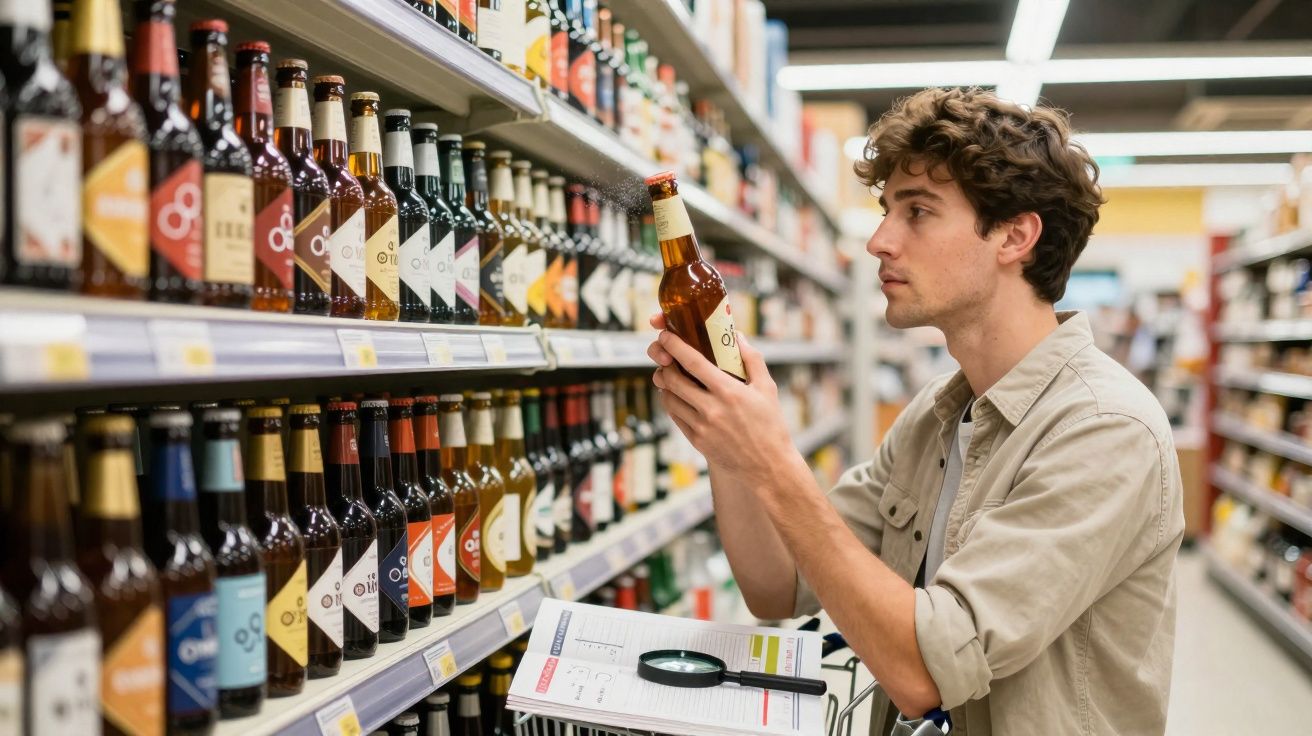
A chilled blond beer in front of the television, a football night with friends, a quick six-pack from the supermarket: for many people in France and Germany, beer is an entirely routine part of everyday life. A fresh analysis by the French consumer magazine “60 Millions de consommateurs” is now challenging that habitual purchase - and reveals that several major brands perform unexpectedly poorly in testing.
Consumer test finds traces of pesticides in beer
For its investigation, the “60 Millions de consommateurs” team had 45 beers that are especially frequently bought in shops analysed: 39 pale lagers and 6 wheat beers. In the laboratory, specialists screened for around 250 different pesticide molecules that can originate from the cultivation of barley and hops.
Result: pesticide residues were detected in 34 of the 45 beers tested - albeit at very low levels.
The findings also show that many bottles contain more than one substance. The most common was the controversial weedkiller glyphosate, alongside three other active substances from the fungicide group: boscalid, folpet and phthalimide. In total, 25 beers contained detectable traces of glyphosate.
Measured concentrations ranged from roughly 0.4 to just over 9 micrograms per litre. At the top sat a well-known abbey-beer brand: its pale version reached just under 9.3 micrograms per litre - the highest figure in the entire sample.
Health risk - or mainly a quality issue?
First, the reassuring part: according to the magazine, this is not acutely dangerous. The editorial team calculated how much a person would theoretically have to drink to exceed the maximum recommended daily intake for glyphosate. The outcome borders on the absurd: you would need around 2,000 litres per day of the most contaminated beer.
For that reason, the testers are not presenting this as an immediate hazard. Instead, they emphasise other concerns: the quality of raw materials, how traceable supply chains really are, and how much extra pesticide exposure can build up across everyday foods - from cereal products and vegetables through to drinking water.
The central message: pesticides simply do not belong in a pint glass - even when the amount remains legally unobjectionable.
Three familiar brands clearly underperform in the beer pesticide-residue ranking
In the overall results, three beers stand out for the wrong reasons. They score noticeably worse than the rest not only on pesticide readings, but also on transparency and value for money. The magazine advises against buying these beers regularly.
Brands singled out most critically in the test
- Affligem Blonde - a lager marketed as an abbey beer, produced on an industrial scale.
- Hoegaarden - a very well-known wheat beer.
- Itinéraire des Saveurs - a pale own-label beer from a major French supermarket group.
All three show above-average pesticide residues, with Affligem Blonde leading the field for glyphosate content. In addition, the testers point to further shortcomings:
- vague or overly brief information about the origin of the grains used
- labels that, according to the report, are difficult to read or potentially misleading
- prices that do not match the quality level implied by the marketing
Terms such as “monastery”, “abbey” or “tradition” create the impression of craft production and extra care with ingredients. In the view of consumer advocates, the lab results - combined with the rather thin information provided on the bottle - do not fully support that image.
Eleven beers had no detectable residues at all
The study also delivers a positive takeaway: 11 of the 45 beers analysed contained no detectable pesticide traces. Strikingly, this group includes some very large brands that are also found on German shelves.
Large-scale industrial production can apparently bring residue levels down substantially - at least for part of a brand’s range.
Among the beers that tested “clean” were, for example:
- Heineken lager
- Carlsberg
- 33 Export
These cases suggest that a mass-produced beer does not automatically mean higher pesticide residues. Clearly, significant gains can already be made through the selection of raw materials and suppliers.
How beer drinkers can make better choices in the supermarket
After reading the test, shoppers face an obvious practical issue: standing in front of the shelves, you cannot see glyphosate or boscalid. Even so, there are ways to tilt the odds in your favour.
Four signs worth checking on the label
- A short, clear ingredients list: water, malt, hops, yeast - the more straightforward, the better. Any additives or flavourings should be explicitly stated.
- Transparent origin information: mentions of regional barley, hops from specific growing areas, or named partner farmers indicate a degree of accountability.
- Match price to substance: a high price and elaborate “tradition” styling say nothing about how clean the raw materials are. Comparing the price per litre helps.
- Organic certification as a guide: organic producers are only allowed very limited use of chemically synthetic pesticides. However, it does not guarantee zero residues.
One additional principle remains familiar: less is more. Drinking beer in moderation reduces not only alcohol strain on the body, but also any potential intake of contaminants - whether pesticides, fusel alcohols or other trace substances.
Glyphosate, fungicides & more: what is actually behind these names?
To non-specialists, many terms in the study sound like laboratory jargon rather than something connected to brewing. A brief overview makes the classification easier.
| Active substance | What it is used for in farming | Why it can end up in beer |
|---|---|---|
| Glyphosate | Weedkiller on fields, often used before sowing or to clear fields | Dissolved residues can reach the barley that is later turned into malt |
| Boscalid | Fungicide against fungal diseases in various crops | Protects cereal plants and can deposit on the grain |
| Folpet | Widely used fungicide in fruit and wine-growing, and partly in arable farming | Residues can remain on the plant and survive processing in detectable form |
| Phthalimide | Breakdown product of certain fungicides | Forms when other active substances degrade and then appears as a trace in the final product |
Permitted limit values are based on toxicological studies and sit well above the quantities measured in beer. As a result, the debate is less about a sip or a bottle, and more about the cumulative effect of many small contributions across the whole diet.
What German consumers can take from the French study
Most of the beers analysed come from French supermarkets. Even so, the underlying question translates easily to Germany: how transparent are the big brewing groups? How strictly do retailers monitor their own-label products? And how clean are multi-country raw-material chains when barley comes from Eastern Europe, hops from Germany and bottling happens in Belgium?
For domestic breweries, the study may serve as a prompt to measure pesticide levels proactively and communicate results openly. Some craft breweries already promote regional organic barley or contracts with specific farmers. Anyone choosing such a product often pays more, but will usually get clearer origin details and a closer link to the agriculture behind it.
Consumers, in turn, can adjust purchasing habits step by step: try a beer with an organic label, test regional brands, ask the brewery from time to time, or read lab reports published on brewery websites. Questions like these create pressure - and in the food sector, that kind of pressure often leads to improvements faster than any advertising campaign.






Comments
No comments yet. Be the first to comment!
Leave a Comment