
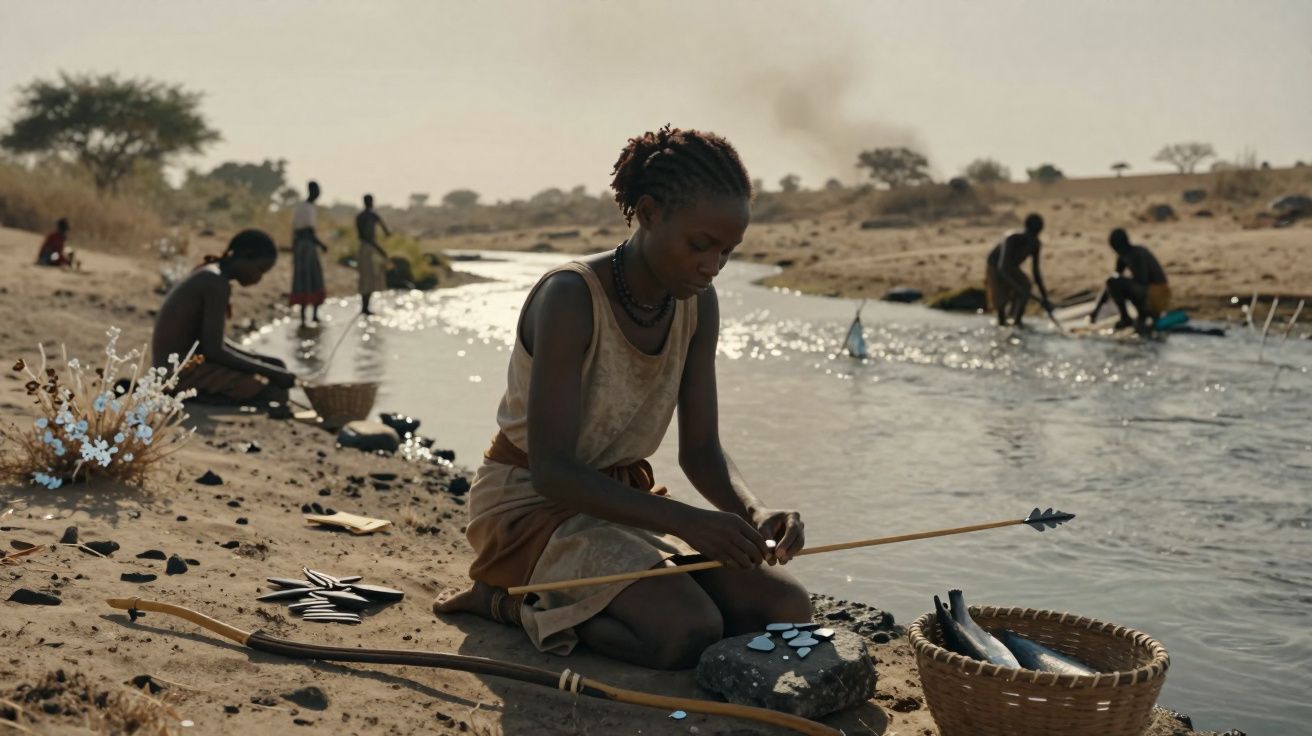
Around 74,000 years ago, the Toba supervolcano on what is now the Indonesian island of Sumatra blasted so much material into the atmosphere that large parts of the planet were pushed into a climate crisis. Many researchers have argued that nearly all early humans died during this period-perhaps leaving only about 1,000 breeding individuals. New discoveries from Ethiopia now outline how some people made it through the disaster: they radically reshaped their diet and tracked dwindling rivers as if following a final lifeline.
Shinfa-Metema 1 in Ethiopia reveals a story of survival
In north-west Ethiopia lies the archaeological site known as Shinfa-Metema 1. Here, archaeologists uncovered a tightly packed record of life: stone tools, animal bones, traces of hearths, and fine signatures of volcanic ash. Taken together, these finds point to a community that stayed put even as conditions around them became far harsher.
"Instead of fleeing or dying out, the people stayed where they were-and consistently changed what and how they hunted, gathered and cooked."
In many cases, researchers expect major environmental upheavals to trigger abandonment of settlement sites. At Shinfa-Metema 1, however, occupation remained steady. That continuity is exactly what makes the site so informative: it offers a close-up view of the decisions people made when their surroundings abruptly turned much more unforgiving.
Ash fall from Indonesia-and a sudden shift to a much drier climate
Microscopic glass fragments preserved in the sediments-so-called cryptotephra-show both the age of the layers and where the ash originated. Scientific analyses link them clearly to the Toba eruption and place the archaeological sequence at roughly 74,000 years ago.
Researchers also examined ostrich eggshells from the same layers. Their chemical signature is highly sensitive to aridity. The result was striking: immediately after the ash arrived, the dryness indicator jumped sharply upwards. The dry season lengthened, and rainfall became less reliable.
Because the eggshells form during a single laying period, the climate shift must have arrived very quickly-on the scale of years rather than centuries. For people living there at the time, this was not a slow drift but a tough, sudden stress test.
From antelope hunter to river specialist: Shinfa-Metema 1 after Toba
Before the climate intensified, people at Shinfa-Metema 1 mainly hunted antelope and other land animals, supplemented by fish, monkeys and small game. The animal bones provide a clear picture of what was on the menu.
After the Toba phase, the balance changed dramatically:
- Share of fish among the animal remains: increase from about 14% to around 52%
- Land animals: marked decline
- Bones with cut marks and burn marks: still present, but with a different range of species
The community leaned far more heavily on what the reduced river system could still supply: fish, animals concentrating at the last water sources, and likely edible plants growing near the banks. Cut marks and charred fragments indicate that prey was butchered on site and cooked using controlled fire.
"Survival here did not mean a heroic solo act, but a series of small, pragmatic adjustments in everyday life."
Stone Age high-tech: tiny arrowheads as a game-changer after the Toba eruption
Among the stone tools, one set stands out-minute, triangular points. Their size and patterns of damage fit projectiles launched at high speed, very likely early arrowheads.
A team led by anthropologist John Kappelman of the University of Texas at Austin argues that such projectiles would have given hunters clear advantages:
- Greater distance from the animal, reducing risk to the hunter
- Higher success rates with smaller, faster prey
- More efficient use of energy at a time when food was scarce
Earlier finds from South Africa had dated the use of modern long-range weapons to about 71,000 years ago. Shinfa-Metema 1 could push that boundary slightly further back. In a period of shortage, any technical improvement that raises the odds of a hit can be decisive.
Shrinking rivers as a forced route
In dry regions, seasonal rivers do not simply vanish everywhere at once. Instead, they break up into chains of small waterholes. These remaining pools concentrate life: thirsty animals, fish trapped in residual ponds, and people searching for food.
If a group hunts and gathers too intensely around one waterhole, resources are quickly depleted. The next option is the next pool upstream or downstream. Over time, this creates a sequence of short moves that can carry people step by step away from their original settlement area.
"The river becomes an invisible guide rail: it dictates where anything can still be harvested or hunted-and therefore where people go."
This pattern may have played a key part in early human movements. For a long time, many models assumed that migration was mainly enabled by wetter “green corridors”. The Ethiopian evidence supports a different scenario: severe droughts can also compel people to travel long distances, pushed along thinned-out river networks.
No global volcanic winter-yet severe regional breaks
Earlier theories painted Toba as an almost total catastrophe that triggered a bottleneck in human history: only a tiny group survived, genetic diversity collapsed, and nearly everything was wiped out. More recent African evidence refines that picture.
For instance, a sediment core from Lake Malawi shows no sign of a pronounced “volcanic winter” in East Africa. Other sites likewise suggest that impacts varied greatly by region. Shinfa-Metema 1 now adds a scenario from a dry river system to this wider puzzle.
For the bigger picture, this implies that people came under extreme pressure, but not equally everywhere. Some groups likely died out, others diminished, and a few adapted successfully-forming the small remnant from which later populations developed.
Those who survived shaped everyone who followed
Genetic studies suggest that the number of breeding humans in that era fell to roughly 1,000. This bottleneck does not mean that only 1,000 individuals were alive, but that genetic diversity was equivalent to roughly that many people. Anyone within that surviving remainder therefore indirectly influenced the traits of all later humans.
The researchers stress that the inhabitants of Shinfa-Metema 1 were not necessarily the direct ancestors of all people living today. Even so, the site offers a vivid illustration of capabilities that would have separated life from death at the time:
- Flexible switching between food sources
- A technical edge in hunting (for example, bow and arrow)
- Willingness to leave a familiar place when resources run out
Any group that later left Africa and spread across Eurasia would have needed a behavioural toolkit of this kind.
Why this discovery is archaeologically so rare
Very few sites combine three elements within a narrow time window: clearly datable volcanic ash, remains of hunted animals, and evidence for complex hunting technology. Shinfa-Metema 1 delivers precisely that combination. As a result, a single archaeological archive can show how one community responded to an abrupt environmental crisis.
"The value of the site lies not only in whether people survived, but in how they survived."
Rather than piecing together comparisons across many distant locations, researchers can reconstruct a connected sequence here: climate shock, a drying river, a shift in diet, fine-tuning of hunting technology, and gradual relocation along the riverbed.
What we can learn today from the supervolcano shock
Even if that ancient situation cannot be mapped directly onto today’s crises, it still carries a timeless message. Human groups endured extreme periods not because the environment treated them kindly, but because they reacted quickly, spread risks, and exploited new resources.
Terms like “bottleneck” may sound clinical, yet they describe dramatic realities: when a species comes close to extinction, a few generations can decide whether it disappears or persists in a smaller, tougher form. For global issues such as climate change or food security, these prehistoric stress tests remain worth studying.
A practical present-day parallel: in many dry regions, people protect their livelihoods by rotating seasonally between herding, fishing and small-scale farming. That multi-track approach is strikingly similar to the flexibility shown by the inhabitants of Shinfa-Metema 1. Having more than one strategy ready makes it less likely that a community ends up trapped when conditions fluctuate.
The Toba eruption therefore stands as a brutal natural experiment conducted on our own species. Most early humans died; perhaps only a genetic residue of around 1,000 individuals remained. That we are here today owes much to those who, beside a drying river in Ethiopia, caught fish, sharpened arrows-and simply refused to give up.






Comments
No comments yet. Be the first to comment!
Leave a Comment