
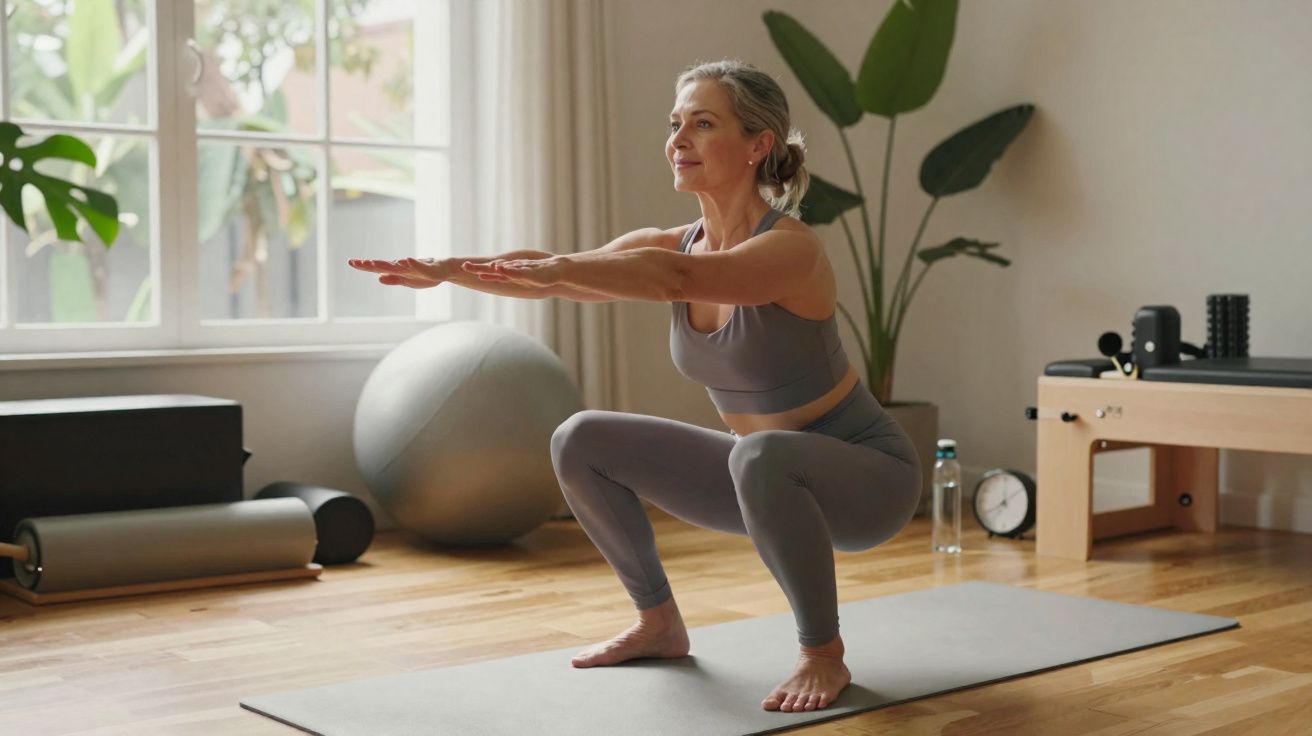
Over 50, many people notice it first when rising from the sofa or lowering themselves into a chair: you need more strength, and movements can start to feel a little heavier and less fluid. While it’s easy to assume the answer is an expensive gym membership or punishing workouts, many sports coaches highlight a simple, free movement classic instead - a Pilates-based squat variation that needs no equipment and can be done at home every day.
Why a simple squat becomes so powerful as we age
What the gym calls a “bodyweight squat” is already built into everyday life: every time you sit down and stand up, you’re essentially doing a squat. From a chair, the sofa, the toilet, getting out of the car - the body repeats the same pattern over and over. And later in life, that capability often determines whether someone stays independent or starts relying on support.
"Anyone who can still sit down safely and stand back up well into old age protects their day-to-day independence far more effectively."
As the years pass, the body naturally loses muscle mass - especially in the legs and glutes. That can make stairs, carrying shopping, gardening and even short walks feel more demanding. Strong, well-trained leg and glute muscles help counteract that decline. A daily squat builds exactly that reserve of strength - no marathon training and no kit-filled home gym required.
Coaches also stress an important point: the best results don’t necessarily come from the toughest sessions, but from movements that transfer directly to daily life. This is precisely where Pilates fits. The method blends mindful breathing, accurate joint alignment and controlled, functional movement - and a bodyweight squat slots neatly into that approach.
Pilates squat: what it actually does inside the body
The Pilates version of the squat doesn’t just challenge the big muscles; it also helps stabilise the body as a whole. With regular practice, it particularly develops:
- Thigh muscles: support climbing stairs, standing up and longer walks
- Glute muscles: stabilise the pelvis and ease strain on the lower back
- Calf muscles: help with balance and steadiness on your feet
- Core (abdominals and deep trunk muscles): promotes an upright posture and protects the spine
- Joint tracking in hips, knees and ankles: reduces poor loading patterns and helps prevent pain
There’s another benefit, too: performing the movement slowly and with control improves how your nervous system and muscles work together. That sharpens coordination and therefore also supports fall prevention - a major health factor from 60 onwards.
How to do the Pilates squat correctly after 50
Technique is what matters. Done poorly, squats can irritate the knees; done well, they can strengthen them. A basic version often recommended by Pilates coaches looks like this:
Starting position: stand securely, align neutrally
Stand tall. Place your feet roughly hip-width apart, with toes pointing slightly forwards. Spread your weight evenly through the whole foot - heel, ball of the foot and toes. Keep pelvis and spine neutral and upright, with your gaze forwards.
Let your arms rest by your sides to begin with. Lightly engage your core, as if gently drawing your navel towards your spine. Breathe steadily in and out without lifting your shoulders.
The descent: bend with control
Breathe in, keep your torso steady, then slowly bend at the hips, knees and ankles. Think about sending your hips back as though you’re sitting onto an imaginary chair. This helps stop the knees drifting too far forwards.
If it makes the movement easier, reach your arms forwards - it acts as a counterbalance and improves stability. Keep your knees broadly tracking towards your toes without collapsing inwards. Maintain a long, straight back; avoid rounding.
The rise: strong, without momentum
Breathe out, press your feet firmly into the floor and return to standing. Drive the movement from your legs and glutes, not by using momentum. Let your arms lower back to your sides.
As a guideline, many coaches suggest three rounds of 12 to 15 repetitions. Beginners can start with 8 clean repetitions. Quality matters more than quantity.
Tips for beginners and anyone with discomfort
If you haven’t exercised for a long time, or you already deal with knee, hip or back issues, begin especially cautiously. Often, small tweaks are enough to make the movement work well.
| Problem | Practical adjustment |
|---|---|
| Feeling unsteady with balance | Lightly hold the back of a chair or a table |
| Knee pain | Only squat as far as you can without pain; send the hips further back |
| Weak back | Shorten the range of motion, consciously lift the breastbone, increase abdominal engagement |
| Strong general insecurity | Start by sitting down onto a chair and standing up again without momentum - this also counts as a squat |
If you’re unsure, have your technique checked once by a physiotherapy clinic or an experienced Pilates instructor. A quick outside look can prevent compensations that might otherwise become habits.
How often squats can help - setting realistic goals
To see measurable change, the body needs a consistent stimulus. Many specialists advise treating the Pilates squat like brushing your teeth: a routine habit, not an occasional “extra”.
A possible plan for people over 50 could look like this:
- Week 1–2: twice per week, 2 rounds of 8 repetitions
- Week 3–4: three times per week, 3 rounds of 10 repetitions
- From week 5: 4 to 5 times per week, 3 rounds of 12–15 repetitions
If you already stand up and sit down frequently, use those moments deliberately. For example, add two controlled squats before you sit each time - it’s an easy way to increase everyday activity almost without noticing.
How Pilates and everyday life complement each other
Pilates aims to make movement more efficient and kinder to the joints. Combined with squats, you get several benefits at once: strength gains, improved posture, more stable joints and more intentional breathing. Many people notice after a few weeks that stairs feel easier and their back feels less fatigued.
"Small movements repeated consistently change everyday life more than sporadic peak performances in the gym."
If you want to do a little more, you can pair the squat with other simple exercises, such as:
- A single-leg balance or hip-hinge balance exercise to train stability
- Gentle standing trunk rotations to improve spinal mobility
- Arm circles and shoulder rolls to relieve the neck and shoulders
Risks, limits - and when a check makes sense
For most healthy people, bodyweight squats are low risk. If you have severe joint problems, osteoarthritis flare-ups, cardiovascular conditions or dizziness, it’s best to have your capacity checked beforehand. The same applies after operations involving the hip, knee or spine.
Warning signs during the exercise include sharp knee pain, sudden dizziness, a feeling of pressure in the chest or shortness of breath. If any of these occur, stop immediately and seek medical advice if needed. A mild burning sensation in the muscles, however, is normal - it simply shows they’re working.
Why this everyday move can genuinely slow ageing
Ageing doesn’t automatically mean frailty. People who regularly include functional exercises such as the Pilates squat can noticeably slow the loss of strength and mobility. Fewer falls, more confidence in day-to-day tasks and better quality of life are tangible outcomes.
There’s also a psychological benefit: once you feel your body can still do things, you’re more likely to move overall. Walks become longer, stairs are avoided less, and activities with children or grandchildren remain realistic. In that sense, the squat is more than a fitness exercise - it becomes a small daily investment in staying self-determined as you get older.



Comments
No comments yet. Be the first to comment!
Leave a Comment