
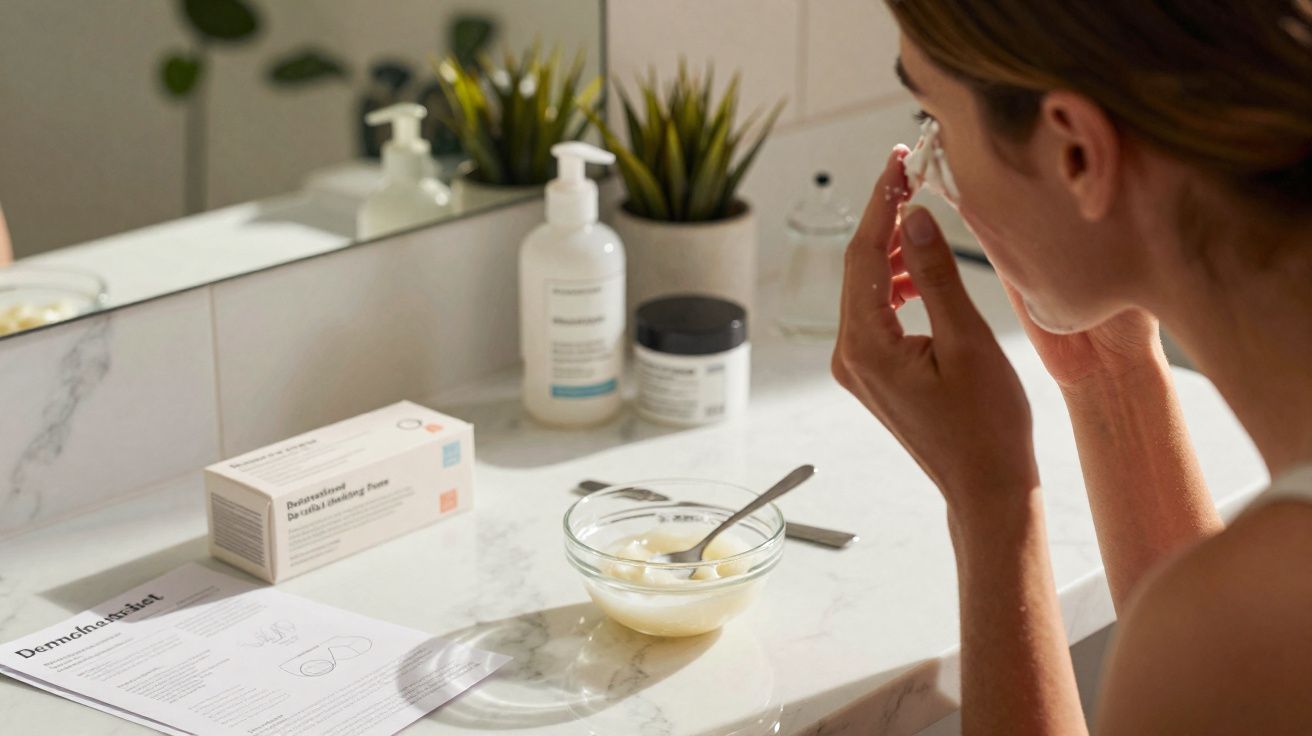
Fashion trends come and go, bold claims abound, and the list of cautions keeps growing.
Baking soda is making a return to the bathroom cupboard, fuelled by tutorials promising smoother-looking skin and less noticeable dark circles. Some beauty professionals endorse specific uses, while stressing strict rules to prevent irritation and disruption to the skin barrier.
Why baking soda is so appealing
A fine powder that is inexpensive and widely available, baking soda can act as a very gentle mechanical exfoliant. Mixed with water, it creates an alkaline solution (around pH 8 to 9), which can help break down oily residues. By lifting away dead skin cells, it temporarily smooths the surface and can leave the complexion looking clearer after rinsing.
“Its alkaline pH can disrupt the hydrolipid film if it’s used too often. Occasional application is more than enough.”
In salon settings, therapists who use it tend to prepare a quick “fresh paste”, cushioned with soothing ingredients. The aim is a short-term glow, not an intensive course of treatment.
Gentle cleanse or over-stripping?
Healthy skin typically sits at an acidic pH of roughly 4.7 to 5.5. Repeatedly pushing that pH upwards can activate enzymes that weaken the barrier and increase dehydration. Used too frequently, baking soda may therefore dry out and irritate the skin-especially if your skin is reactive or sensitive.
Used rarely and blended with other ingredients, it can help reduce excess sebum, brighten dull areas and make texture look finer. Used neat, it can scratch thinner skin and upset the skin’s natural acid balance.
Wrinkles and dark circles: what you can realistically expect from baking soda
Fine lines may look softer after micro-exfoliation because light reflects more evenly off a smoother surface. This effect is temporary. It does not change the depth of creases or address collagen loss.
For dark circles, the potential benefit is mainly brightness. Baking soda can lighten an area that looks grey due to built-up keratin or surface impurities. It does not improve a tear trough hollow, deep-set hyperpigmentation, or dark circles driven by visible blood vessels.
“Baking soda doesn’t correct under-eye hollows or visible vessels. It mainly improves surface dullness.”
A controlled recipe (no essential oils) plus a patch test first
This version is designed to reduce irritation risk, avoids essential oils near the eyes, and should only be used on intact, healthy skin.
- 1 tablespoon of plain yoghurt (acid buffer, soothing effect)
- 1 teaspoon of runny honey (humectant)
- 1/4 teaspoon of food-grade baking soda
- 1 teaspoon of finely ground oat flakes (light emollient)
Precise method
- Do a patch test in the crook of your elbow 24 hours beforehand. There should be no prolonged stinging and no redness.
- Mix until you get a soft, spreadable paste. Apply to clean skin, keeping 1 cm away from the eyelids.
- Massage for 60 to 90 seconds using very gentle circular motions. Leave on for 2 to 3 minutes.
- Rinse with lukewarm water, then finish with a splash of cool water. Pat dry.
- Apply a pH-neutral moisturising cream. In the evening, avoid using a retinoid on the same day.
“Maximum recommended frequency: once a week for normal skin; every two weeks for sensitive skin.”
Precautions and contraindications
- Avoid the eyelids, the immediate eye area, and the lips.
- Do not use on irritated skin, eczema, rosacea flare-ups, or uncontrolled inflammatory acne.
- Do not use within 7 days of an acid exfoliation, a strong retinoid, a peel, waxing, or laser treatment.
- No essential oils near the eyes, even diluted.
- Stop immediately if you experience burning, tightness that persists, red patches, or itching.
What specialists recommend for longer-lasting results
For established wrinkles, the go-to actives remain retinoids, peptides and hyaluronic acid used in daily skincare, alongside broad-spectrum sun protection. For dark circles, caffeine-based care targets puffiness, vitamin C can help with ashy-looking dullness, and techniques such as fillers or intense pulsed light address structural or vascular causes.
What baking soda does… and does not do
| Goal | What baking soda can contribute | Limitations | Targeted alternative |
|---|---|---|---|
| Immediate smoothing | Surface refinement, quick glow | Temporary effect | Gentle PHA acids, enzyme exfoliant |
| Marks and dull complexion | Superficial brightening | Limited effect on deep pigment | Stabilised vitamin C, niacinamide |
| Bluish dark circles | Boosts brightness | Does not act on vessels | Caffeine, cold, vasoconstricting care |
| Puffiness | Little impact | No draining action | Lymphatic massage, sleep, reduced salt |
| Established wrinkles | Limited optical smoothing | Does not stimulate collagen | Retinoids, peptides, photoprotection |
Quick FAQ
Can you use it neat on the skin?
No. Always use it in a buffered blend and only on healthy skin. Used neat, it disrupts pH and raises the risk of irritation.
How long should you leave it on?
Three minutes maximum-set a timer. The benefit comes from the gentle massage and the rinse, not from leaving it on for longer.
What about the eye contour?
That skin is too thin. Keep your distance. Choose dedicated serums with caffeine, peptides or vitamin K, applied with light tapping.
A simple four-week baking soda protocol
Week 1: patch test, one short application, then intensive moisturising in the following days.
Week 2: pause; introduce a pH-friendly cleanser and daily sun protection.
Week 3: a second application if your skin tolerates it, still with no essential oils.
Week 4: reassess, then space out to monthly use if you’ve achieved the glow you want.
Budget and trade-offs
A 500 g bag of baking soda costs only a few pounds and can last for months when used occasionally. The real spend is on the supporting products: a barrier-repair moisturiser, sunscreen, and an antioxidant serum. The routine remains affordable if baking soda stays a minor, occasional add-on and you invest properly in serious photoprotection.
Warning signs and a plan B
- Persistent redness: stop immediately and return to a minimalist routine (gentle cleanser, barrier cream, SPF).
- Tightness lasting beyond 24 hours: reduce to once a month or abandon the protocol.
- Swollen eyelids: stop and use cold compresses; switch to a soothing, dedicated eye-contour product.
“Baking soda can give a low-cost boost of radiance, provided it’s used rarely, buffered, and kept well away from the eye area.”
Going further, safely
An enzyme exfoliant based on papain or bromelain can deliver similar smoothing with a more skin-compatible pH and better tolerance. An ultra-soft cleansing brush, used once a week, can also reduce keratin build-up without destabilising the hydrolipid film.
For dark circles, combine good sleep habits, salt management, cold compresses and caffeine-based care. The results tend to stack up more reliably than any single dramatic step. For wrinkles, the steady use of a well-formulated retinoid and daily sunscreen matters more than any occasional kitchen shortcut.






Comments
No comments yet. Be the first to comment!
Leave a Comment