
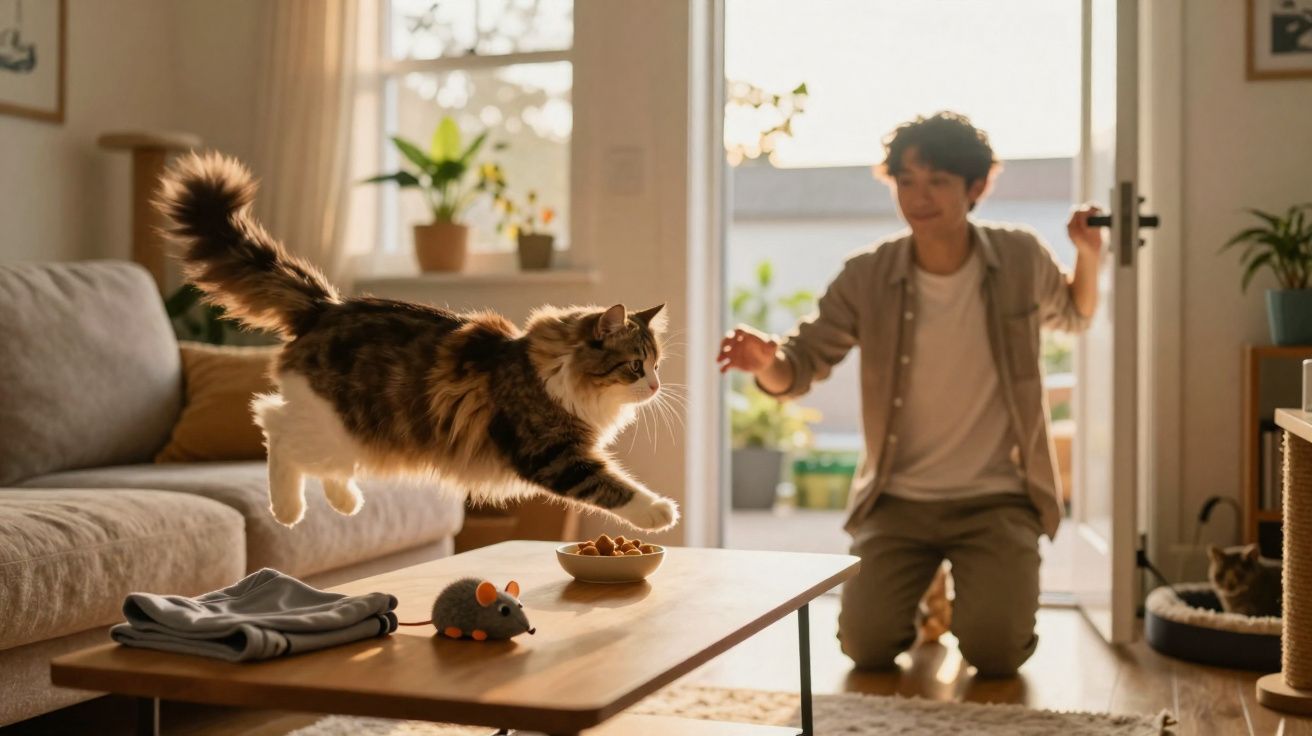
The worry often appears before a first long trip or a move: how reliable is a cat’s memory, how attached is it to “its” person - and at what point does that bond fade? If you understand what’s going on inside a cat’s brain, it becomes easier to feel calm about holidays, a long-distance set-up with your pet, or an unavoidable separation.
How long can a cat remember their person?
The brief answer: far longer than many people assume. A cat’s scientifically tested short-term memory sits at around 16 hours. Emotional memory of familiar people, however, can last for years - especially when day-to-day life together was close and consistent.
What matters is not so much the length of the separation, but the depth of the relationship that existed beforehand.
If a cat has linked a person with many positive, repeated experiences - food, play, safety, cuddles - that person becomes anchored in long-term memory. Stories of cats recognising a former person even after years aren’t just sentimentality; they fit well with what behavioural research observes.
How cats’ memory actually works
Short-term memory: the “to-do list” of daily cat life
Short-term memory, often called working memory, supports a cat in everyday situations. It helps it keep track of things like where the food bowl was placed or which direction a sound came from. Studies indicate that this kind of information remains accessible for roughly 16 hours.
- Where was the bowl a moment ago?
- Which door was recently open?
- Where did the toy go that it was just chasing?
This type of memory keeps life running smoothly, but it doesn’t build a deep bond. In this context, a human is more like part of the surroundings.
Long-term memory: where a person is “stored”
The truly interesting part is long-term memory. This is where experiences end up when they are intense enough - usually because they are tied to strong feelings: security, fear, pain, pleasure, play drive.
In that archive, “your” person is saved as a bundle of impressions: smell, voice, touch, routines, and the emotional state these things create in the cat. If a cat repeatedly feels safe, full, relaxed and mentally engaged with someone, it stores that person deeply. That entry isn’t simply “overwritten” just because a few weeks or months pass.
What cats really remember - not just a face
Smell: the most important “calling card”
A cat’s nose is its primary tool. To a cat, each person has a completely distinctive scent. When a cat rubs against your legs, hands or head, two things happen at once: it marks you with its own scent - and it also files your body scent into its internal scent archive.
A person’s individual smell is often the strongest memory anchor for a cat.
Even after a long separation, a familiar scent can still flip the switch to “oh, I know this” - for instance, when a jumper that’s been in the wardrobe for weeks is taken out again.
Voice and tone: like a familiar song
Experiments using audio recordings show that cats recognise the voice of their primary person and can clearly distinguish it from unfamiliar voices. It’s less about the words and more about melody, rhythm and volume.
Many owners know the pattern: you call from the hallway and, from another room, there’s an immediate response - ears turning, a meow, getting up. This link between sound and positive outcomes (food, strokes, attention) can become firmly embedded in memory.
Routine and rituals: the framework around the bond
In day-to-day life, cats and people develop a stable rhythm: feeding times, play slots, evening sofa habits. For many animals, that predictable structure is the heart of feeling secure.
When a person suddenly disappears - a business trip, hospital stay, a move - that framework is what collapses. A cat may react strongly to the disruption even though it hasn’t “forgotten” the person.
- Some cats withdraw and sleep more.
- Others meow more often or seem restless.
- Others become more clingy with the stand-in carer.
None of this means the memory of the original person has vanished. It’s simply that the missing piece of the routine is painfully obvious.
What happens when you’re away for a long time?
The key indicator is how your cat behaves when you return. Many owners report that after weeks or months away, they receive an almost exuberant welcome.
- The cat runs to the door, tail tip held upright like a question mark.
- It purrs louder and for longer than usual.
- It rubs its full body length along your legs and hands.
- It kneads with its paws on your lap or on a blanket near you.
- It “talks” using a series of particular sounds you recognise from everyday situations.
These signs make one thing clear: the cat didn’t need to “get to know” you again. It’s picking up exactly where things left off.
A cat’s most intense declaration of affection is often the moment when, after a separation, it behaves as if you were never gone - and instantly slips back into routine.
Can a cat sense how important it is to someone?
Cats don’t think in human ideas of loyalty or “faithfulness”, but they react very sensitively to behaviour. If you’re patient, consistent and kind, you’re effectively investing in shared memory every day.
Typical signs of a strong bond include:
- The cat actively seeks your closeness, not only at feeding times.
- It prefers to sleep where your scent is strongest.
- It shows its belly, looks relaxed, and slow-blinks towards you.
- It allows touch even when it’s in a physically vulnerable position.
Experiences like these are written into its emotional archive. If you go away for a while, what it misses isn’t an anonymous food provider - it misses that whole emotional package.
Practical tips so your cat stores you positively for the long term
In daily life: build the bond, don’t just “provide” (cat memory of their owner)
- Clear routines: feed at roughly similar times and keep small, consistent “welcome home” rituals.
- Active play: short daily play sessions with a wand toy, ball or puzzle toy strengthen your shared connection.
- Affection on their terms: don’t force contact; watch for when your cat is actually seeking it.
- A calm voice: speak to your cat often in a recognisable, friendly tone.
During a longer absence: support the memory
- Leave familiar items behind: a blanket, T-shirt or cushion with your scent.
- Brief a trusted carer so they can imitate feeding times and rituals as closely as possible.
- If possible, ask them to play short video or voice messages - not every cat reacts, but some respond very clearly.
These steps don’t replace you, but they keep familiar patterns present until you’re back.
Can a cat really “forget” their person?
In theory, an extremely long period - especially one accompanied by stress or trauma - can weaken old associations. Illnesses that affect the brain can also influence memory, just as they can in humans.
More commonly, something else happens: the cat forms an additional attachment system with a new carer. That doesn’t mean the old one is automatically deleted. If the earlier person reappears one day, the cat may activate both memories in parallel. How obvious that is will depend on the animal’s personality.
So if you’re worried that a few weeks’ holiday will make you “disappear” from your pet’s mind, you can relax. What has grown lovingly over months or years doesn’t simply collapse after a handful of days.
What studies suggest about cats’ “episodic” memory
Behavioural researchers sometimes describe cats as having a type of memory that resembles parts of human “episodic” memory. In other words, cats can remember specific events, including place and sequence - not just bare facts.
Examples from experiments and everyday life:
- The cat knows which cupboard you take treats from and waits right there.
- It remembers which windowsill it watched a bird from days ago - and returns to that same spot.
- It reacts to a particular sound (doorbell, keys) because that noise has often signalled a particular event.
Applied to people, this means your cat doesn’t store only “Person X provides food”, but whole scenes, atmospheres and routines. If you shape those scenes over years, you remain a character in its internal film.
For owners, that shift in perspective can be reassuring: the question “When will my cat forget me?” fades into the background. What matters more is this: how do I shape our time together so it earns a stable, good place in the cat’s mind - and, even more importantly, in its feelings?






Comments
No comments yet. Be the first to comment!
Leave a Comment