
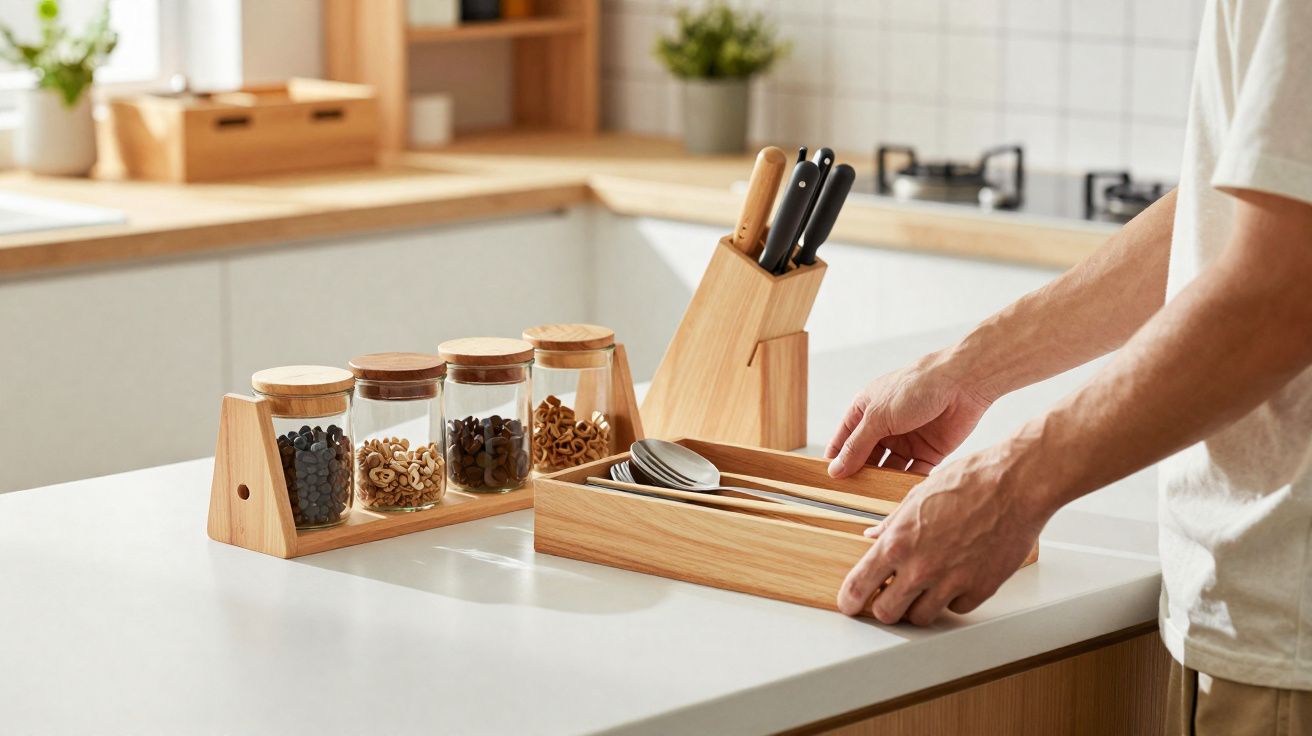
A handful of leftover timber boards can become a well-thought-out organisation system.
Most people know the scene: the kitchen worktop is crowded, pens and cables pile up on the desk, and in the bathroom toiletries end up queued behind one another. At the same time, the cellar is home to old shelf boards, bits of pallet, or offcuts from the last furniture job. Those very scraps can be the starting point for 14 simple scrap wood projects that bring structure to almost any surface - with next to no spend, but plenty of upcycling value.
Why scrap wood is the quiet hero of tidy spaces
Wood offcuts often get shoved into a corner and forgotten. Yet they’re ideal for tackling everyday annoyances: where do oil bottles go, what about coffee capsules, notebooks, charging leads? Timber is sturdy, naturally warm-looking, and easy to work with - even if you don’t have a fully equipped workshop.
"With a few neatly prepared boards, a cramped workspace can be turned into a clearly organised zone where every item has its own fixed place."
What makes it appealing is the made-to-measure feel. Rather than relying on standard sizes from a furniture chain, you create solutions that slot into spare corners, narrow recesses, or that awkward final gap between a wall and a cupboard.
Which scrap wood is actually suitable
Not every board from the cellar belongs anywhere near the kitchen worktop. If you’re planning with scrap wood, start with a straightforward check:
- Suitable: solid furniture timber, clean plywood, leftover parquet, untreated pallet boards.
- Better left for the garden: pressure-treated structural timber intended for outdoors (often greenish and strongly scented).
- Use caution: very old paint layers that are flaking or smell unusual.
Begin by brushing the timber down and letting it dry properly. Next comes sanding: start with a medium grit, then move to a fine finish, roughly up to 120-grit paper. It’s common to uncover surprisingly attractive grain underneath.
For kitchens and bathrooms, a durable finish is worth the effort. Acrylic paint topped with clear varnish, or a hardwearing wood lacquer, helps ensure splashes from water, oil spatters, and soap don’t leave marks. In many communities, open workshops build long-lasting shelves or small bookcases from exactly these kinds of offcuts - a good indication of how tough reclaimed wood can be when it’s properly prepared.
14 scrap wood projects that clear your worktops
The key to better order is to group items, use vertical space, and introduce layers. Instead of lining everything up side by side, you create defined zones - practical, and calmer to look at too.
Kitchen ideas
- Raised tray for oils and spices: Fix a narrow board onto two small blocks and bottles and vinegar no longer sit directly on the worktop.
- Carry caddy for kitchen tools: An open wooden box with a handle that gathers wooden spoons, a whisk and scissors. When cleaning, you can shift the whole set aside in one go.
- Slim wall-mounted spice ledge: A single board becomes a mini shelf above the worktop, just deep enough for lidded jars.
- Vertical holder for chopping boards: Two side strips and a base panel are enough to keep boards upright, rather than leaning against the wall.
- Coffee organisation system: A small compartment shelf or a shallow drawer made from offcuts so capsules or pads sit sorted instead of rattling around in a box.
- Holder for coffee filters and napkins: Two narrow compartments side by side, sized precisely for filter papers and paper napkins.
- Mini platform for washing-up liquid and brush: A small stand beside the sink so the sponge, washing-up liquid and hand soap aren’t left sitting in puddles.
Desk organisation
- Organiser for pens and notebooks: A small wooden tray with dividers separates pens, markers, scissors and sticky notes.
- Monitor riser with storage: A wide, solid top on two side pieces; underneath there’s room for a keyboard, notebook or external storage.
- Charging station for phone and tablet: A board with slots for devices, plus a concealed compartment behind it for an extension lead. Cables run through small cut-outs.
- Wall pockets for post and paperwork: Flat boxes made from thin plywood, mounted one above another, keep bills, letters and to-do papers separated.
Bathroom and hallway under control
- Bathroom shelf for toiletries: A narrow platform on feet or battens so skincare, toothpaste and a razor sit neatly along the basin edge.
- Wooden tray for keys and bits in the hallway: A low-sided box or small tray by the door for keys, sunglasses and loose change.
- Mini bookcase for a sideboard: Offcuts form an open box that keeps cookbooks, photo books or children’s books close at hand.
How to make each project fit even the tightest corner
Before you touch the saw, grab a tape measure. The crucial dimensions are:
- the available width on the worktop or desk,
- the maximum depth so you can still work comfortably,
- the height clearance under wall units or below the monitor.
A quick pencil sketch on paper makes planning easier: where should compartments sit, how tall should the edges be, and where do you need hand-holes or cable cut-outs?
| Project | Difficulty level | Tools required |
|---|---|---|
| Washing-up liquid platform | very easy | saw, sandpaper, wood glue |
| Monitor riser | easy | handsaw or jigsaw, screws, drill |
| Charging station | medium | jigsaw, drill for cable holes |
| Wall pockets for post | medium | saw, square, wall plugs and screws |
Most of these builds only require straight cuts. A basic handsaw, sanding block, wood glue and a few screws are generally enough. If you’re not confident, many DIY shops will cut timber to size - leaving you to do the assembly at home.
Colour ideas and everyday protection
If you want these helpers to last, the surface finish matters. In the kitchen, a painted and lacquered finish works well because it can be wiped clean. In the bathroom, a water-based clear protective varnish helps keep moisture at bay.
If you prefer a rustic feel, a wood stain can emphasise the grain. In more modern kitchens, matte, lighter shades tend to look calmer. A practical approach is to pick up colours already present in cupboard fronts, tiles or handles, so the scrap wood pieces read as custom accessories rather than stopgaps.
"Every finished piece doesn’t just hold things - it also tells the story of a board that was nearly thrown away."
More than just tidiness
Using scrap wood thoughtfully keeps costs down and reduces trips to the furniture shop. It also cuts waste, because less material ends up in a skip. Many people notice an added benefit: when your main surfaces are structured, it’s easier to focus and you’re less likely to lose track of shopping or paperwork.
Once you’ve completed a couple of small builds, you tend to see new offcuts differently. An old bed slat base no longer looks like rubbish - it becomes a supply of slats for more shelving. A sawn-off table leg can turn into a support for a new platform. Children can also help with simple tasks such as sanding or sorting screws, giving them a hands-on feel for tools and materials.
It’s also sensible to consider potential risks: poor ventilation while sanding, old finishes, or sharp edges. A dust mask, eye protection and careful sanding reduce these issues significantly. If you’re unsure whether an old coating could be problematic, it’s better to use that timber for a cellar project or an outdoor job rather than anything that sits directly in the kitchen.
Things get particularly effective when wooden solutions are paired with other organisation habits: a raised tray in the kitchen alongside clear jars with labels, or a monitor riser on the desk alongside a digitally decluttered desktop. Step by step, you end up with rooms where surfaces stay clear - even when everyday life gets busy again.





Comments
No comments yet. Be the first to comment!
Leave a Comment