
The bloke came in wearing a baseball cap pulled so far down I could hardly make out his eyes.
Mid-thirties, strong jaw, shoulders set like he was bracing himself. He yanked the cap off quickly-like tearing off a plaster-then dragged a nervous hand through very fine hair that was already thinning at the temples. The tiny beat afterwards, when he waited to see what I’d do? I see that pause day in, day out.
He wasn’t asking for a miracle. He simply didn’t want his head to look like a losing fight. “I don’t want to cover it up,” he told me, “I just don’t want it shouting at people from across the room.” Completely fair. So we spoke about shape, we spoke about texture, and we spoke about what’s realistic.
And I gave him the same answer I’ve given hundreds of times: there’s one short cut that quietly wins-over and over-on fine hair and receding temples. The important bit is understanding why it works.
The short haircut that actually works with fine hair and receding temples
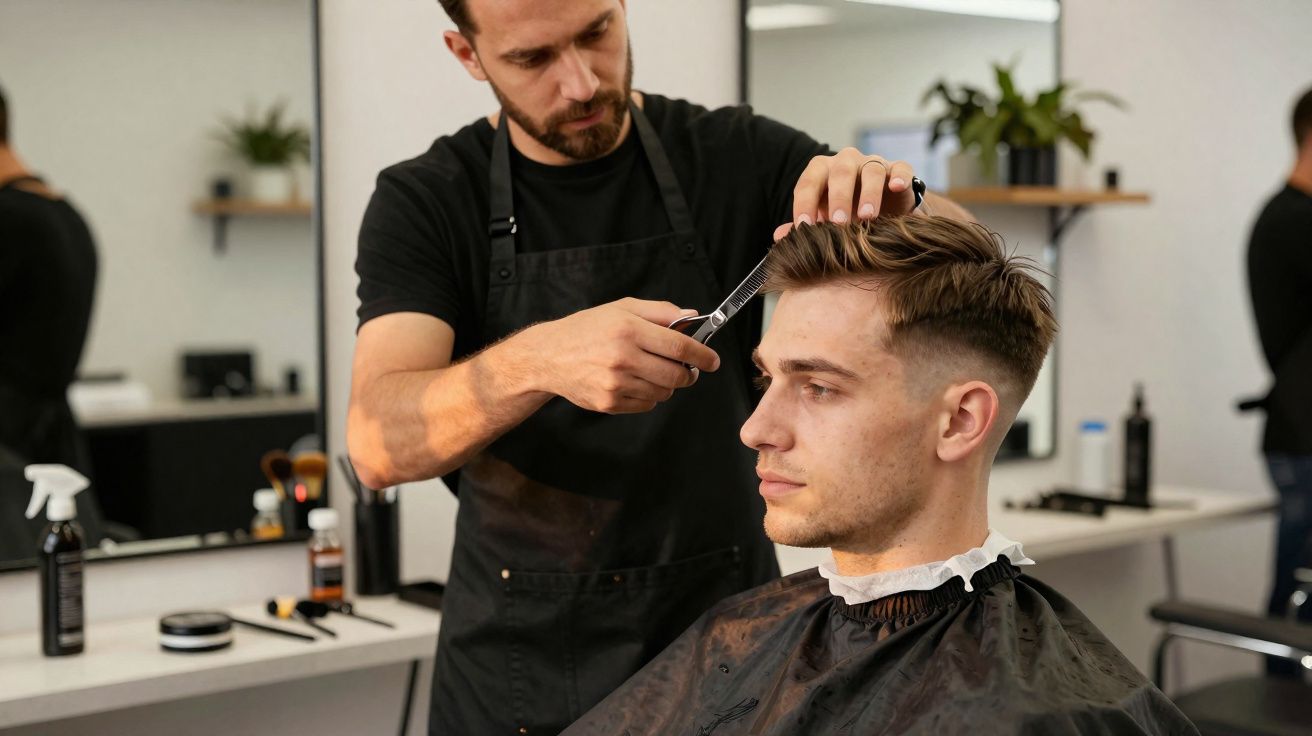
If you’ve got fine hair and your temples are receding, the strongest option is a short, textured crop with faded sides. Not a buzz cut. Not a comb-over. Not a panicky fringe. Think: a clean fade around the ears and neckline, with the top kept short, choppy, and nudged slightly forward.
Most of the time, the top wants to sit somewhere around 1–3 cm, depending on how much density you’ve got. Short enough to avoid the scalp showing in “stripes”, but long enough for your barber to break up the light with texture. The sides need to be close and tight, because that’s what helps the recession melt into the overall outline rather than reading as two bare corners.
On fine hair, this sort of crop works like visual camouflage. Instead of light bouncing off a flat surface and revealing thin areas, it catches on broken texture. The fade cleans up the silhouette, the shorter top stops collapsing, and your receding temples stop being the first thing anyone notices. The whole look reads sharper, calmer, and less fussy.
The secret is straightforward: it works with the direction of loss instead of trying to argue with it. When the corners are weaker, longer hair at the temples often creates contrast-full next to empty. Tightening the sides and keeping the top short removes the “holes” and turns your head shape into one clean, unified form.
Fine hair also tends to hate extra length. It drops, splits into sections, and exposes the scalp in streaks. With a short length and a textured finish-point-cutting, chipping, and a bit of rough styling-the eye sees movement rather than thinness. Then the fade acts like a tidy frame, pulling attention back to your face instead of your hairline.
A short textured crop for fine hair: what it looks like in real life
Here’s a real example. A regular came in last month-41, office job, two kids, hairline shifting back since he was 32-and let out a sigh as he sat down: “I’m exhausted pretending I’ve still got the same hair I had at uni.” He’d been wearing a vague side part and brushing it forward to mask the temples. Under bright lighting, it was all visible.
We went for a tight mid fade, roughly a #0.5 on the sides, blended up softly. On top, I left about 2 cm, cut it blunt with scissors, then chipped into it to create broken texture. I pushed the top slightly forward with my hands-no harsh parting, no sharp line trying to trick the eye.
When I spun him towards the mirror, he narrowed his eyes for a moment, then smiled-surprised, like he didn’t quite trust it yet. He didn’t look like a man “losing his hair”. He looked like a man who’d chosen a modern, confident cut that happened to suit exactly what he’d got. His wife messaged me the next day to say he’d taken twice as many selfies as usual.
And it keeps working as it grows out. Instead of collapsing into an awkward comb-over direction, it simply loosens and softens. That’s why so many men say, “This grew out better than anything else I’ve tried.” That isn’t luck-it’s good structure.
How to get this cut (and not leave with the wrong one)
Let’s get practical. When you sit in the chair, avoid the vague request: “short back and sides, a bit longer on top.” That’s how you end up with a generic trim that ignores fine hair and receding temples. Use language that directs the hands: “short textured crop,” “faded sides,” and “styled slightly forward on top.”
I usually start by asking how bold you’re willing to go on the sides. For fine hair with receding temples, a low fade to mid fade is typically the sweet spot-tight around the ear, then gradually softer as it climbs. On top, scissors matter: they let your barber build that uneven, broken texture. The key is cutting into the hair, not just straight across it, so it doesn’t sit in neat, thin rows.
When it comes to styling, skip anything shiny or heavy. A dry, matte product is the move: a light paste or clay, about a pea-sized amount, properly warmed in your hands, then pressed into the hair rather than smeared over the surface. You’re aiming to rough it up, push the front slightly forward (or just a touch to the side), and keep it looking like controlled mess-rather than helmet hair.
Two mistakes show up constantly:
- Hanging on to length at the temples. A long, wispy corner draped over a receding spot doesn’t conceal anything; it acts like an arrow pointing at the issue.
- Going too long on top with fine hair. Hoping extra length creates volume usually backfires-fine hair separates and shows more scalp.
On a human level, I understand the worry. Cutting shorter while your hair is thinning feels counterintuitive-like you’re admitting defeat. Visually, it’s the opposite: shorter becomes your ally. When everything is tighter and deliberate, people read it as a style decision, not damage control.
One more truth people don’t love hearing: perfectly styling your hair every single day is a fantasy. Let’s be honest-almost nobody does that daily. That’s another reason this crop works so well: even if you use product three times a week and just towel-dry the rest of the time, it still looks intentional. That takes pressure off your mornings.
There’s a moment that happens in the chair when a man sees this shape for the first time and goes quiet-not upset, not shocked-more like he’s mentally letting go of the fight.
“The second we stop pretending the hairline hasn’t shifted, the whole face softens. A good cut doesn’t deny reality-it makes peace with it.”
That’s what this short, textured, faded cut delivers. It won’t erase recession; it reframes it. You move from How do I hide this? to How do I wear this well?
- Short textured crop on top: about 1–3 cm, choppy, worn slightly forward
- Low fade or mid fade on the sides: tight near the ear, softer as it rises
- Dry, matte product: clay or paste, tiny amount, worked into the roots
Once those three elements are in place, the rest is personal taste: a touch more fringe if you want softness, a slightly tighter fade if you prefer edge. The backbone stays the same-and that’s where the quiet confidence comes from.
Living with the cut: maintenance, mindset, and small adjustments
This is the bit people tend to overlook: a cut like this is “alive”. It shifts week by week, and that’s part of why it flatters fine hair and receding temples. You’re not chasing one magic appointment-you’re setting a rhythm between you, your hair, and your barber.
Most men do best with a tidy-up every 3–5 weeks. Go closer to 3 if you like a razor-crisp fade, or closer to 5 if you prefer a softer, lived-in finish. The upside is that fine hair often looks better with a hint of disorder; as the fade relaxes, the whole silhouette becomes easier-and that can actually suit a receding line.
We’ve all caught our reflection in a shop window and thought, “Is that what my hair looks like from the side?” This cut reduces those surprises. In profile, the blend from temple to crown reads smoother, so the eye travels across the head instead of stopping at the corners. That means fewer little hits of self-consciousness during the day-often more than you realise until they’re gone.
Mentally, it changes the story. You’re no longer “the bloke losing his hair and trying to hide it”. You become “the bloke with a clean, modern cut that suits him right now”. People might not be able to name the difference, but they pick up on it when you walk into a room carrying yourself a fraction taller.
Some men like pairing this crop with short stubble or a neat beard to balance the face. A clean shape on top, plus texture along the jaw, creates a more even frame-less attention on the temples and more on the overall structure. It’s like changing lighting in a photograph: the subject is the same, but what stands out first shifts.
Two extra tweaks that help (and rarely get mentioned):
First, keep an eye on your hairline in harsh lighting, not just bathroom lighting. Overhead office lights and daylight from above will show density differently, and that’s exactly where a short textured crop earns its keep. If you’re checking your style, check it where it actually gets tested.
Second, look after the scalp. Fine hair can look its best when the scalp isn’t irritated or greasy. A gentle shampoo routine and occasional exfoliating scalp wash can reduce build-up, helping hair sit cleaner and take product more evenly-especially important when you’re relying on texture rather than length.
Over time, your conversation with your barber will change. The temples may drift back a little further, or the crown might start thinning. The good news is this cut adapts smoothly: it can go slightly tighter, a touch shorter, or more textured. No dramatic “before and after”-just small, respectful adjustments that keep you aligned with where you are.
Plenty of men eventually say, “I honestly wish I’d gone short years ago.” That’s the understated power of a haircut that doesn’t fight reality, but shapes it into something you can feel good about at 30, 40, 50-without chasing the hair you had at 20.
| Key point | Detail | Why it matters to you |
|---|---|---|
| Short textured crop | Top kept at 1–3 cm, choppy, worn slightly forward | Adds movement and reduces the visibility of thinner areas |
| Low fade or mid fade | Sides cut very short and blended gradually upwards | Helps receding temples disappear into the overall shape |
| Matte, lightweight product | Paste or clay, small amount, worked into the roots | Adds texture and lift without heaviness; natural finish that lasts |
FAQ
- Will cutting my hair shorter make my thinning and receding temples look worse?
Usually not. A well-done short textured crop with a fade reduces contrast between dense and sparse areas, so the result looks deliberate rather than patchy.- What should I tell my barber to get this exact kind of cut?
Ask for a low fade or mid fade on the sides and back, plus a short, textured crop on top (around 1–3 cm) styled slightly forward with no hard side part.- Which products work best for fine hair with this style?
Go for a matte paste or clay. Use a tiny amount, warm it in your hands, then press it into towel-dried hair to build texture without shine or weight.- How often should I get this haircut redone?
Every 3–5 weeks suits most men-nearer 3 for a crisp fade, nearer 5 for a softer grow-out that still keeps its shape.- Can this cut still work if my hair keeps receding over time?
Yes. The shape can be adjusted gradually-slightly shorter, tighter, or more textured-so it evolves with your hairline instead of forcing a sudden drastic change.






Comments
No comments yet. Be the first to comment!
Leave a Comment