
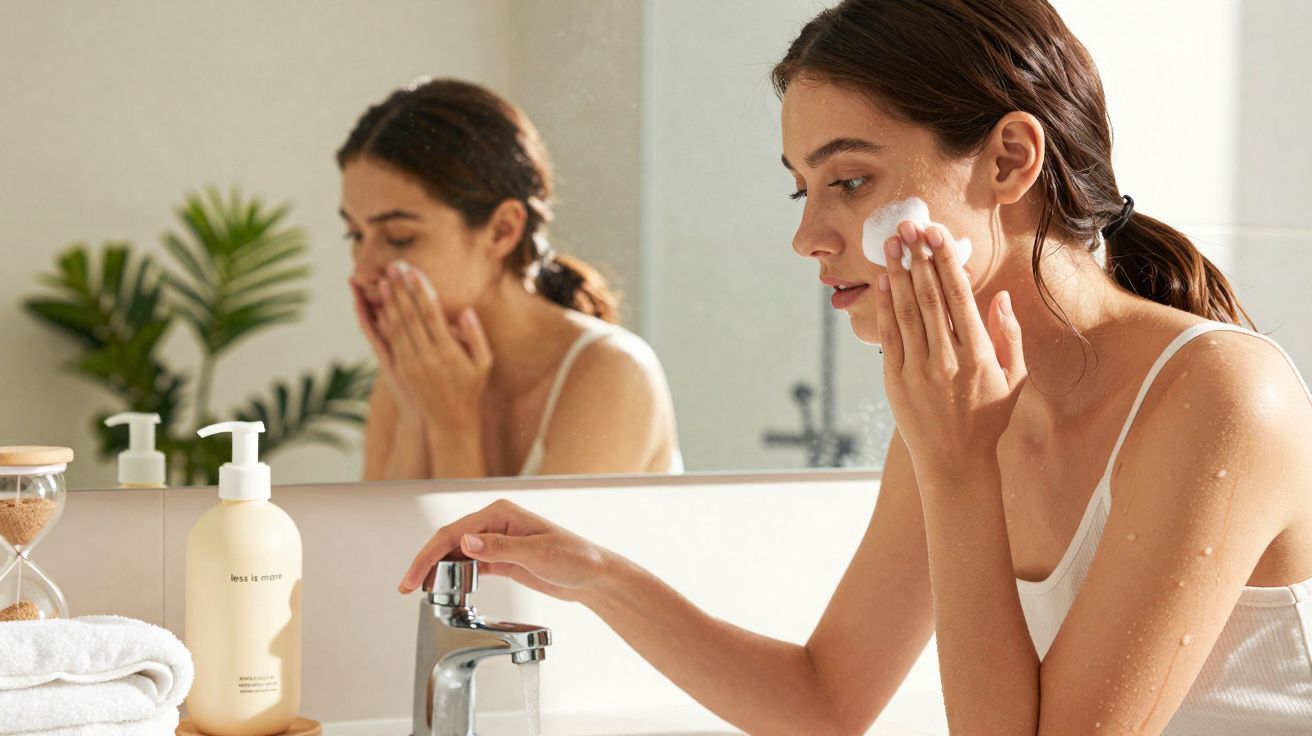
The bathroom mirror is steamed over, the tap is still running, and your playlist is quietly playing in the background.
You’ve had a full-on day, your skin feels “grubby”, and your instincts nudge you towards doing more: scrub for a bit longer, stay under the warm water, let the cleanser really do its thing. Thirty seconds turns into a minute, then two. Your cheeks begin to tingle, your nose feels tight, yet you keep massaging because that’s what flawless-skin routines on social media seem to demand.
Later, while you’re drying your face, there it is again: that familiar sting. A few hours pass and redness appears. Maybe you notice tiny flakes around the nose. You blame the weather, hormones, or your pillowcase. You almost never blame how you washed your face.
But what if the harm started right there at the basin - every time you cleansed for just a little too long?
Why “extra clean” can quietly damage your skin barrier
Washing your face looks innocent enough. It’s only water and foam, isn’t it? In practice, it’s a delicate trade-off with your skin barrier: either you protect it, or you strip it back. The barrier is a thin, easily disrupted layer of skin cells and lipids that keeps hydration in and irritants out. Leave a soapy cleanser on for too long and that protective layer gradually gets worn down.
If you work cleanser in for one, two, even three minutes, you’re not only loosening grime. You’re also dissolving the natural oils that help bind skin cells together. That “squeaky clean” tightness people still chase as proof of cleanliness? It’s your barrier signalling it has had enough.
Healthy skin doesn’t feel squeaky. It feels settled - calm, comfortable, almost unremarkable. For many people, the trouble begins at the sink.
Dermatologists see this pattern all the time. Someone arrives saying their skin has suddenly become sensitive in their 30s, 40s, or 50s: more redness, more stinging from products, breakouts that don’t resemble teenage acne. They’ve swapped moisturisers repeatedly and even cut out dairy, yet their face still burns after cleansing.
When they’re asked how long they wash for, the reply is often hazy: “I really work it in.” “A couple of minutes, maybe?” Some follow viral “60-second rule” videos - and then extend the time “just to be safe”. Others cleanse two or three times daily, assuming discipline equals better skin.
On a microscopic level, that extra effort compounds. A 2022 review on barrier function reported that over-cleansing and prolonged exposure to surfactants increases transepidermal water loss - put simply, your skin leaks water. That leak shows up as dullness, tightness, or the frustrating shiny-but-dehydrated look that no highlighter can disguise.
A helpful way to picture the skin barrier is a brick wall: skin cells are the bricks; lipids are the mortar. Longer washing sessions rarely knock the bricks down - instead, they soften and remove the mortar. As the “glue” thins, tiny gaps appear. Through those gaps, allergens, pollution, and even fragrance molecules can get in and spark inflammation.
That’s why skin can feel oily and desert-dry at the same time. Your skin tries to defend itself by producing more sebum, while deeper layers are still losing water. It’s also why rosacea, eczema, and perioral dermatitis often flare in people who are “just trying to cleanse properly”. The routine meant to help becomes part of the problem.
To complicate matters, many cleansers are designed to cling briefly to the skin. Gel and foam formulas often include surfactants that need only 20–30 seconds of contact to do the job. Push that to 90 seconds and they keep stripping. Add hot water and you speed up lipid removal even further. The effect is subtle and cumulative - like fine cracks forming in glass.
One more quiet contributor is friction. Cleansing brushes, rough flannels, or vigorous scrubbing can amplify irritation when your barrier is already compromised. If your skin is feeling reactive, your hands (used gently) are usually the safest tool.
How to cleanse your face without wrecking your skin barrier
There’s a straightforward guideline many dermatologists would happily stick above every bathroom sink: keep cleansing under 60 seconds total. That includes wetting your face, massaging the cleanser, and rinsing. Think of it like brushing your teeth - thorough, yes, but not obsessive. For most people, 20–30 seconds of gentle massage is more than enough.
Start with lukewarm water rather than hot. Hot water alone can weaken the barrier, particularly if you repeat it morning and night. Choose a cleanser suited to your skin type, but if your face ever feels tight afterwards, favour mild, low-foam options. Massage in small circles over oilier areas (typically the T-zone), then quickly sweep over drier zones such as cheeks and around the eyes.
As soon as you can feel the cleanser’s slip evenly across the skin, you’re finished. Rinse until there’s no slippery film left - then stop. That extra time standing under the running water “for a few more seconds” is often where barrier damage quietly creeps in.
The most common trap is believing more cleansing will solve what you can see on the surface: - Breakout? Cleanse longer. - Heavy make-up? Cleanse longer. - Spent the day in a polluted city? Cleanse longer.
That internal voice equating cleanliness with control can be powerful - especially when you’re anxious about your skin.
In real life, over-long cleansing is usually a mix of habit and distraction. People scroll on their phone while massaging in cleanser. They leave it sitting like a mask while they fold towels or tidy the bathroom. They double cleanse and turn it into a nightly mini-facial.
Let’s be honest: hardly anyone follows tutorials perfectly every single day. Life is chaotic. You’re late, you’re tired, you miss steps. The aim isn’t a rigid ritual; it’s a handful of non-negotiables that protect the barrier: short contact time, a gentle formula, no harsh scrubbing, and moisturising immediately afterwards.
“Your cleanser is a rinse-off product, not a treatment mask,” explains London-based dermatologist Dr Amrita Das. “If you’re leaving it on long enough to answer your emails, you’re probably irritating your skin and paying for it with sensitivity later.”
If you want to retrain the habit, use a simple cue: hum a short chorus, or count slowly to 25. Keep your phone out of the bathroom so you’re not tempted to scroll with cleanser on your cheeks. And if your skin is already red, peeling, or stinging, treat it like rehabilitation: cleanse less often, shorten the time, and switch to the gentlest formula you can find.
After rinsing, how you dry your face matters too. Rubbing with a towel adds more friction when the barrier is vulnerable. Pat dry instead, and apply moisturiser while the skin is still slightly damp - it helps reduce transepidermal water loss and makes the skin feel comfortable sooner.
- Ideal face-washing time: 20–40 seconds of massage, under 60 seconds total
- Water temperature: lukewarm, never steaming hot
- Frequency: for most people, once in the evening; in the morning, a quick rinse or very gentle cleanse if needed
- Immediate follow-up: apply a hydrating toner or moisturiser within 1–2 minutes
- Warning signs: stinging after cleansing, ongoing tightness, new flaking or redness
The quiet power of doing a little less at the sink
There’s something unexpectedly radical now about doing less to your face. Skincare culture rewards effort: more steps, more actives, more time at the basin. Yet many dermatologists will tell you the glow people chase often shows up only once they stop overdoing it - and it frequently begins with the simplest step: cleansing.
When you shorten face washing, your barrier gets room to rebuild. Those lipids can settle back into place. After a few weeks, people often notice the same changes: make-up sits more smoothly, redness is less intense, and that urgent need to “scrub it all off” in the evening starts to fade. Skin stops shouting and returns to a steadier baseline.
Most of us know the moment: you catch your reflection and feel tempted to start again - to strip everything back to raw, spotless skin. The irony is that your skin already wants to support you; it’s designed to protect and repair. Sometimes the kindest move is to get out of its way, switch off the tap a little earlier, and let your barrier breathe.
| Key point | Detail | Why it matters to you |
|---|---|---|
| Washing time | Keep cleansing under 60 seconds total; massage for 20–40 seconds | Lowers the risk of dryness, redness, and long-term sensitivity |
| Temperature and texture | Lukewarm water + a gentle, low-foam cleanser matched to your skin type | Helps protect the lipid barrier and improves comfort after washing |
| Overall routine rhythm | Proper cleanse at night; lighter, more hydrating morning routine | Simplifies your routine, saves time, and stabilises skin over the long term |
FAQ: face washing time, the 60-second rule, and protecting your barrier
How long should I actually wash my face for?
Most dermatologists recommend 20–40 seconds of gentle massage, with under 60 seconds total including rinsing. That’s typically enough for a well-formulated cleanser to lift sweat, SPF, and light make-up without undermining your skin barrier.Is the social-media “60-second rule” safe?
It can be fine for some people, but for many with sensitive, dry, or reactive skin, it’s simply too long. If your face feels tight, itchy, or looks red afterwards, reduce the time. Trends are one-size-fits-all; your barrier isn’t.Can washing too long make acne worse?
Indirectly, yes. Over-washing can irritate and dehydrate the skin, which may prompt extra oil production and weaken the barrier. That stressed, inflamed environment can make breakouts more persistent and slower to calm down.What if I wear heavy or waterproof make-up?
Do a quick first step (micellar water or a gentle oil/balm) to dissolve make-up, followed by a short, mild second cleanse. Two brief, gentle cleanses are usually kinder to the barrier than one long, vigorous scrub.My skin already feels damaged - what should I change first?
Drop hot water, switch to a fragrance-free gentle cleanser, cleanse only at night for a while, and keep contact time short. Follow with a simple moisturiser containing ceramides or fatty acids, then give it a few weeks before judging results.



Comments
No comments yet. Be the first to comment!
Leave a Comment