
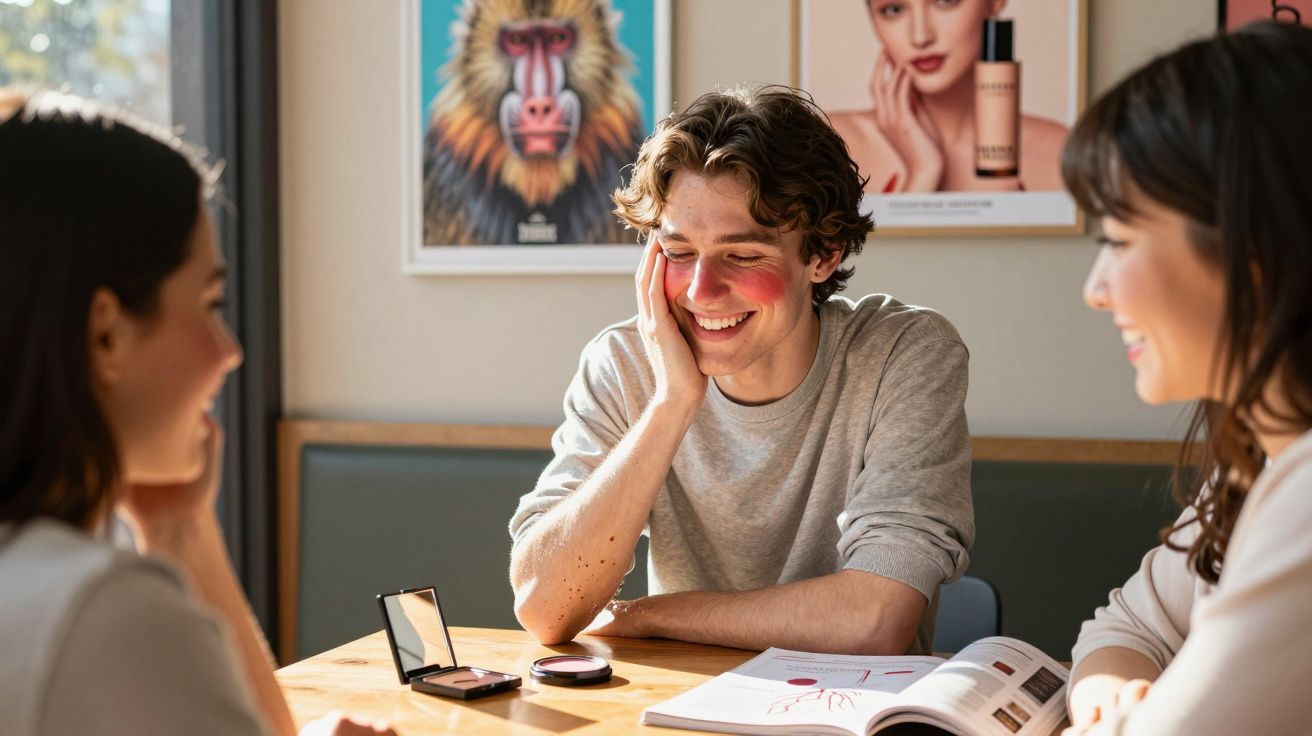
We have all been there: you feel mortified and, almost immediately, a wave of heat rises from your neck and spreads across your cheeks. The more you dwell on it, the warmer-and visibly redder-you seem to become. And if someone points it out with “are you blushing?”, it can make the colour climb even faster.
When you are already feeling self-conscious, this automatic reaction can seem like your body piling on. Yet from an evolutionary perspective, blushing may not be pointless at all: it may offer real social benefits.
What is blushing?
Blushing is a visible bodily response to emotions such as embarrassment, shyness, or self-consciousness. It happens when blood flow briefly increases to the skin of the ears, face, neck, or chest.
Even if others do not notice it, you will often experience it as a rush of warmth or a faint tingling across the face.
How the sympathetic nervous system triggers blushing (adrenaline/epinephrine)
When an emotion sets off blushing, the sympathetic nervous system-which governs many automatic body processes-switches on and releases adrenaline (epinephrine). This affects the tiny muscles around blood vessels.
In much of the body, adrenaline tends to constrict blood vessels. In the face, however, it has the opposite effect: vessels dilate, allowing more blood to pass close to the skin. That sudden increase in surface blood flow is why your face feels hot and why the skin can appear red.
People with lighter skin tones usually show this redness more clearly. For people with darker skin tones, the colour change may be subtle or not visible-yet the same underlying physiological process still occurs.
A useful distinction: blushing versus other facial redness
It is also worth separating blushing from other causes of facial flushing. Heat, alcohol, spicy foods, and exercise can all increase facial blood flow, but they do not necessarily carry the same social meaning as an embarrassment-driven blush.
Likewise, facial erythema (ongoing facial redness) is often mistaken for blushing. This persistent redness can result from several conditions, including rosacea, allergic contact dermatitis, medication reactions, and lupus erythematosus (a long-term autoimmune disease).
The social role of blushing in humans
People tend to blush when they feel intensely self-aware-most commonly in response to unwanted social attention.
Although the “fight-or-flight” system is involved, blushing is not about gearing up to face danger. Instead, researchers argue it evolved as a social cue: a way of signalling to others that we recognise we have made a mistake, breached a norm, or feel embarrassed about what has happened.
Because it is involuntary, blushing is often interpreted as a marker of honesty or sincerity. In that sense, it can act like a wordless apology after a social slip, helping to repair relationships and preserve social bonds following a transgression.
Different feelings can bring on a blush, but the mechanism remains the same: increased blood flow to the face that produces heat and redness. What varies is the emotional context-for instance, blushing in anger is linked to arousal and frustration, whereas blushing from embarrassment is rooted in self-awareness and social emotion.
Why people blush for different reasons (including social anxiety and narcissism)
Not everyone blushes in the same situations. In one study, children with social anxiety were more likely to blush from embarrassment when they received exaggerated praise, compared with moderate praise or no praise.
In a follow-up study, researchers found that children who scored high for narcissism-characterised by an inflated sense of self-importance, a desire for admiration, and reduced empathy-blushed only when they received moderate praise. The authors suggested the children blushed because the praise did not align with how well they believed they had performed.
Who is most likely to blush?
Blushing is reported more often among women and younger people. This may help explain why blushing is frequently linked with youth, vitality, and fertility.
People with social anxiety also tend to blush more readily.
Over time, many people blush less as they get older and accumulate more life experience. That reduction may reflect increased familiarity with social rules-or simply feeling less troubled when those rules are bent or broken.
Animals can blush, too: primates, mandrills, fertility, and testosterone
Humans are not the only species that can show facial colour changes. Some primates have pale facial skin that can blush, including Japanese macaques and bald uakaris.
For mandrills, facial colour change has a particularly important role in reproduction. Females have darker faces when they are young and after giving birth, but their faces turn bright red during the follicular phase of the menstrual cycle, effectively advertising fertility.
Male mandrills also change colour. When fertile females are nearby, males can become redder as they produce more testosterone.
Make-up trends and modern “blush” culture
Human cosmetics may echo similar attraction and fertility signals-whether deliberately or without conscious intent.
On social media, for example, TikTok and Instagram feature people joking about being “addicted” to blush through hashtags such as #Blushaholics and #BlushBlindness. Strong blush placement is also widely seen in K-Pop styling-and it is not limited to female groups.
When to get help for blushing
Because blushing is involuntary, you cannot simply will it to stop once it starts.
That said, if you develop a blush or facial redness that persists for more than a few days, comes with pain, or causes significant distress because of cosmetic concerns, it is sensible to speak with your GP or another health professional.
For blushing linked to social anxiety, cognitive behavioural therapy (a talking therapy that helps reshape unhelpful thoughts and behaviours) may be helpful.
In uncommon cases where blushing is driven by an overactive sympathetic nervous system, surgery may be considered. Two procedures are described: - Sympathectomy, which removes part of the sympathetic chain (a long bundle of nerve fibres running alongside the spine). - Sympathicotomy, which cuts this chain near the second rib where it connects to the spine.
Evidence suggests these operations can be effective and may improve quality of life for people with severe symptoms.
For most people, however, blushing does not need medical treatment. If you can ride out the awkward moment, it can be an opportunity to notice what your body is communicating-and what that reaction reveals about you and the way you relate to others.
Amanda Meyer, Senior Lecturer, Anatomy and Pathology in the College of Medicine and Dentistry, James Cook University and Monika Zimanyi, Associate Professor in Anatomy, James Cook University
This article is republished from The Conversation under a Creative Commons licence. Read the original article.



Comments
No comments yet. Be the first to comment!
Leave a Comment