
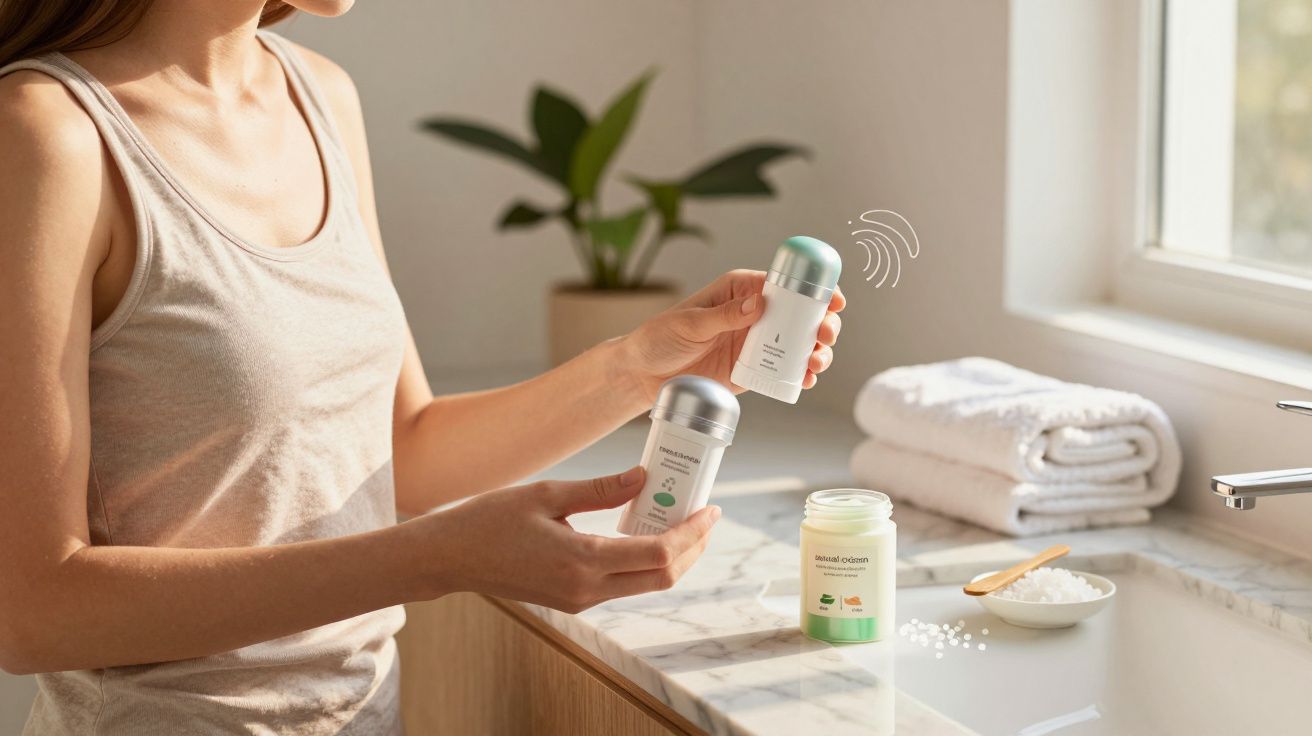
When summer arrives, warmer temperatures combined with a more active routine often mean you perspire more.
That’s a good thing: sweat is your built-in evaporative cooling system. On an average day, most people will produce at least 500 millilitres of sweat - and that’s before any strenuous exercise.
The downside is that sweating can intensify body odour. To manage this, many of us apply an antiperspirant or deodorant daily. Although both are typically used on the underarms, they are not the same product: they work in different ways and target different parts of the problem.
Understanding the distinction makes it easier to work out why a product isn’t performing as you expect - and helps you stay fresher.
Sweat doesn’t smell
To see how underarm products work, it helps to start with the real source of unpleasant odour.
Fresh sweat itself is odourless. It mainly comes from two types of sweat glands: eccrine glands and apocrine glands.
Eccrine sweat glands produce the largest volume of sweat and are spread across most of the body. They release sweat that is mostly water, and their main job is thermoregulation (helping control body temperature). Eccrine sweat also contains electrolytes and small amounts of other substances, which typically do not create strong odours.
Apocrine sweat glands are found mainly in the armpits and groin. Their sweat is richer and more oily, containing proteins, sugars and oils. Even so, it is also odourless when first produced.
The smell develops because various skin bacteria feed on apocrine sweat and, in the process, generate volatile, smelly compounds. Some of these can be detected by the human nose at extraordinarily low levels - trillionths of a gram per litre of air. Apocrine sweat glands tend to switch on around puberty.
This is where antiperspirants and deodorants come in. Although people often use the terms interchangeably, the names reflect two distinct mechanisms.
What antiperspirants do (and how antiperspirant ingredients work)
In broad terms, antiperspirants all follow the same basic approach: they include active ingredients that reduce sweating by stopping sweat from reaching the skin surface in the first place.
The active ingredients are usually metal-containing salts - most commonly aluminium chlorohydrate, aluminium sesquichlorohydrate, aluminium chloride, or a zirconium–aluminium compound.
These ingredients react with water and other molecules inside the sweat gland to form a temporary plug, which reduces the flow of sweat onto the skin. With less sweat available on the surface, skin bacteria have less material to break down into odour-causing compounds.
What deodorants do
Deodorants take a different route. They do not prevent sweat from coming out; instead, they reduce odour by preventing it from being released or by making it less noticeable. They can do this in several ways.
Some deodorants include antimicrobial agents that lower the number of microbes responsible for producing odorous molecules. Others rely on perfumes that mask unwanted smells.
Deodorants can also contain odour absorbers, which bind volatile compounds, and in some cases help absorb moisture as well.
Another strategy is to use selected active ingredients that shift the local pH of the skin, making the underarm environment less favourable for bacteria.
Additional approaches - still under development - aim to stop bacteria from producing odours in the first place, or to neutralise odour precursors before bacteria can consume them.
There’s overlap, too
Beyond the main active ingredients, underarm products commonly contain extra components that act as preservatives, add a pleasant fragrance, help the product apply smoothly, and improve how it feels on the skin.
If your main goal is simply to reduce odour, a deodorant may be enough. If you also want to sweat less, you’ll need an antiperspirant. If you’re torn between the two, many products blend both approaches - for example, a strongly scented antiperspirant, or antiperspirants that also include antimicrobial ingredients.
People’s preferences vary, whether for personal reasons (such as fragrance choice) or because they prefer particular outcomes. As habits change and we get older, the body can respond differently to the same product - so you may need a bit of trial and error, and in some cases it may be worth seeking medical advice.
Getting better results from antiperspirant and deodorant
How you apply these products can influence how well they work. Antiperspirants tend to perform best when put on clean, completely dry skin (many people find night-time application helpful, as sweating is often lower during sleep). Deodorants, meanwhile, may be reapplied during the day if odour is the main concern, particularly after exercise.
It’s also worth factoring in everyday contributors to underarm odour: tight, non-breathable clothing can trap sweat; some fabrics hold smells more than others; and regular washing of clothing (especially workout gear) can reduce lingering odour that can otherwise return quickly when you start to sweat again.
What about “natural” deodorants?
Despite a rumour spread by an email hoax, evidence-based research indicates aluminium-based antiperspirants are safe and do not pose health risks.
Even so, “natural” deodorants are popular for a range of reasons. While they may use different active ingredients compared with “regular” deodorants, they usually work in the same ways - through antibacterial action, masking odour, absorbing moisture, or a combination of these.
A common active ingredient in “natural” formulations is sodium bicarbonate, used to absorb moisture and odour and to alter underarm pH. Certain essential oils are also frequently included for their scent and antimicrobial properties.
Crucially, “natural” does not automatically mean safer. Some alternative deodorant ingredients have not been tested as thoroughly for safety.
Others may carry similar risks to synthetic ingredients - for example, bacteria could develop antimicrobial resistance to both synthetic antimicrobials and natural ones, including essential oils.
Daniel Eldridge, Senior Lecturer in Chemistry, Swinburne University of Technology
This article is republished from The Conversation under a Creative Commons licence. Read the original article.




Comments
No comments yet. Be the first to comment!
Leave a Comment