
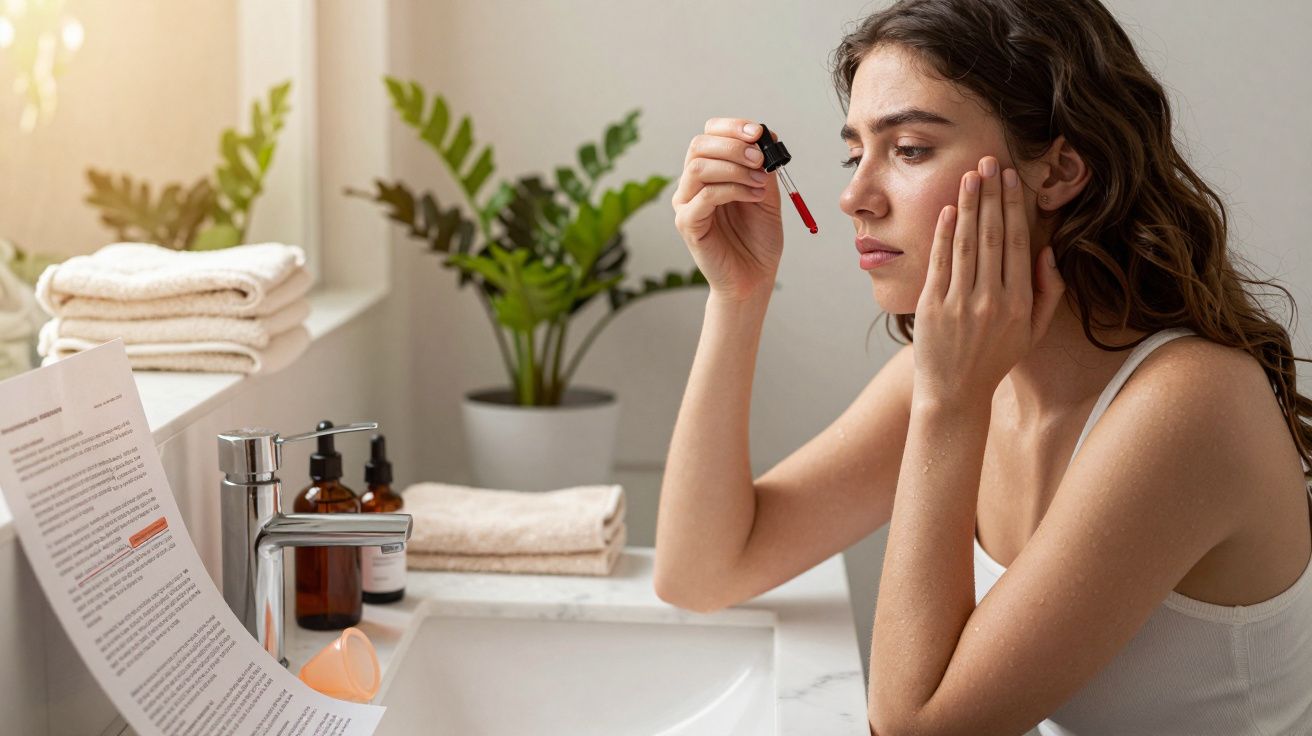
In the fast-shifting world of beauty trends, few ideas have generated as much controversy - and as much unease - as menstrual masking. The term refers to using menstrual blood on the skin, most commonly on the face, as a homemade skincare “mask”.
Propelled by social media, hashtags such as #periodfacemask have attracted billions of views. Typical clips show people spreading period blood on their skin for a short period and then washing it away, yet there is no consistent guidance on how much to apply or how long it should be left in place.
Supporters sometimes frame the practice as restorative or empowering, presenting it as a ritual that helps them feel connected to their bodies and to ancestral femininity. The key question, however, is what the evidence actually shows.
Menstrual masking and skin regeneration research: what the science really suggests
People who promote menstrual masking often claim that period blood contains stem cells, cytokines and proteins capable of renewing the skin. At present, there is no clinical evidence that applying menstrual blood topically is an effective skincare treatment. Even so, research into its biological components has produced findings of medical interest.
One study reported that plasma taken from menstrual fluid could substantially improve wound healing. In laboratory experiments, wounds treated with menstrual plasma achieved complete repair within 24 hours, compared with around 40% repair when using standard blood plasma.
This rapid regeneration is thought to relate to proteins and other bioactive molecules found in menstrual fluid - the same kinds of substances involved in enabling the uterus to rebuild itself each month.
On the back of this, scientists are investigating whether synthetic menstrual fluid could be developed to help manage chronic wounds.
Stem cell science has also highlighted menstrual blood–derived stem cells, commonly known as MenSCs. These cells can be expanded relatively easily and are able to differentiate into a wide range of cell types.
Research on mesenchymal stem cells (MSCs) from multiple sources indicates they may support skin repair by increasing collagen, softening wrinkles and releasing growth factors that help address damage from burns, ultraviolet (UV) exposure and wounds.
Because MenSCs appear adaptable and have shown a favourable safety profile in early work, they are viewed as a potential route towards medical treatments designed to regenerate skin and slow photoaging - premature ageing driven by long-term sun exposure.
It is also important to separate what happens in a laboratory or clinical development setting from what happens at home. Medical research uses controlled processing, standardised dosing and sterility measures - conditions that are not achievable in a bathroom routine.
In addition, menstrual fluid varies from person to person and from day to day across the cycle (including differences in thickness, cellular content and microbial load). That variability makes it difficult to generalise claims about skincare “results”, and it further underlines why controlled medical research is the appropriate setting for exploring any potential benefits.
Not the same as a “vampire facial” (PRP)
Some advocates compare menstrual masking to the celebrity-popularised “vampire facial”, associated with figures such as Kim Kardashian. A vampire facial typically involves platelet-rich plasma (PRP), which is derived from the patient’s own blood and then introduced into facial skin by injection.
Clinicians and researchers warn that this comparison is misleading. Menstrual fluid is not simply blood: it is a complex mix of blood, shed endometrial tissue (the lining of the uterus), vaginal secretions, hormones and proteins.
As menstrual fluid moves through the vaginal canal, it can also collect bacteria and fungi, including Staphylococcus aureus - a microbe commonly found on skin that can cause infection if it enters pores, broken skin or small cuts. There is also the possibility of transferring sexually transmitted infections (STIs) to the skin.
PRP, by contrast, is prepared under sterile clinical conditions. A small blood sample is taken, then spun in a centrifuge to isolate the platelet-rich fraction, which is injected back into the skin using fine needles.
Some practitioners may also combine PRP with dermal filler to produce quicker cosmetic changes. These procedures can cost thousands of pounds - unlike menstrual masking, which costs nothing and is easy to try, even if it is not supported by evidence.
“Body-based” beauty trends beyond menstrual masking
Menstrual masking is not the only unconventional beauty practice that uses bodily fluids. Urine therapy - applying urine to the skin - has historical links to Ayurvedic traditions and has previously been promoted as a way to “detoxify” the body or treat illness.
Some contemporary proponents claim it may help with acne or eczema, but these assertions are not backed by robust scientific evidence.
It is true that urine contains urea, an ingredient used in certain moisturisers. However, the urea in urine is present at much lower concentrations and is not the same as the purified, manufactured urea used in skincare formulations.
The broader suggestion that raw urine or menstrual blood can safely stand in for clinical-grade cosmetic ingredients is not supported by dermatological evidence.
Menstrual masking sits in a complicated space where body positivity, cultural ritual and pseudoscience can overlap. For some people, it functions as a celebration of menstruation and a refusal to accept stigma. For others, it is an unproven - and potentially unsafe - beauty trend.
There is no denying that menstrual fluid contains biologically active components. But any safe, effective use of those components belongs in carefully designed medical research and regulated product development, not in improvised skincare routines at home.
As with many viral health and beauty trends, it matters to distinguish symbolism from science. Menstrual masking may feel meaningful or empowering to some, yet from a dermatological standpoint it is better treated as a personal belief than as a reliable skincare practice.
Dipa Kamdar, Senior Lecturer in Pharmacy Practice, Kingston University
This article is republished from The Conversation under a Creative Commons licence. You can read the original article there.




Comments
No comments yet. Be the first to comment!
Leave a Comment