
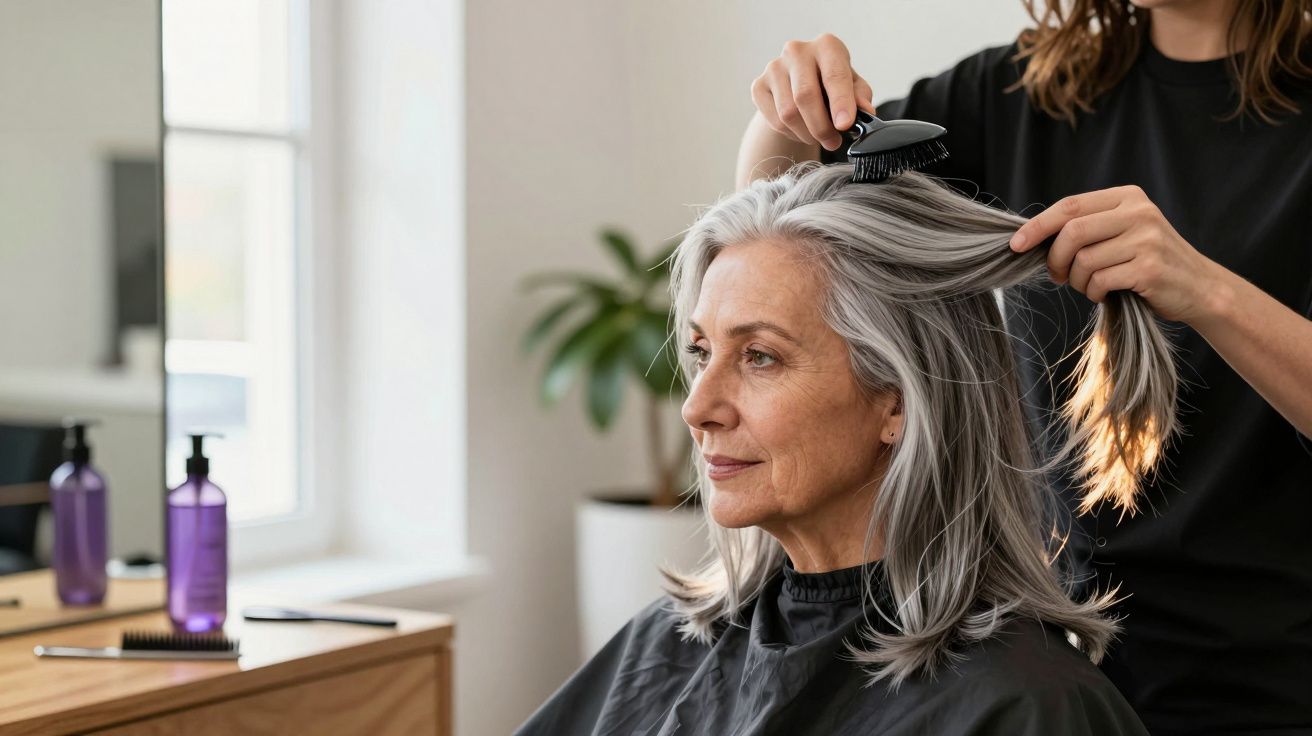
As more women step away from full-head dye, one discreet technique is changing how we wear grey hair after 50 - and it does it without the tell-tale root line.
Rather than battling every new white strand, many colourists are now enhancing what’s already there. Using reverse colouring, they work with natural greys to build depth, boost shine and create a softer, more youthful-looking frame around the face - without that harsh band of regrowth.
What reverse colouring really means
Reverse colouring (often described as reverse balayage or lowlighting) flips traditional highlighting on its head. Instead of lifting and lightening, the colourist places slightly deeper tones through the mid-lengths and ends to restore dimension.
Think of it as pencilling in shadows between silver strands so grey hair looks deliberate, multi-tonal and well finished.
It’s especially sought-after for salt-and-pepper hair - where natural brown, grey and white sit side by side. Rather than trying to erase the white, a colourist uses lowlights and carefully chosen toner formulas to refine undertones, improve shine and reintroduce contrast where hair can look flat or washed out.
Who reverse colouring suits best (especially for grey hair after 50)
This approach tends to work brilliantly for people who:
- already have roughly 30–40% grey or white hair (or more)
- want to move away from full coverage colour without feeling “fully grey” overnight
- prefer a natural, soft-focus result rather than a bold, fashion shade
- are happy to return to the salon a few times a year for upkeep
If your natural base is very dark (close to black) and your regrowth is bright white, you can still benefit - but your colourist may blend reverse colouring with other techniques, such as gently lightening remaining dark lengths, to avoid stark, stripy contrast.
How a reverse colouring appointment typically unfolds in the salon
Compared with a quick root touch-up, reverse colouring is usually more precise and step-led. Most appointments include the following stages.
The clarifying start
Many colourists begin with a clarifying shampoo to remove product build-up, pollution residue and yellowing caused by heat styling or hard water. Starting clean matters because toning grey and silver is subtle - and fresh, residue-free hair takes toner more evenly.
The toner (and sometimes gloss): the core of the technique
Next, the colourist applies a toner or a gloss - and in some cases, both. This isn’t the same as a permanent all-over dye; it’s typically a semi-permanent product worked through the lengths.
A toner can deepen the natural base by one to three levels while neutralising unwanted yellow or brassy hues, helping grey hair read as cooler, brighter silver.
On salt-and-pepper hair, the effect is usually a softer, smoky blend rather than a harsh divide between darker natural sections and stark white strands. A gloss also contributes shine, giving the hair a more refined, “salon-fresh” finish.
The lowlights: placing the shadows
For true reverse colouring, the stylist then adds lowlights in very fine slices. Small sections are deepened - typically with cool or neutral shades - to create depth in key areas such as under the top layer, through the nape, or around the face for framing.
- Very fine sectioning helps keep the result soft and believable.
- Deeper pieces are often concentrated where hair reads too pale or too flat.
- A skilled colourist will leave some bright white strands untouched for sparkle and contrast.
The aim isn’t solid coverage. It’s a multi-dimensional greige (grey-beige) blend that catches the light and avoids a blocky, “coloured” look.
A useful extra step: finishing and placement around the hairline
A thoughtful colourist will also consider how grey behaves around the temples and hairline, where contrast can be most noticeable. Slightly softer placement near the face can keep the look airy and modern, while still giving definition.
Why it can be so flattering after 50
As we age, skin tone, hair texture and density often shift. Reverse colouring works well because it responds to those changes rather than trying to overwrite them.
By softening harsh lines and enhancing silver brightness, reverse colouring can make features look fresher - without shouting “I’ve just had my hair coloured”.
Here’s how it can help in practical terms:
| Challenge | Effect of reverse colouring |
|---|---|
| Harsh demarcation line | No obvious “helmet” of colour, because toner and gloss fade gradually over 8–9 weeks. |
| Yellow or dull grey tones | Cool-toned patine/toner neutralises brassiness and brings out cleaner silver. |
| Thinner-looking hair | Lowlights create shadow and visual density, so hair can appear fuller. |
| Face looking tired | Gentle contrast around the face adds structure and a brighter overall impression. |
Because the gloss washes out softly rather than growing out sharply, you avoid the stark root band associated with permanent dye. For many women growing out decades of box colour, reverse colouring can act as an elegant transition rather than an awkward in-between stage.
How long it lasts and what maintenance looks like
The toners and glosses used in reverse colouring generally fade over 8 to 9 weeks. Instead of leaving a firm line, the result simply becomes more subtle, so the shift between appointments feels gradual rather than dramatic.
If you want to keep the same coolness and depth in your greys, plan on visiting the salon roughly every two months.
Some people extend appointments to 10–12 weeks, accepting that the tone may warm slightly as the gloss fades. The colour shouldn’t go patchy, but the shine and the ash effect will diminish with repeated washing.
Daily care for bright, silver-toned hair
Grey and white hair can be more porous and more fragile, so targeted maintenance is essential if you want the colour to stay crisp.
Purple and blue products: what they actually do
Shampoos and masks designed for grey or white hair often contain violet or blue pigments. They work on basic colour theory: purple helps counter yellow tones, while blue calms down orange warmth.
Used once or twice a week, a purple shampoo can keep silver shades looking clean, while a violet mask supports both tone and hydration.
On the days in between, a gentle, sulphate-free shampoo helps preserve your salon gloss without stripping it too quickly.
Hydration, nourishment and protection
Because grey hair’s cuticle can feel coarser, conditioning ingredients become particularly valuable. Products containing argan oil, shea butter or keratin can help to:
- smooth the hair fibre for better light reflection
- reduce breakage on finer, ageing strands
- stop ends frizzing and dulling the silver effect
A leave-in serum with UV and anti-pollution filters adds extra protection, helping prevent sun-related yellowing and shielding hair from environmental particles that can roughen the surface.
Temporary colours: experimenting without commitment
If you’re interested but cautious, temporary options provide a gentler entry point. Colour-depositing sprays, foams and masks can add an icy silver veil, a pearly sheen, or even a soft pastel hint over grey lengths.
These wash-out products let you try cooler (or slightly bolder) tones before committing to a full reverse colouring session.
Gloss treatments sit in a similar category. They won’t dramatically change your base shade, but they can amplify shine and help make salt-and-pepper hair look intentional rather than uneven.
Risks, limits and how to speak to your stylist
Although reverse colouring is typically milder than bleaching or repeated permanent dye, it still involves chemical processing. If toners or lowlights are overused without proper care, hair can feel drier over time.
The biggest risk is often dissatisfaction rather than damage: if lowlights are too dark or too concentrated, the result can look heavy instead of light, airy and youthful.
For your consultation, bring photos of salt-and-pepper hair blends you genuinely like, and be upfront about your colour history. Older permanent dyes, henna and at-home toners can all affect how new pigment settles. If you’re nervous about going cooler or deeper, ask for a discreet strand test underneath.
An additional practical point: if you have a sensitive scalp, mention it early. Your stylist can adjust product choice and timing, and advise on any patch testing that’s appropriate before toning services.
Useful terms to know before you book
These are common phrases you may hear during a grey-hair consultation:
- Patine / toner: a semi-permanent product that refines tone and boosts shine without fully changing your natural colour.
- Gloss: a clear or lightly tinted treatment designed to enhance shine, sometimes with mild colour correction.
- Lowlights: deeper strands placed through the hair to create shadow and dimension (the opposite of highlights).
- Porosity: how readily hair absorbs and releases moisture and colour; highly porous hair can grab toner quickly and fade faster.
What the transition can look like in real life
A realistic example: someone in their early 60s with around 60% grey, still colouring their hair dark brown, decides to stop full dye. Their stylist first lifts the remaining dark lengths gently, then uses reverse colouring with cool lowlights and an ash gloss. Over several months, the hair gradually evolves into a chic silver-brown blend - without the harsh, two-tone regrowth that often comes with quitting permanent colour cold turkey.
Used with care, reverse colouring turns salt-and-pepper hair from something you simply “get through” into a style choice in its own right - supported by intelligent toning, well-placed shadow and a more relaxed relationship with the salon chair.

Comments
No comments yet. Be the first to comment!
Leave a Comment