
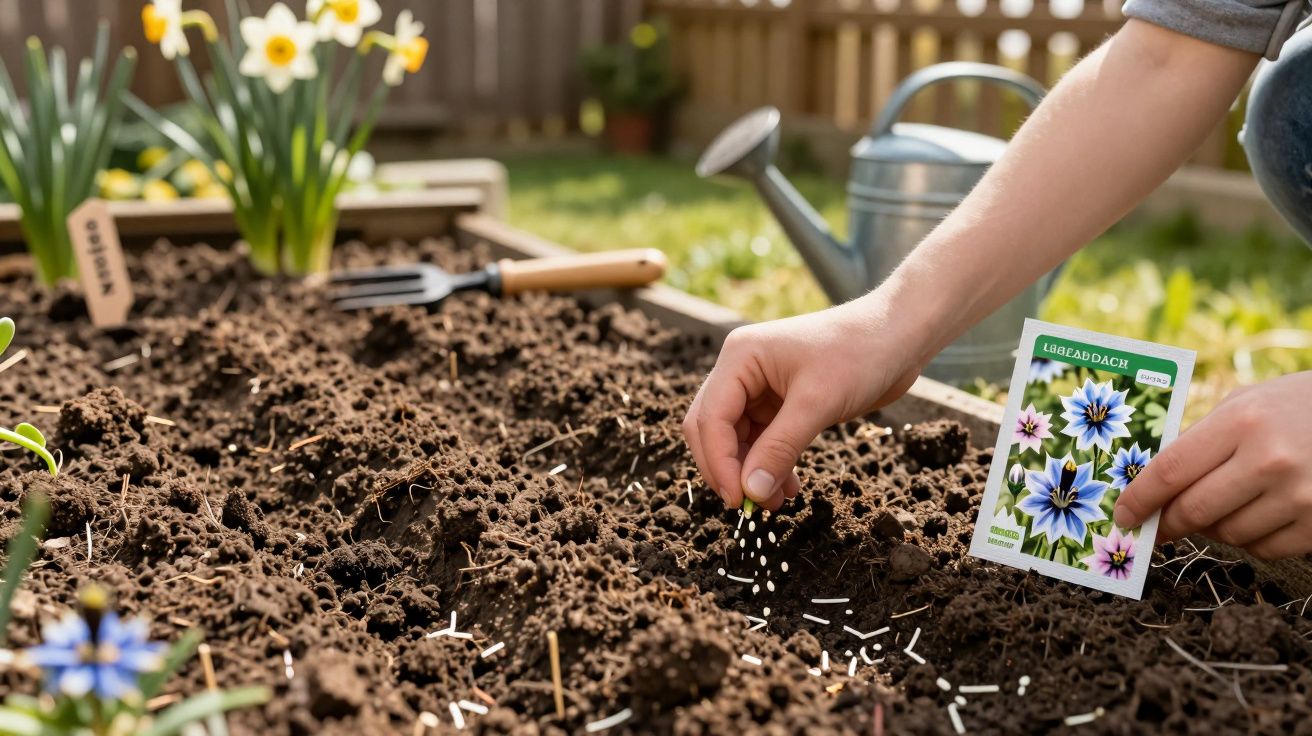
While many borders still look bare and a little gloomy in March, this is exactly the moment to set the scene for a surprisingly lush summer display. One annual flower, with a delicate wild-perennial charm, can make beds, paths and even vegetable plots look alive right through to late summer-almost on its own.
The flower that practically does the work for you: Nigella damascena (Love-in-a-mist)
The plant that garden professionals rave about is Nigella damascena, commonly known in English as love-in-a-mist. It has the best of both worlds: the carefree feel of a meadow flower and the refinement of a cottage-garden favourite. Its fine, star-like blooms sit in airy, thread-like foliage that looks like a soft green veil.
Most plants reach around 40–60 cm tall. Flower colours range from pale blue to white and gentle pink shades. That slightly accidental, “tousled” look is exactly why it’s so loved in naturalistic and romantic planting schemes.
Sow Nigella damascena in March and you’ll usually get a near-continuous ribbon of flowers from mid-June to the end of August-often longer.
A major advantage is its toughness for an annual. It grows quickly, copes well with ordinary garden soil, and forgives many beginner mistakes. That’s why it’s widely recommended as a perfect starter plant if you want a prettier garden without turning into a full-time gardener.
Why March is the ideal time to sow Nigella damascena
In March the soil begins to warm up and prolonged hard frosts become less common. That in-between stage is exactly what Nigella damascena prefers. The seeds don’t need summer heat; they do best in cool, fresh soil that’s no longer frozen.
- Sowing in March: flowering usually begins from mid-June
- Flowering period: until late August; in mild weather into September
- Perfect for: gaps in borders, mixed beds, cottage gardens, wildlife-friendly gardens
People who sow in March often notice the same pattern: at first, very little seems to happen. Then, a few weeks later, what was a dull strip of soil suddenly becomes a light blue or white “mist” across the bed. Many home gardeners describe this as the moment they decide the plant has earned a permanent place in their sowing list.
How to sow, step by step
The best part: Nigella damascena doesn’t require a greenhouse, modules or any complicated propagation kit. Sowing direct outdoors is absolutely sufficient.
1. Choose the right spot (for stronger Nigella damascena)
This plant loves sunshine. A fully sunny position produces sturdier growth and far more flowers. It will tolerate partial shade, but flowering is often noticeably lighter.
Just as important is a loose, well-drained soil. Love-in-a-mist really dislikes waterlogging. In most gardens, normal soil is perfectly adequate-there’s no need for any premium compost mix.
2. Prepare the soil
A few minutes of preparation before sowing makes a big difference later:
- Remove weeds thoroughly
- Loosen the soil and break up large clods
- If the soil is very poor, work in a little well-rotted compost
The finer and more crumbly the surface, the more evenly the seeds tend to germinate.
3. Sow correctly and water gently
Scatter the seeds on the surface. They should not be buried deeply, because they are light germinators. A very thin dusting of soil or fine compost is plenty.
After sowing, lightly firm the area with your hand and water using a fine rose or gentle spray. A strong jet can easily wash the seeds away.
Important: don’t sow too thickly. Dense seedlings may look lush at first, but they weaken each other and flower less.
The most common mistake: not leaving enough space
Many gardeners sow far too generously because they’re worried about bald patches. Later on, it backfires. When young plants end up packed together like a carpet, they compete for light and nutrients-leading to thin stems and smaller blooms.
Once seedlings have produced several true leaves, thin them out. Aim for 20–25 cm spacing. If you want especially large, airy clumps, you can increase this to 30 cm.
| Spacing | Effect in the border |
|---|---|
| under 15 cm | too crowded; competition; smaller flowers |
| 20–25 cm | balanced, airy clumps; plenty of flowers |
| up to 30 cm | fewer plants, but particularly impressive individual clumps |
Thinning can feel drastic at first. Even so, it pays off: the remaining plants grow stronger and generally keep flowering for significantly longer.
How to keep the display going for most of summer
Once established, love-in-a-mist largely looks after itself. In a typical British summer, an occasional watering during prolonged dry spells is enough. Constant irrigation isn’t necessary.
If you want the longest possible flowering season, deadhead regularly by removing spent blooms. That encourages the plant to put energy into new buds rather than seed production.
Snip off faded stems-and in return you’ll get fresh flowers for weeks. It’s one of the simplest ways to extend the season.
Many gardeners also cut Nigella damascena for indoor arrangements. The delicate stems usually last around ten days in a vase, sometimes longer if you change the water regularly. It looks especially good paired with:
- ornamental grasses
- gypsophila
- small-flowered roses
- other meadow-style flowers such as cornflower or cosmos
Self-seeding: your garden helps out next year
Towards the end of summer, the plant forms decorative seed pods. If you leave them in place, you may get a bonus the following spring: ripe pods split, seeds drop to the ground, and new plants appear on their own.
Over time this creates a lightly naturalised, lively look. If you’d like to keep things more controlled, cut off some pods and allow only a few to ripen in the most attractive spots.
Where Nigella damascena looks best
Love-in-a-mist is more versatile than its delicate appearance suggests. It isn’t limited to romantic borders-it can also suit modern gardens if you place it with intention.
- Among roses, it softens stiff, formal planting and adds movement.
- In the vegetable garden, it fills gaps after early crops and attracts pollinating insects.
- In gravel or dry beds, it provides a gentle contrast to stone and hard landscaping.
- In pots on balconies and patios, it creates the feel of a miniature wildflower patch.
Combined with other summer flowers, it can be striking. Next to bright yellow coreopsis it creates a vivid contrast; alongside pastel snapdragons it gives a softer, playful effect.
A couple of extra tips for UK gardens
If slugs are a regular nuisance in your area, keep an eye on new seedlings-especially during mild, damp spells. While Nigella damascena is generally robust, young plants can be nibbled before they get going. A simple check at dusk and removing hiding places (like boards and dense debris) can make a noticeable difference.
It’s also worth thinking about succession: for an even longer season, you can sow a second, smaller batch a few weeks after the first. That way, as the earliest plants begin to tire, later ones are ready to take over and keep the border looking fresh.
What beginners should also know
For families with children, Nigella damascena is a brilliant teaching plant: you can clearly show how a flower becomes a seed pod, and how seeds then produce new plants. The rounded pods look like tiny artworks in their own right.
At the same time, it’s important to be clear that-despite the attractive seed heads-this is not an edible plant. It is grown purely as an ornamental. If you have pets, it’s sensible not to let them chew on spent bouquets, even though serious poisoning is uncommon.
If you only start gardening later in the year, Nigella damascena can also be sown in autumn in some areas. A portion of the seed will overwinter in the soil and germinate in spring. March sowing, however, remains the most reliable route to a long, flower-filled summer.
In the end, this flower stands out for a rare combination: minimal effort, maximum impact, and a naturally relaxed look. Sow a packet in March, and by high summer you can sit back-watching a garden that looks effortlessly “designed” without any major work.



Comments
No comments yet. Be the first to comment!
Leave a Comment