
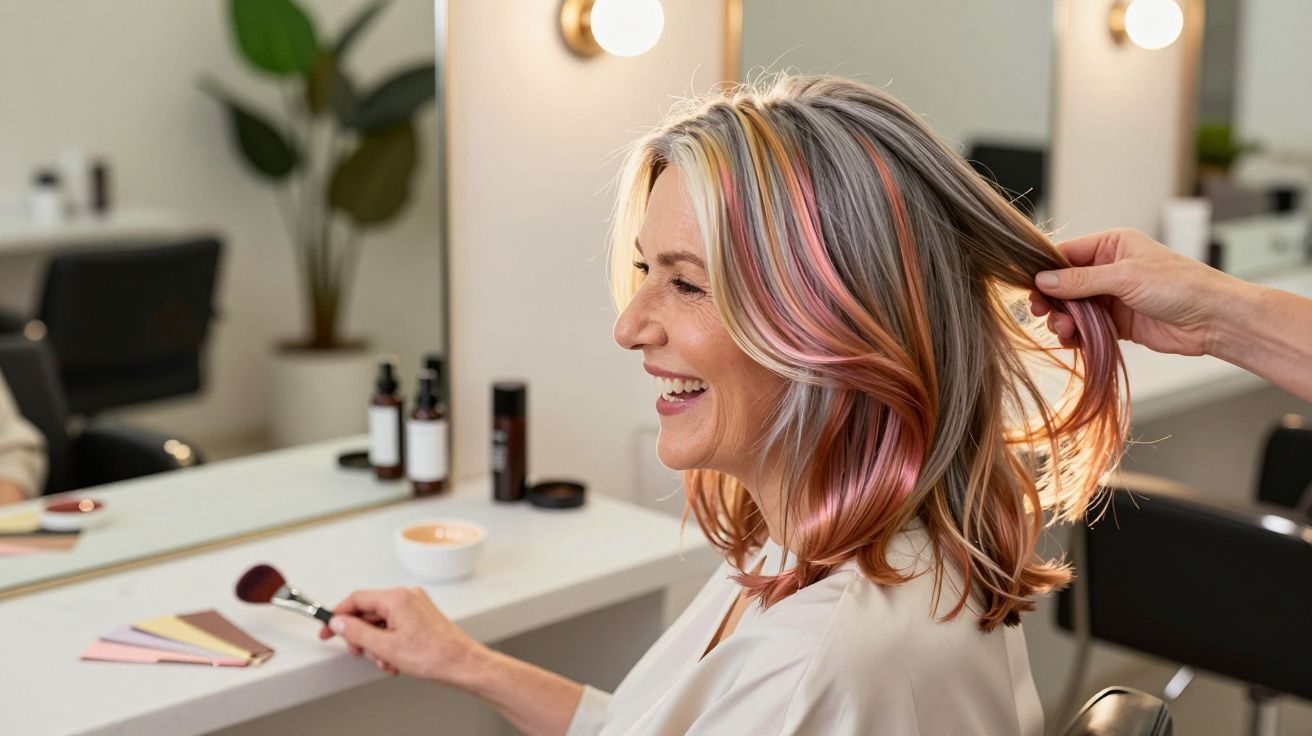
Between the cultural push to “age gracefully” and the sheer exhaustion of constant, high-maintenance dye appointments, a discreet new salon technique-stained glass hair-is becoming the quiet favourite in upmarket colour chairs.
What stained glass hair actually is
Stained glass hair is a colouring method that’s built to blend with grey rather than wipe it out.
Instead of applying a single, all-over shade, a colourist weaves ultra-fine highlights and lowlights through the hair. The tones stay close to your natural base, so you don’t get harsh bands, obvious stripes, or that clearly “done” highlight look.
Think of it as a soft-focus lens for your greys: the silver remains visible, but it reflects light in a smoother, more polished way.
The name is a nod to the earlier glass hair trend, where people chased a mirror-like finish with clear glosses and lamination-style treatments. Stained glass hair keeps the same light-reflective concept, but introduces subtle, tinted shifts-more like the gentle colour variations you see in cathedral stained glass.
How stained glass hair blends grey hair instead of fighting it
The effect comes down to two things: tiny sections and tiny tonal changes.
Rather than laying in thick panels of blonde or brunette, the colourist works in micro-sections placed with intention. Some strands are lifted slightly, others are deepened, and the natural grey hair is allowed to sit between them.
The goal isn’t to conceal grey completely-it’s to blur the boundary so the eye struggles to separate pigmented hair from silver strands.
Professionals emphasise that contrast needs to stay restrained. Go too light, and it reads as conventional highlights; go too dark, and the grey can look like obvious regrowth. Keeping the tones just one or two shades away from the base colour is what makes everything melt together.
Why celebrities over 50 are embracing stained glass hair
Colourists in London, New York, and Los Angeles report that some of their most exacting clients are requesting this softer approach.
Actresses in their fifties and sixties are increasingly stepping away from the flat, uniform colour that used to dominate red carpets. The new preference is hair that looks genuinely expensive and well looked after-without pretending ageing isn’t happening.
It also mirrors the wider shift in beauty: extreme fillers and overly smooth foreheads are being swapped for smaller, more natural-looking refinements. The underlying idea is the same-you can soften the signs of ageing without trying to erase them.
Low-maintenance colour with the “day 45” test
A major selling point of stained glass hair is how it behaves weeks later, not just when you leave the salon.
Many high-end colourists judge success at around a month and a half after the appointment. If the colour still looks diffused and the grey growth isn’t creating a hard line, the work has passed the “day 45” check.
With translucent, layered colour, plenty of clients can push appointments out to six-or even eight-weeks without feeling like they look “undone”.
Because the colour is sheer and the placement is broken up, new grey growth blends into the existing pattern instead of sitting beneath a solid block of pigment. That usually means softer roots and fewer last-minute bookings before a wedding, date, or important work event.
Stained glass hair placement to flatter the face
Stained glass hair isn’t only about camouflaging grey hair-it also changes how your features read.
Artistic directors in top salons often position brightness and depth around the cheekbones and jawline. As facial features naturally soften with age, carefully placed colour can reintroduce definition so the face doesn’t appear washed out.
Lightness near the eyes and temples can lift the expression, while slightly deeper tones around the jaw can restore structure.
Blondes often notice that traditional, face-framing highlights can make skin look flatter or paler over time. A stained glass approach keeps the glow, but adds strategically darker strands to sculpt the overall look.
Example placements your colourist might suggest
- Softer, brighter pieces near the eyes to make the gaze look more open.
- Slightly deeper lowlights just behind the ears for added depth in ponytails and updos.
- Fine, cool-toned strands through the fringe so they mingle naturally with silver hairs.
- A balance of warm and cool tones through the mid-lengths to stop long hair looking heavy.
Stained glass placement can also be adapted to different textures and cuts. On curls or waves, for example, colourists may focus on where the hair naturally catches the light so the blend reads dimensional without looking stripy when the hair moves.
At-home upkeep: glosses, glazes and “patinas”
When the salon colour starts to soften, you don’t necessarily need a full recolour.
Many professionals suggest using at-home glosses or glazes, sometimes described as “patinas”. These are semi-transparent formulas designed to add shine and a hint of tone, rather than depositing heavy pigment.
Picture them like a tinted lip oil for hair: a sheer wash of colour with high shine, not a solid lipstick.
Brands have increasingly borrowed technology from skincare and make-up-light-reflecting particles and conditioning polymers-to create a more reflective finish. The payoff is hair that looks smoother and less frizzy, which can make grey hair appear more intentional and less uneven.
To help the stained glass effect last, it also helps to use a gentle, colour-safe shampoo and a heat protectant if you blow-dry or use hot tools; shine and softness are a big part of what makes the blend look “expensive”.
| Product type | What it does | How often |
|---|---|---|
| Clear gloss | Boosts shine and softness without altering colour | Every 2–4 weeks |
| Tinted glaze | Adds warmth or coolness and revives faded areas | Every 3–6 weeks |
| Colour-depositing mask | Deep conditioning with a stronger tonal refresh | Occasionally, when hair looks dull |
Who stained glass hair works best for
This method can suit many hair colours and skin tones, but it’s especially helpful in a few common situations:
- People with early or scattered grey who don’t want to commit to full coverage.
- Anyone fed up with sharp root lines from traditional permanent dye.
- Clients with busy schedules who want fewer salon visits.
- Those aiming for an “age-inclusive” look rather than a dramatic makeover.
It can be tailored for brunettes, blondes, and redheads. On darker hair, the gap between base, highlights and lowlights needs careful control so the result stays soft rather than stripy. On very light blondes, translucent lowlights can prevent the overall shade drifting into a washed-out beige.
It’s also a useful stepping stone for people transitioning away from permanent, all-over colour: by reintroducing controlled variation, the grow-out often looks less abrupt while you move towards a more natural blend.
Things to discuss with your colourist
A thorough consultation is what keeps expectations realistic and results consistent. Before you book in, it’s worth thinking through three points:
- Your tolerance for visible grey: Are you happy seeing some silver, or do you want it only faintly noticeable?
- Maintenance budget and time: How often can you realistically come back to the salon?
- Preferred tone direction: Do cooler, ashier shades suit you best, or do warmer, golden tones flatter your skin more?
Bring reference photos where grey hair is visible rather than fully covered. That helps your colourist gauge how sheer or pronounced the stained glass hair effect should be.
Risks, limits and realistic expectations
Stained glass hair can make greying feel softer and more intentional, but it isn’t a magic eraser.
If hair is already around 80–100% white, the technique can be harder to balance. More lowlights may be needed to bring back depth, which can increase maintenance. In that scenario, some people opt to lean into an all-silver look and use glosses mainly for shine.
From a chemistry standpoint, even translucent dyes still change the hair fibre. Frequent colouring combined with heat styling can contribute to dryness or breakage, so bond-building treatments and gentle shampoos are worth considering. And if you have sensitive skin or a history of reactions to dye, a patch test is still essential.
Grey hair, identity and small acts of control
For many, stained glass hair sits between full acceptance and total denial of ageing.
It lets someone in their forties or fifties recognise themselves in the mirror-without ignoring the reality that their hair is changing. That small sense of control can feel surprisingly significant during a life stage that often includes shifts in work, health, and family responsibilities.
Used well, the technique is less about hiding a “flaw” and more about refining a feature-like a great blazer that sharpens the shoulders or a softly blurring foundation that evens the complexion. The grey remains part of the picture, simply seen through a kinder, more flattering stained-glass filter.




Comments
No comments yet. Be the first to comment!
Leave a Comment