
Yet it doesn’t have to end there.
Every winter, it happens to someone: you open the washing machine, pull out a beloved wool knit, and realise it’s suddenly more “child-sized” than cosy. The usual outcome is a frustrated sigh and a jumper relegated to the back of the wardrobe-or straight into a charity bag. But that’s often jumping the gun. There’s a simple (and slightly unexpected) method that can relax tightened wool fibres and help a shrunken sweater (jumper) regain softness and some of its former size. It’s a technique quietly passed around by laundry pros, repair shops, and the kind of online communities that prefer fixing clothes to binning them.
Why wool shrinks: the hidden trap in your washing routine
Wool doesn’t behave like cotton or polyester. Each wool fibre is a natural micro-spring, covered in tiny overlapping scales. Those scales are part of what makes wool brilliant for warmth: they trap air, help regulate temperature, and draw moisture away from your skin.
Run wool through the wrong combination of heat, movement and chemicals, and those same scales start causing trouble. Warm-to-hot water, strong agitation and harsh detergents encourage fibres to rub, twist and lock onto one another. That process is called felting. Once felting kicks in, the knit tightens up, the fabric turns firmer, and the garment shrinks in all directions.
When wool felts, the fibres tangle and clamp together, turning a flexible knit into a dense, smaller fabric.
Even a machine setting labelled “wool” isn’t always enough. Shrinkage tends to happen when several factors pile up at once:
- Water temperature above 30°C
- A fast spin, heavy drum movement, or an overly long programme
- Standard detergent instead of a wool wash or delicate soap
- An overfilled drum that increases friction
- Tumble drying, even on a low-heat setting
Once you can see the difference, it’s easy to assume the jumper is done for. But in plenty of cases-especially when the wool hasn’t felted too severely-the fibres can still be encouraged to relax and stretch back part of the way.
Rescuing a shrunken wool sweater: the softening bath that can help
Textile conservators and knitwear specialists have relied on controlled soaking for years to work with natural fibres. The principle is straightforward: soften the fibre, and you often get a chance to guide it back towards a roomier shape.
At home, that translates into a lukewarm soak plus a gentle softening agent-something that helps wool relax rather than swell and matt together. The goal isn’t to completely “reverse” felting (that’s rarely realistic), but to recover enough size and comfort to make the garment wearable again.
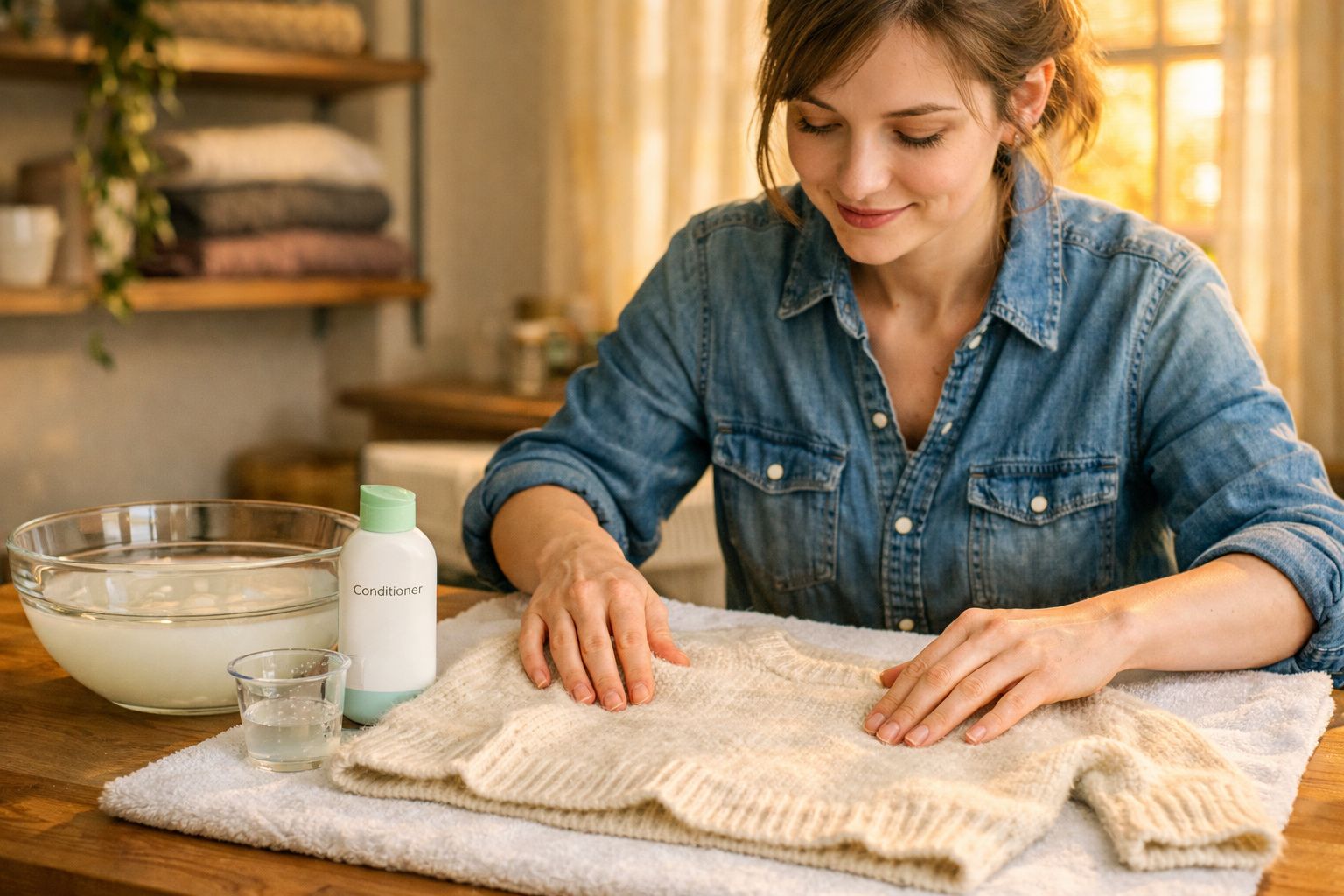
A carefully prepared soak can loosen the grip between wool fibres, giving you a window of time to reshape the sweater by hand.
What you’ll need for the rescue soak
Most people already have what’s required. Laundry professionals usually recommend:
- A large bowl, basin, or sink with about 2 litres of lukewarm water (roughly 30°C)
- Either 4 tablespoons of white vinegar or hair conditioner (silicone-free), or 2 tablespoons of vegetable glycerine
- 1 clean bath towel for drying and shaping
Vinegar can help shift the pH back into a wool-friendly range, keeping fibres more flexible. Silicone-free conditioner can lightly coat and lubricate fibres so they slide past each other more easily. Glycerine draws in moisture and can leave the knit feeling noticeably more supple. Whatever you choose, don’t overdo it: you want controlled softening, not a slippery garment that’s awkward to handle.
Extra tip (worth doing if the jumper is coloured): if you’re using conditioner or vinegar for the first time on a dyed knit, test a hidden area briefly to make sure the colour doesn’t bleed.
Step-by-step: stretch without tearing
Once your bath is ready, the method matters just as much as the ingredients. Move too quickly and you’re more likely to break fibres than relax them.
1) Soak-never scrub
Lay the jumper onto the water and gently press it down so it absorbs evenly. Leave it alone for at least 30 minutes; if the wool is thick or tightly knitted, 45 minutes often works better.
As it soaks, don’t rub, wring, or “massage” the fabric. The liquid and softener need time to penetrate the knit. Extra movement here adds stress when you want the opposite.
2) Remove water gently
Lift the garment with both hands so its weight is supported. Let it drip for a few seconds, then lay it flat on your towel. Roll the towel up with the jumper inside and press lightly to squeeze out most of the moisture.
Never twist or wring a wet wool sweater; rolling it in a towel keeps the fibres aligned and protects the knit.
You’re aiming for damp, not dripping. If it’s too wet, reshaping becomes patchy and some areas can stretch more than others.
3) Reshape while the fibres are relaxed
Lay the damp jumper flat on a dry towel or another clean surface. Start by squaring up the shoulders and tidying the neckline. Then, using both hands, ease the fabric outwards:
- Pull along the side seams to restore chest width
- Gently extend from the hem to recover body length
- Work from wrist towards shoulder to loosen and lengthen the sleeves
Do this in small steps-just a few millimetres at a time-repeating the motion rather than yanking hard once. For a dependable reference, compare it with a similar jumper that fits well. You can even place the “good” jumper underneath as a rough template.
If one area refuses to budge-cuffs and waistbands are common trouble spots-stretch that section, pause for a minute, then try again. Wool usually responds better to patient, repeated coaxing than one forceful pull.
Optional but helpful (for accuracy): a tape measure, foam blocking mat, and rust-proof pins can make reshaping more precise, particularly around sleeve length and body width. This is essentially a simplified form of knit “blocking”.
4) Hold the new shape as it dries
Dry the jumper flat, away from radiators, direct sunlight, or heated flooring. Too much heat firms fibres again and can undo the gains you’ve made. Drying can take up to 24 hours, and it’s worth checking a couple of times to adjust the outline if any parts start contracting slightly.
| Stage | What to do | What to avoid |
|---|---|---|
| Soaking | Use lukewarm water and a mild softener | Hot water or vigorous agitation |
| Water removal | Press inside a towel and keep it supported/flat | Twisting or wringing the knit |
| Reshaping | Stretch slowly, in small increments | Pulling hard in one direction |
| Drying | Dry flat and adjust the shape now and then | Hanging the garment or applying direct heat |
How to stop your wool shrinking next time
Even if the rescue method works surprisingly well, prevention is still faster-and cheaper. Most disasters come from tiny “it’ll be alright” shortcuts rather than total ignorance.
Set up a wool-safe routine
A few tweaks make a big difference:
- Turn jumpers inside out before washing to reduce surface friction.
- Put each knit into its own mesh laundry bag to limit rubbing against other items.
- Choose a cold wash or a programme capped at 30°C, with a very low spin.
- Use a detergent made for wool, or only a small amount of mild soap.
- Avoid fabric softener with strong synthetic perfumes, which can coat fibres in unhelpful ways.
Many wool garments don’t actually need washing that often. Often, a few hours airing-on a hanger or laid flat-will shift odours and moisture. For minor marks, spot-clean with a damp cloth and a drop of gentle soap rather than running a full cycle for one stain.
Another prevention detail: avoid enzyme-heavy “biological” detergents unless the label clearly says they’re suitable for wool, as they can be tougher on animal fibres.
Handle drying and storage like a pro
After washing, wool behaves best when it’s well supported. Dry jumpers flat on a towel or drying rack. Hanging them while wet can pull the shoulders and neckline out of shape. When the knit is nearly dry, you can fine-tune the fit again by hand: straighten hems, line up sleeve seams, and gently nudge the neckline back into place.
For longer-term storage, folding is usually better than hanging-especially for heavier knits. If moths are a concern, keep wool items in breathable garment bags with cedar blocks or lavender sachets. Moths are less interested in clean knitwear than pieces stored with traces of sweat or food.
When to accept defeat-and when to get creative
Not every jumper can be brought back. If the knit has turned stiff, dense, and barely stretches at all, the felting may be too advanced, and the softening bath might only produce a small improvement.
Even then, it doesn’t have to be wasted. Heavily felted wool is often repurposed into:
- Cushion covers or hot-water-bottle sleeves
- Pot holders and trivets
- Slippers or insoles cut from the thick fabric
- Pet blankets or toy stuffing
Repair cafés and visible mending groups often share simple upcycling patterns for felted jumpers. A bad wash can become useful material for a project rather than a guilty contribution to landfill.
Wool labels, blends and risk levels: what to check before washing
This rescue approach won’t act the same on every knit, because fibre content changes everything. A label that says “100% merino wool” will respond differently from one marked “wool 30%, acrylic 70%”. As a general rule, the higher the wool content, the greater the risk of felting-but also the better the chances of reshaping if you act early.
Check the care label before any wash: it tells you not only how to clean, but also how the fabric might react to heat and movement.
Cashmere, alpaca and other premium animal fibres tend to behave like wool, but they can be even more delicate. They may respond well to the same softening bath, yet they need extra restraint during stretching because fibres can snap if pulled too hard. Blends with synthetics often shrink less, but if you overstretch them while drying, they can lose their original drape.
Understanding these differences helps you choose between hand-washing, a machine wool cycle, or dry cleaning. It also changes what you do when shrinkage happens: rather than panicking, you can grab a basin, a little vinegar or conditioner, a towel-and give the jumper a proper second chance.



Comments
No comments yet. Be the first to comment!
Leave a Comment