
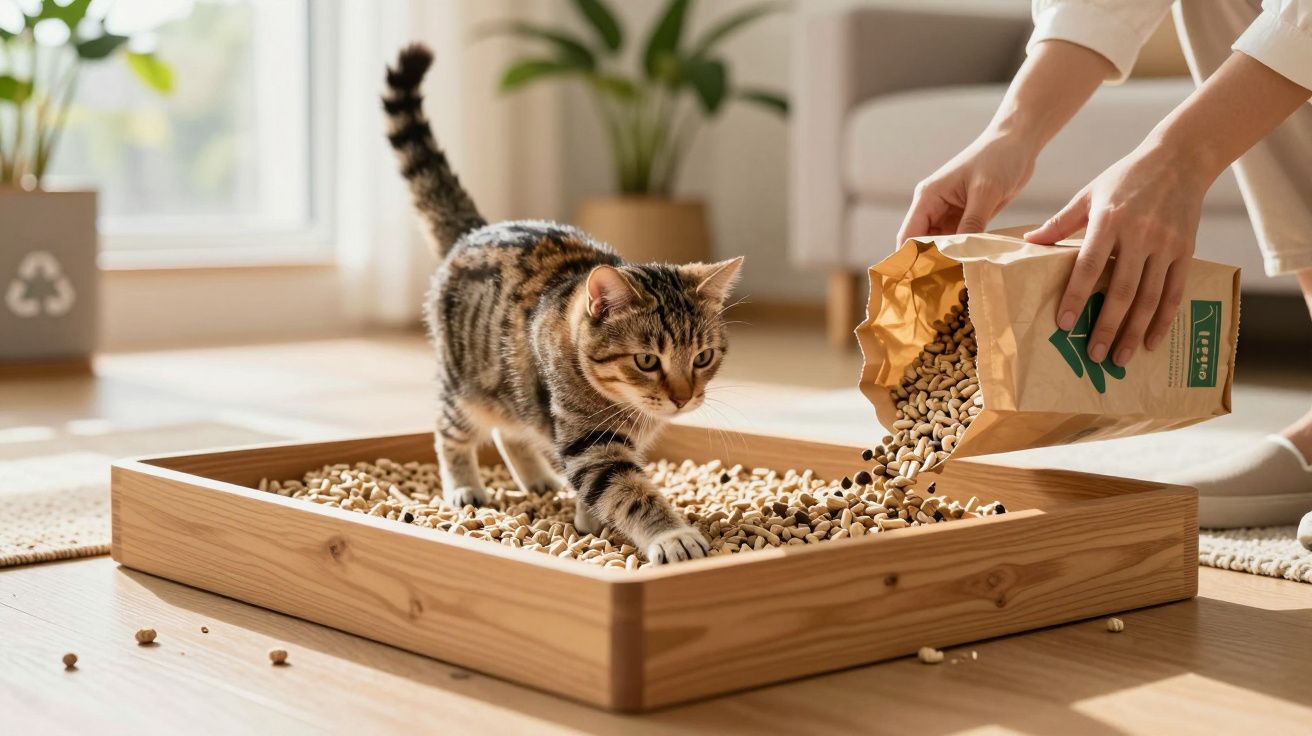
Behind the drama there is often an unassuming detail in the litter tray.
Many owners simply grab the first brightly coloured bag of cat litter they see in the supermarket – then later wonder why the house smells, why there are “protest puddles” beside the tray, or why their cat seems to be coughing all the time. Litter choice may feel trivial, but it affects comfort, health and even your household’s environmental footprint. If you understand what cats genuinely like under their paws, you’ll save time, money and a great deal of cleaning.
Why cats can be so fussy about cat litter
Sensitive paws: texture makes or breaks it
Cats are extraordinarily sensitive to what they stand on. Their paw pads contain countless nerve endings that register surface, temperature and vibration. Coarse, hard or sharp-edged granules can feel to them like walking barefoot over pointed gravel.
When a cat refuses the litter tray, it is often not “bad behaviour” at all – it is discomfort or pain. Common signs that the cat litter isn’t suitable include:
- Your cat places only the front paws in the tray, then backs out again.
- They balance on the rim to avoid stepping on the litter.
- Urine or faeces suddenly appear directly in front of the tray or elsewhere in the home.
A surface that resembles loose soil tends to work best: soft, slightly yielding and easy to scratch through. That way, your cat can follow its natural instinct to bury urine and faeces without every movement stinging the paw pads.
The more pleasant the litter feels, the more consistently a cat stays clean and reliably uses the litter tray.
Dust clouds irritate lungs and mucous membranes
Many traditional mineral litters kick up thick dust clouds when poured or scratched. People instinctively hold their breath – cats do not have that option. Their head is right above the dust source.
Possible consequences include:
- constantly watery eyes or crusting around the eyes
- sneezing, a snuffly nose or a “cold” that never seems to clear
- wheezing breathing, especially in older or sensitive cats
People with allergies or asthma can react to these fine particles too. Choosing low-dust alternatives protects not only your cat, but everyone in the household.
Why pressed wood cat litter is currently a favourite
High absorption helps prevent a soggy tray
Modern plant-based litters made from pressed wood are widely regarded as one of the most convincing options at the moment. The pellets break down into fine wood fibres when they come into contact with liquid and absorb urine very effectively.
Compared with clumping clay made from bentonite or similar minerals, you don’t get heavy, sticky clods that cling to the scoop and harden onto the base of the tray. The surface stays drier and more stable underfoot, which makes routine cleaning noticeably easier:
- Remove solid waste daily.
- Sieve out the used, crumbled wood fibres with a sieve scoop or shovel.
- Top up only what is missing, rather than replacing the entire contents each time.
Good absorbency means less smell, less waste and less work.
Extra tip (often overlooked): pressed wood works particularly well in a tray system with a sifting insert (two trays or a sieve tray). The broken-down fibres fall through, while intact pellets remain on top, speeding up daily maintenance without increasing litter use.
Wood naturally binds ammonia odours
The sharp smell of cat urine is largely driven by ammonia, which forms as compounds in urine break down. In relatively inert mineral litter, bacteria can multiply easily – and the odour can build quickly.
Wood fibres behave differently: their porous structure doesn’t just absorb liquid, it also reduces the conditions bacteria thrive in. As a result, ammonia formation can slow down markedly. Many owners report that, instead of a strong “litter tray” smell, they notice a mild woody scent – similar to a joiner’s workshop or a stable with fresh bedding.
Scented litters try to mask urine odour, but fragrance can mingle with ammonia and end up smelling artificial and, over time, unpleasant. Unscented wood litter relies on odour binding rather than a fog of perfume.
A cleaner home, less rubbish: cat litter as an environmental issue
Natural raw materials instead of hard-to-dispose minerals
Traditional cat litter is often produced from clay or other minerals. These materials must be extracted, dried, transported and later disposed of as residual waste. In many local authority areas, such litter ends up in energy-from-waste incineration or landfill.
Wood-based options, by contrast, typically use by-products from the timber industry such as sawdust. Pellets can be produced without intensive chemical processing, and many products are compostable or at least break down more readily.
| Type of cat litter | Raw material | Typical disposal route |
|---|---|---|
| Mineral (bentonite) | Clay / minerals | Residual waste, incineration |
| Plant-based, wood | Wood offcuts, sawdust | Depending on local council: food & garden waste or residual waste |
| Plant-based, plant fibres | e.g. maize, straw | Often compostable; follow the manufacturer’s guidance |
Disposal rules vary by council, so checking your local waste guidance is worthwhile. As a rule, faeces should never go on a home compost heap; urine-soiled litter may be permitted in some schemes depending on the litter type and local rules.
Additional perspective: even when a product is labelled “biodegradable”, that does not automatically mean it can go into every food & garden waste bin. Councils set their own acceptance criteria, and some exclude pet waste entirely. When in doubt, dispose of used litter via residual waste and prioritise lower-dust, lower-odour options to reduce how much you need overall.
Fewer crumbs tracked all over the house
Another constant frustration is fine grit that works its way into carpet fibres, sticks to socks and somehow ends up in bed. Here, the weight and shape of the litter matters.
Wood pellets and coarser plant-based granules are less likely to cling to fur and paws. A mat or small runner placed at the tray entrance strengthens the effect. Many owners find they vacuum far less often after switching to heavier, less trackable wood litter.
If you’d rather not reach for the hoover four times a day, denser, slightly heavier litter usually helps.
How to find the right cat litter for your cat
Switch gradually instead of changing overnight
Cats are creatures of habit. A full change from one day to the next can be stressful. A gradual approach is usually best:
- Replace roughly a quarter of the old litter with the new one.
- Over 1–2 weeks, slowly increase the proportion of the new litter.
- Watch your cat’s response: do they enter calmly, scratch normally and remain clean?
If your cat seems unsure, a second litter tray can help: one with the old litter and one with the new mix. This allows the cat to choose, and many transition naturally in their own time.
What owners should look for when buying
It pays to look beyond marketing claims. Useful questions include:
- How much dust is produced during pouring and scratching?
- Is the surface soft enough for sensitive paws?
- How well are urine and odours genuinely bound?
- How often does the entire tray need to be emptied and washed?
- What is the litter made from, and what does disposal look like locally?
Trial packs or small bags are ideal for comparing brands without storing a year’s supply in the cupboard.
Practical litter tray tips that matter as much as the litter
More than one tray: location, size and hygiene
Even the best cat litter cannot compensate for a poor set-up. These rules of thumb are widely recommended:
- Provide at least one litter tray per cat, plus one extra.
- Never place the tray right next to food and water bowls.
- Choose a quiet, draught-free spot that is still easy to reach.
- Use a tray large enough for the cat to turn around and scratch comfortably.
- Remove faeces daily, top up regularly and carry out full cleans as needed.
Covered hooded trays can keep smells contained, but they also trap humidity and fumes inside. Sensitive cats may avoid them. If odours are an issue, it is usually more effective to adjust litter choice, cleaning frequency and ventilation than to rely on “fragranced lids”.
A practical addition: litter depth can influence acceptance. Too shallow and urine reaches the base quickly; too deep and some cats feel unstable. Many cats do well with around 5–7 cm of litter, topped up little and often to keep the surface dry and inviting.
If your cat is still toileting outside the tray
If toileting behaviour changes suddenly, a medical issue is more likely than “protest”. Possible causes include:
- cystitis or urinary stones
- pain when passing stools, for example due to constipation
- osteoarthritis, which can make stepping into high-sided trays difficult
- stress in a multi-cat household
In these situations, the first step should be a visit to the vet. Only once physical causes have been ruled out does it make sense to fine-tune the litter, the tray type and the overall set-up.
What makes pressed wood appealing for people and cats
Plant-based litters are often much lighter than mineral options. You notice that when carrying bags home – and again when doing a full change. Anyone with back problems, or anyone managing multiple trays, will appreciate every kilogram saved.
Another benefit is that many wood litters come without strong perfume and smell fairly neutral. That can suit households with babies, sensitive family members, or anyone who finds artificial fragrances irritating.
In the end, every cat has individual preferences. However, practical experience consistently shows that a soft, low-dust, highly absorbent plant-based cat litter, especially pressed wood, suits most cats well – while also easing the load on owners’ noses, lungs and bins.

Comments
No comments yet. Be the first to comment!
Leave a Comment