
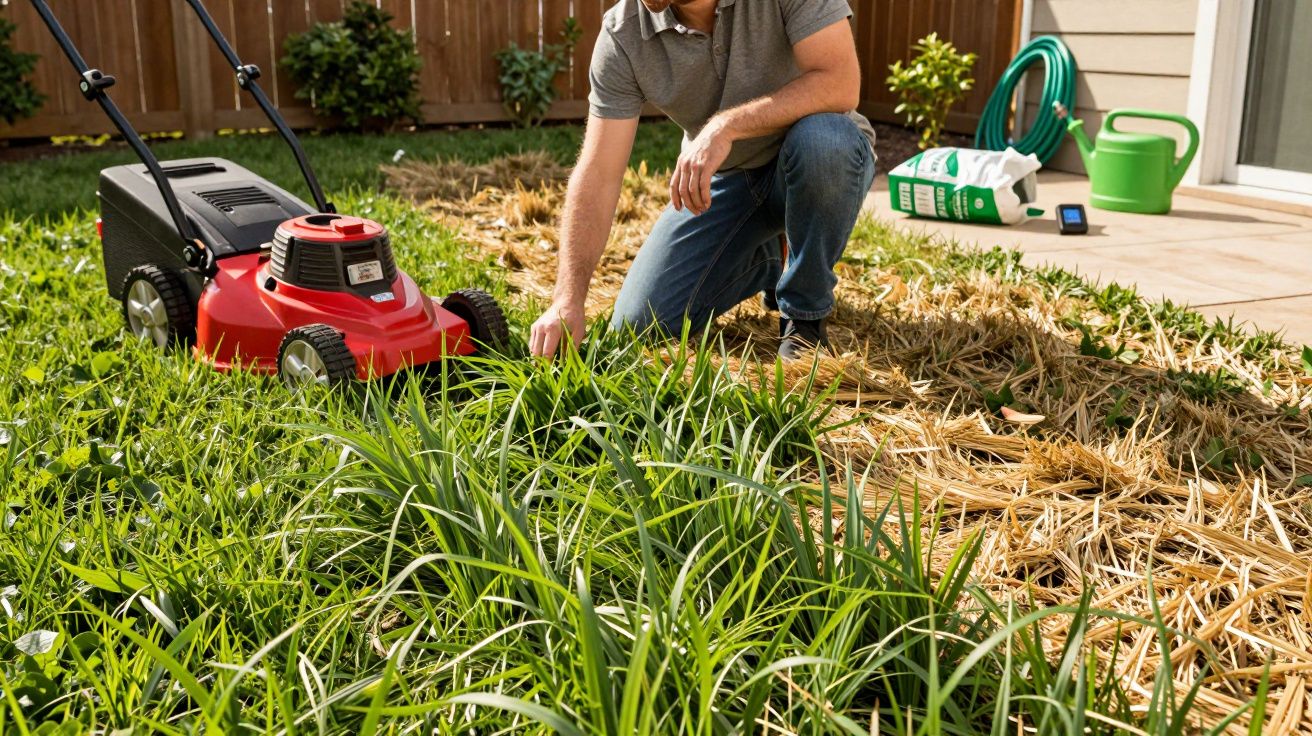
Most people reach first for fertiliser, extra watering or pricey lawn seed. The real game-changer is often ignored: the cutting height setting on your lawn mower. If you consistently match the cutting height to your lawn type and the season, you protect the soil, encourage stronger roots and end up with a tough, lush green carpet rather than a scorched patchwork.
Why cutting height makes or breaks your lawn
Every blade of grass needs enough leaf area to produce energy for the roots through photosynthesis. Cut too low, and you remove those “solar panels”. The grass weakens, the soil heats up, and weeds and moss quickly move into the gaps.
Rule of thumb: never remove more than one third of the current blade length in a single cut - the famous one-third rule.
Go lower than that and you’re effectively shaving the lawn. Gardeners call this scalping: the growth points are damaged, the grass retreats and bare patches appear. Those areas dry out faster and become prime real estate for dandelions, clover and similar opportunists.
How often you mow is tied directly to growth rate. In peak growing periods, mowing every 4 to 7 days is normal; in spring, when growth can be explosive, you may even need two cuts per week - but always moderate cuts, never an extreme “buzz cut”.
The ideal cutting height for different lawn types
A hard-wearing family lawn needs different settings from an ornamental front lawn or a part-shaded area under trees. Use this guide to get your bearings:
| Lawn type / use | Recommended cutting height |
|---|---|
| Family lawn / play area | 3–5 cm |
| Ornamental lawn (rarely walked on) | 2–3 cm, but in hot weather closer to 5 cm |
| Shade lawn | 5–6 cm all year |
| Large, low-maintenance meadow-like areas | 5–8 cm |
The more the area is used, the more you need a bit of blade length as a “shock absorber”. An ultra-short ornamental lawn tolerates very little foot traffic and demands intensive feeding and care.
If you know your grass species
Many home lawns are blends of different grasses. If you can identify the dominant species, you can fine-tune the setting further:
- Cool-season grasses such as Poa (meadow grass) are typically happiest around 6 to 9 cm.
- Fescues tend to prefer 7.5 to 10 cm and react poorly to cutting too low.
- Perennial ryegrass usually copes well at 5 to 7.5 cm.
- Warm-season “summer lovers” such as Bermuda or Zoysia can tolerate 1.5 to 5 cm, but they require professional-level care and lots of sun.
If you don’t know what’s in the seed mix, sticking to 3 to 5 cm for a typical domestic utility lawn is a safe bet. That range balances a tidy look with good resilience under stress.
Seasonal adjustment: raise and lower the cutting height through the year
Your lawn faces completely different conditions in spring, summer, autumn and winter. Keeping the cutting height fixed all year leaves performance on the table.
Spring: a denser carpet with a slightly shorter cut
In spring, it pays to set the mower towards the lower end of the recommended range, without breaking the one-third rule. A slightly shorter cut encourages tillering: a single shoot produces additional side shoots. The lawn visibly thickens and gaps close up.
Summer: lift the height to prevent scorching
When prolonged heat or dry spells are on the horizon, raise the mower noticeably - to at least 5 to 6 cm. Longer blades shade the soil, reduce evaporation and keep the root zone cooler.
Dropping to 2 cm in mid-summer like a football pitch risks straw-coloured, burnt patches - even if you’re watering.
Mowing intervals can stretch a little in summer because growth slows. The key remains the same: never go from “tall and lush” to “very short” in one pass.
Autumn and winter: ease back gently
In autumn you can gradually reduce the cutting height again. Don’t finish the season too low, otherwise the lawn heads into winter weakened. In winter, only a handful of higher cuts are needed - and only when the ground is neither frozen nor waterlogged.
Never mow wet grass: the underestimated mistake
Wet grass bends over, clumps together and is more likely to be torn than cleanly cut. The tips fray, cut edges dry brown, and fungal diseases get an easy opening.
- Mow only when the lawn is dry, where possible.
- If you have no choice: set the cutting height a little higher and use the grass collector.
- Avoid trampling wet grass before mowing, otherwise you’ll leave visible “ironing lines”.
- Switch off the mulching function in wet conditions to prevent clumps and rotting.
Blade sharpness matters just as much. Dull blades batter grass like a club: you’ll see ragged tips and a grey-brown haze across the lawn, even if the cutting height was “correct” on paper.
Extra tip: mowing direction and mower type (often overlooked)
To reduce wear and improve an even finish, alternate your mowing direction (for example, north–south one week and east–west the next). Changing direction helps prevent the grass from permanently leaning one way and makes the cut look more consistent.
It’s also worth knowing that different machines cut differently: cylinder mowers tend to shear cleanly, while many rotary mowers can be harsher when blades are blunt. Whatever the mower type, the best cutting height in the world won’t help if the blade can’t make a clean cut.
Young or stressed lawns: a special programme for problem areas
Newly sown lawns and renovated patches are particularly sensitive. The first mow is usually done when blades reach 8 to 10 cm. Then cut very cautiously down to 5 to 6 cm.
If you overseed, a two-stage approach can work well: first reduce from roughly 8 cm to 5 cm, then-once the young plants are clearly established-drop from 5 cm to about 3 cm, if your lawn type allows it. This reduces the chance of the mower damaging delicate new shoots.
Back from holiday and the lawn is knee-high? This is where the one-third rule acts like a safety net. Do two to three cuts a few days apart, removing no more than a third each time, rather than scalping everything down to utility-lawn height in one brutal session. Once growth reaches around 15 to 20 cm, it’s often better to start with a strimmer or brushcutter before bringing the normal mower back into play.
Setting the cutting height on your lawn mower in a practical way
The height scales on many mowers are approximate, and they vary by model. If you want certainty, measure what you’re actually achieving.
- Place a piece of card on the lawn.
- Mow a short strip with your chosen setting.
- Check the real remaining blade length with a ruler or tape measure.
- Adjust the height lever until you hit the target value.
Alongside this, adopt a simple maintenance routine: after 20 to 25 operating hours, sharpen or replace the blades. Before any adjustments, the mower must be switched off and secured against accidental starting - whether it’s battery, electric or petrol.
Many “miracle cures” for lawns are unnecessary if the blades are sharp, the cutting height is right, and the ground is reasonably dry.
How fertilising, watering and cutting height work together
Cutting height never operates in isolation. A very short lawn needs more nutrients and water because it has less leaf area to build reserves. A slightly higher lawn copes better with missed watering and often does well with more moderate feeding.
If you mow too short while also applying heavy fertiliser, you encourage soft growth that’s prone to disease. Combined with wet conditions, this can practically invite fungal problems such as Dollar Spot or snow mould. A healthy, middle-of-the-road cutting height strengthens the lawn’s natural advantage over moss and weeds - without chemicals.
Extra tip: clippings management without compromising the lawn
When conditions are dry and you’re following the one-third rule, finely chopped clippings can be left on the surface (mulching) to return nutrients to the soil. If the grass is long, damp or growing fast, remove clippings with the collector to avoid smothering, clumping and decay.
Terms and real-world examples for everyday gardening
When professionals talk about tillering, they mean a single blade producing new side shoots. The more often you mow moderately, the more the lawn branches and thickens - making it denser, tougher underfoot and more even in appearance. By contrast, when you cut radically short, the plant is more likely to retreat rather than produce new side shoots.
A clear example: two identical gardens. In the first, the owner keeps the mower consistently at 5 cm and mows every five to seven days. In the second, the neighbour stubbornly uses the lowest setting and only starts the mower every two weeks. After one summer, garden one has an even, slightly springy green carpet. Garden two shows yellowing, bare patches and thick moss along the shaded edges - even though both used the same fertiliser.
If you want to improve your lawn long-term, you don’t necessarily need to scarify immediately, overseed straight away or install an automatic irrigation system. A frank look at your cutting height and the condition of your blades often produces visible change within weeks. Set up properly, the mower stops being just a noisy machine and becomes your most important lawn-care tool - the difference between ongoing “lawn drama” and a green summer lounge underfoot.






Comments
No comments yet. Be the first to comment!
Leave a Comment