
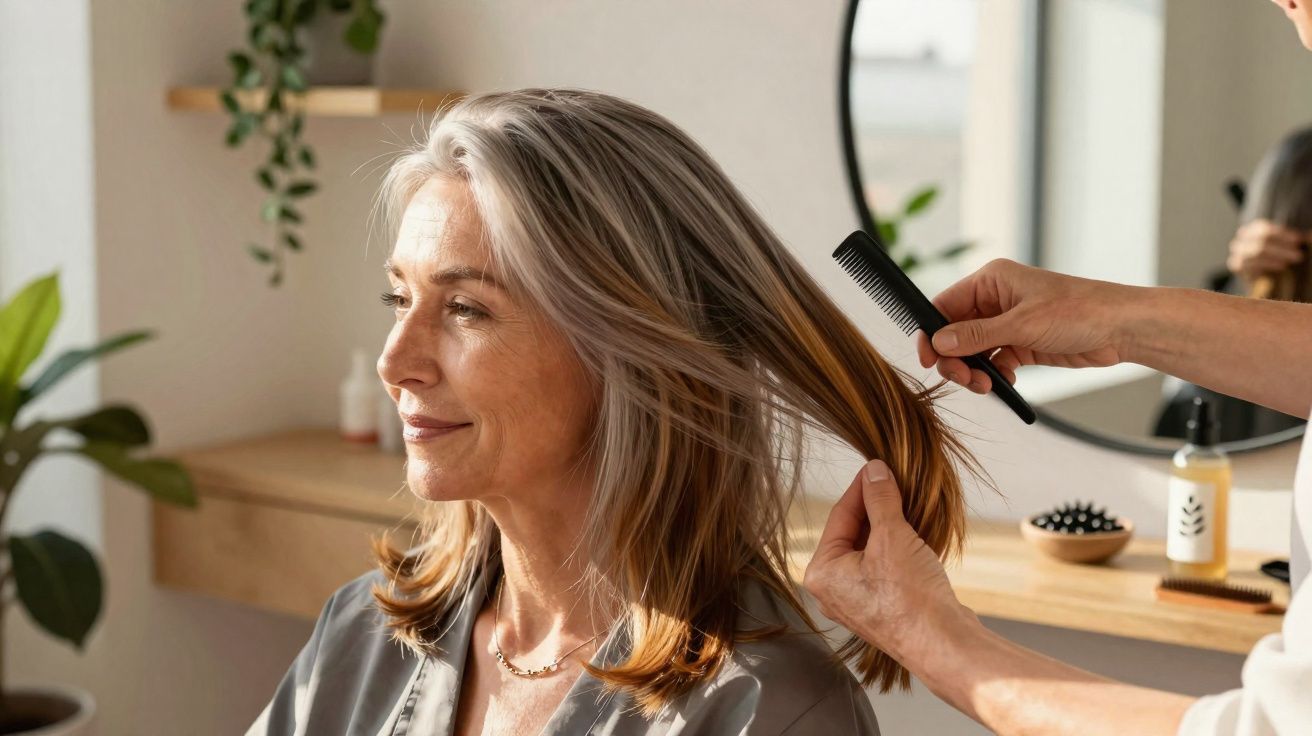
The hairdresser made a quiet tutting sound as she lifted a section near my temple. “See this?” she said, angling the mirror so I could watch my own face change. Under the salon’s bright lights, a few silver strands caught the shine-nothing dramatic, just enough to say, time is moving on. The air smelled faintly of peroxide; hairdryers thrummed in the background. On one side, a teenager was being taken to icy platinum. On the other, a woman in her fifties asked for “the usual dark brown-no grey showing, please”.
My stylist gave a knowing smile. “You don’t have to colour everything any more,” she said. “There’s a newer way to wear it. Softer. More modern. Less… like a paint job.”
It sounded odd-almost like breaking a rule.
Could allowing a little grey to show really make you look fresher?
Grey hair, but softer: how grey-blending is rewriting the rules
If you pay attention on any busy high street, you’ll start to spot it. A woman in her forties with a sunlit bob and a faint haze of silver at the roots that looks deliberate. A man in his fifties with salt-and-pepper at the temples that reads as considered, not neglected. The age of flat, all-over box colour is being nudged aside by something more dimensional.
Rather than treating grey hair like a secret to be erased, this trend works with it. Think glosses, toners and grey-blending techniques instead of heavy, full coverage. The surprising effect is that it often looks more youthful than an opaque, single-shade dye. A little visible grey no longer automatically signals “I’ve given up”; increasingly, it signals confidence.
Colourists describe the same pattern again and again. Clients in their thirties, forties and fifties arrive saying, “I can’t face chasing my roots every three weeks.” One Paris-based colourist I interviewed even called it the “roots fatigue revolution”.
She told me about a 47-year-old client who’d been dyeing her hair jet black since her late twenties. Under salon lighting, the contrast against her pale skin looked severe. Eventually she admitted, “I don’t recognise myself-I look like I’m trying too hard.” They moved her to a soft grey-blending approach: warm chocolate lowlights, with lighter pieces around the face. After that, people stopped asking if she was tired. Her husband assumed she’d done “something to her skin”. She hadn’t. It was just her hair.
There’s an easy visual explanation for why it works. A solid, dark block of colour-especially when it’s uniform from root to end-creates a hard line against a face that’s naturally gaining softness and shadows with age. Fine lines and under-eye darkness can look more pronounced by comparison. When hair has depth-lighter ribbons, a mix of tones, and a touch of visible grey-the whole impression becomes gentler.
It’s a bit like lighting in a room. Harsh overhead light reveals every detail; warmer lamps soften the edges. Grey-blending does something similar for your features. The hair looks less like a helmet and more like part of your real, lived-in story. Silver strands stop reading as “mistakes that weren’t covered” and start reading as texture.
A note on what’s really changing
This isn’t about abandoning effort; it’s about redirecting it. The focus shifts from “hide everything” to “make it look intentional”. In practice, that means better placement, softer tones, and hair that still looks good weeks after an appointment-rather than only for the first ten days.
Goodbye full dyes: new ways to cover (and embrace) grey hair
A technique many colourists now rely on is partial coverage-not all or nothing. Instead of attacking every grey strand, they brighten or soften specific areas: around the face, at the crown, and through the lengths where the eye naturally settles.
Often, a demi-permanent gloss is used to reduce the stark contrast between darker hair and lighter roots. Or a colourist will add ultra-fine highlights that thread through the greys so you can’t tell where one ends and the other begins. The grey is still present-but it no longer forms a sharp boundary line. The result reads as “youthful hair with nuance”, rather than “fresh dye, ageing face”.
For many people, the route looks familiar: - At 35, the first grey shows up. - By 38, you commit to classic colour: a solid shade close to your natural tone. - By 42, the regrowth line feels like your personal nemesis.
You start booking appointments around holidays, weddings, work events-anything involving a camera. And there’s that universally bleak bathroom-mirror moment: you tilt your head and spot a crisp white stripe dividing your parting.
Then you miss an appointment-because of work, family, money, illness, life. You walk into the salon with about 3 centimetres of regrowth and expect judgement. A good colourist, increasingly, will say: “We can work with this. Let’s blend it-don’t erase it.”
From a technical standpoint, this shift is also about scalp comfort and long-term hair quality. Frequent, full-head permanent dyes can dry out the hair shaft, irritate sensitive scalps, and gradually dull natural shine. With total coverage, aggressive pigment is repeatedly placed on every strand-grey or not. Your lengths end up suffering for a handful of stubborn roots.
When you move to grey-blending, lowlights and glosses, hair tends to be less battered. The pigment you still have in non-grey strands can keep reflecting light, and the cuticle layer is under less stress. The practical outcome is hair that moves, catches daylight and looks touchable-rather than a heavy sheet of colour that appears “fresh” only briefly.
Extra consideration: cost, upkeep and time
One overlooked benefit of stepping away from full dyes is predictability. Grey-blending appointments can take longer on the day (because placement matters), but they’re often needed less frequently. Many people find they swap “every three weeks forever” for a calmer rhythm-more like every 8–12 weeks, depending on their cut and how quickly their hair grows.
From trend to routine: how to switch to grey-blending without panicking
If you’ve coloured your hair for years, inviting grey back in can feel genuinely unsettling. The most comfortable approach is usually a gradual transition. Book an appointment and say plainly: “I want to stop full coverage and move towards grey-blending.” Say it clearly-like you’re ordering exactly what you want.
A strong starting point is: - choose a base colour one or two shades lighter than your current dye; then - add very fine highlights (often called babylights) where your grey is most visible.
That combination reduces the shock of regrowth straight away. Instead of a bright line pushing through a dark wall, your roots grow into a mix of tones.
The first few months can be the hardest emotionally. You might catch your reflection in a shop window and think, “Is that me?” Your brain is used to uniform colour. Give it time to recalibrate. You’re not “letting yourself go”; you’re giving yourself room to breathe.
Try not to emergency-dye at home the moment a cluster of silver appears at your parting. Quick box fixes often create a different headache: uneven bands, stubborn warmth, and dry ends that look frazzled in daylight. Between appointments, spacing out washes, using purple or blue shampoo to reduce brassiness, and using temporary root sprays for big occasions can help you stay the course.
“Once my clients stop battling every single grey and start working with them, their whole face relaxes,” says London colourist Marta R. “They don’t look older. They look like themselves-without the stress.”
Practical ways to ease the transition
- Test in a low-risk area first
Begin with grey-blending near the nape or under-layers before changing the most visible top section. If you dislike it, it’s easier to adjust. - Choose semi-permanent over permanent where possible
Semi- and demi-permanent formulas fade softly, so you avoid a razor-sharp root line. - Play with tone, not only coverage
Warm caramel or cool ash around the face can flatter your skin more than your original natural shade ever did. - Plan “transition months”
Allow 6–12 months to move from all-over colour to blended grey so each in-between stage feels like part of the plan. - Support texture as well as colour
Grey hair is often drier. Hydrating masks, lightweight oils and gentle heat styling help keep it soft and reflective-which tends to read as younger.
Extra care tip: protect new growth
If you’re using toners, glosses or lightening, ask your stylist about bond-building treatments and heat protection. A blended look relies on shine; anything that roughens the cuticle (over-bleaching, daily high heat, harsh clarifying shampoos) can make hair look dull even if the colour is perfect.
What looking “younger” really means when you stop hiding every grey hair
Talk to people who’ve made the switch and a pattern emerges: they don’t mainly talk about colour. They talk about energy. About feeling less on edge when they wash their hair. About recognising themselves from morning to evening-rather than fearing the next half-centimetre of growth.
This new approach to grey hair isn’t a protest against beauty. It’s a recalibration of what actually makes someone look fresh: healthy texture, light that moves across the hair, tones that echo the skin rather than fighting it, and a style that still looks good three weeks later-not only on day one. And, quietly, a more peaceful relationship with the calendar.
The twist is that many people look younger the moment they stop trying to look exactly 25. Not because the years vanish, but because the strain does-and that ease is what reads as glow.
| Key point | Detail | Value for the reader |
|---|---|---|
| Shift from full dye to grey-blending | Use highlights, lowlights and glosses instead of uniform colour | Softer regrowth and a more natural, youthful look |
| Protect hair and scalp | Reduce permanent dyes, favour demi or semi-permanent formulas | Healthier, shinier hair that ages better |
| Plan a transition period | Allow 6–12 months with gradual adjustments | Less stress, no drastic “before/after” shock |
FAQ:
- Question 1 Does letting some grey show automatically make me look older?
- Question 2 How often will I need salon visits with grey-blending compared to full dyes?
- Question 3 Can I switch from black box dye to this new trend without damaging my hair?
- Question 4 Will this work on curly or textured hair, or only on straight hair?
- Question 5 What can I do at home to keep my blended grey looking fresh between appointments?




Comments
No comments yet. Be the first to comment!
Leave a Comment