
Around 74,000 years ago, a colossal volcanic eruption disrupted climates, devastated landscapes and pushed early humans to the brink.
Archaeological evidence from Ethiopia now suggests that some people did not survive through luck alone, but through rapid, deliberate adaptation. Rather than staying put or dying out, they shifted their diet, treated rivers as a vital lifeline and moved gradually across the landscape. The findings connect with the long-debated idea that a supervolcano nearly wiped out early Homo sapiens, leaving perhaps only around a thousand survivors-and they offer a plausible, on-the-ground scenario for how survival could have worked in practice.
The Toba supervolcano eruption that nearly changed everything
At the heart of these new insights is the Toba supervolcano on Sumatra, Indonesia. Its eruption roughly 74,000 years ago is among the most powerful eruptions the planet has experienced. For years, vast quantities of ash entered the atmosphere, with sunlight and rainfall patterns shifting sharply in some regions.
For a long time, Toba was framed as an almost apocalyptic moment for our species. Some researchers argue that the global population of early Homo sapiens crashed to roughly 1,000 surviving individuals. Exact figures remain contested, but the broader point is not: humanity was pushed dangerously close to the edge.
Evidence from Ethiopia indicates that survival in this crisis was not accidental, but the result of hard, fast adaptation.
Shinfa-Metema 1: Toba supervolcano evidence in north-west Ethiopia
The key site in the study is Shinfa-Metema 1, in north-west Ethiopia. Archaeologists uncovered a dense layer containing stone tools, animal bones and hearths. Crucially, the same sediments also held tiny volcanic glass shards known as cryptotephra.
Chemical analysis links this cryptotephra unambiguously to the Toba supervolcano eruption. In other words, people were living at Shinfa-Metema 1 as ash from Toba fell-and they remained there even as conditions deteriorated.
Ashfall, aridity and a rapid climate stress test
To understand what followed, the researchers paired the ash evidence with a highly sensitive climate proxy: ostrich eggshell. The chemical signature of ostrich eggshell reacts quickly to shifts in temperature and moisture. Immediately after the layer associated with Toba’s ash input, the eggshell values show a clear jump towards drier conditions.
Dry seasons became longer and more severe, rivers contracted, and vegetation declined. This was not a slow drift over millennia; it was a relatively abrupt push into intense drought-an environmental stress test that local people had to respond to within only a few generations.
From antelope hunters to river specialists
Animal remains provide a direct window into diet. Before the climate tightened, the group exploited a wide range of prey and resources: antelope, monkeys, smaller mammals and fish. The pattern suggests a broadly flexible menu.
After the arid shift, that balance changed dramatically. Fish bones in discarded food waste rose from about 14% to roughly 52%, while the proportion of terrestrial animals fell. Cut marks and scorching on the bones indicate that animals were butchered at the site and cooked on open fires.
In a short period, people radically reorganised their diet and relied on the river as the most dependable remaining food source.
Such a pronounced change is unlikely to be random. It fits a purposeful strategy: when game becomes scarce across drying plains, people concentrate on what remains predictable-shrinking waterways that still hold fish, and waterholes that draw thirsty animals.
An additional implication is practical rather than dramatic: intensified fishing and waterhole hunting often require changes in daily routines-more time spent near water, different tool use, and tighter scheduling around seasonal flow. Even without nets being preserved archaeologically, repeated fish exploitation at this level hints at well-practised methods for capturing and processing small, slippery prey efficiently.
Fine stone points and a possible early arrow-and-bow
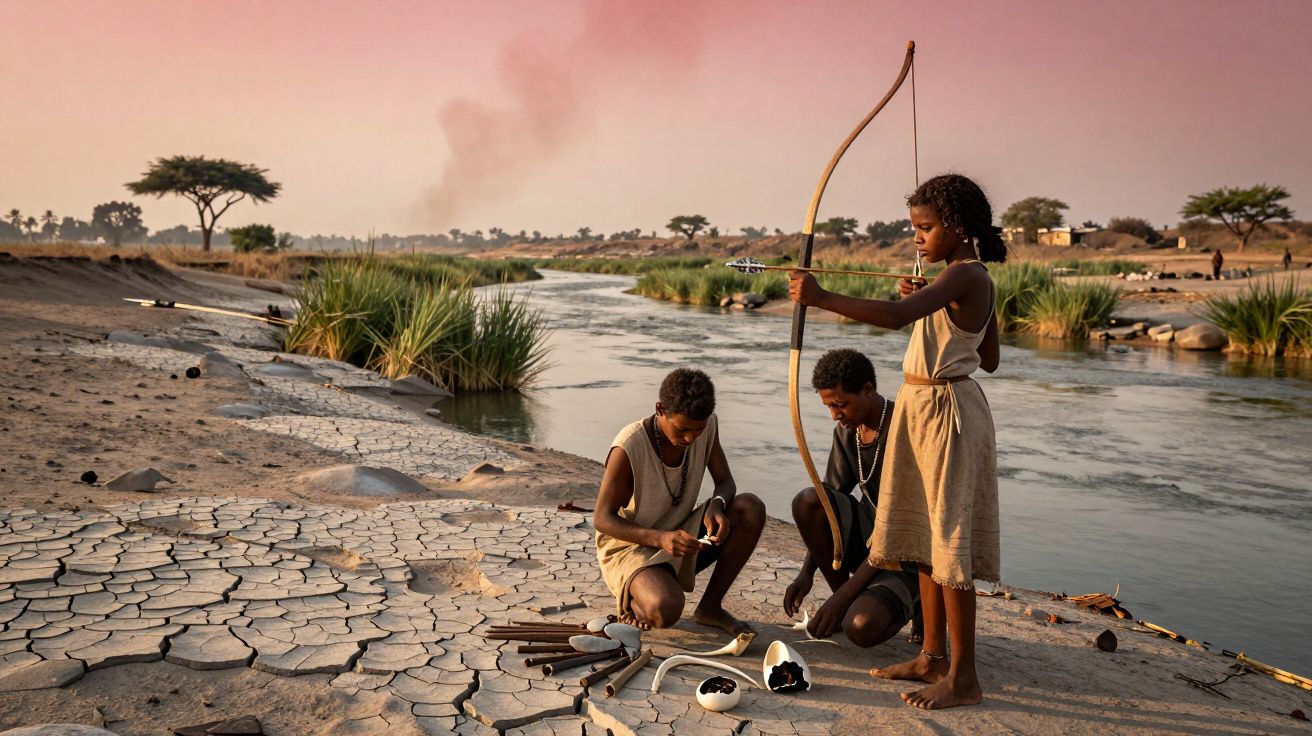
Among the stone tools from Shinfa-Metema 1, one type stands out: small, triangular points. Their size, shape and wear patterns lead the research team to interpret them as projectiles, very likely early arrowheads.
If that reading is correct, it nudges the appearance of modern-distance weaponry further back in time. Finds in South Africa have often placed arrow and bow technology at around 71,000 years ago. Shinfa-Metema 1 may indicate that such weapons were in use earlier-or at least that similar projectile strategies had already spread widely.
During food shortages, distance weapons offer a clear advantage: hitting small, fast animals from safer range saves energy and reduces injury risk. In a thinned-out landscape, precision can matter more than raw strength.
Rivers as lifelines-and as routes out
Shinfa-Metema 1 sits beside a seasonal river system in an otherwise dry region. These rivers do not simply disappear through the year; they often break into chains of waterholes. Those remaining pools become magnets for animals-and for people.
Around these water points, life concentrates in predictable ways:
- Thirsty hoofed animals return regularly to drink.
- Fish remain trapped in the surviving pools.
- Plants near the banks stay green for longer than the surrounding terrain.
For hunter-gatherers, that predictability matters. The group at Shinfa-Metema 1 likely moved between waterholes along the river corridor. When one stretch was exhausted, they shifted to the next pool-staying close to the channel and, step by step, moving further from earlier home ranges.
How drought can steer migration corridors
Many models have assumed that early humans travelled furthest during wetter phases, when savannahs expanded and resources were plentiful. The Ethiopian evidence supports a different possibility: severe dry spells can create narrow but dependable corridors along rivers.
When a particular waterhole no longer provided enough food, people had to move on. Repeated, short-distance relocations along a river can accumulate over time into major population movements-potentially including pathways that later contributed to dispersal beyond Africa.
A related factor, often invisible in stone and bone, is social organisation. In harsh conditions, groups may reduce risk through information-sharing and alliances-knowing where water persists, which pools still hold fish, and when neighbouring groups have moved on. Even modest cooperation networks can amplify the survival value of a river corridor by turning scattered waterholes into a navigable, socially understood landscape.
Was Toba truly a global catastrophe?
Older hypotheses portrayed the Toba eruption as a near-worldwide volcanic winter that killed off most humans. New African records point to a more nuanced picture. For example, sediments from Lake Malawi do not show a clear signal of a severe volcanic winter across East Africa.
Instead of uniform devastation, the evidence increasingly suggests a patchwork of regional impacts. Some areas suffered drought and vegetation stress; others remained relatively stable. Research in South Africa has previously indicated that coastal populations endured the period around Toba. Shinfa-Metema 1 adds an inland, dry-river setting to that survival map.
What Shinfa-Metema 1 shows-and what it cannot prove
The people living at Shinfa-Metema 1 were probably not the direct ancestors of every later group that moved into Eurasia. Genetic and archaeological findings more often support multiple, partly separate populations leaving Africa in waves.
The site’s value lies elsewhere: it provides a concrete example of the capabilities that successful groups would have needed in a crisis:
- A flexible diet that can pivot quickly as conditions change.
- Efficient hunting approaches, potentially including projectile weapons for smaller prey.
- Willingness to abandon camps when resources thin out.
- Use of linear landscape features such as rivers as natural routes.
Together, these traits can separate collapse from continuity. Groups that clung to old routines risked starvation during drought; groups that switched strategies created the platform for later expansion.
How researchers read crisis histories in ash, eggshell and bone
Shinfa-Metema 1 also highlights how rare it is for several independent lines of evidence to align within the same narrow time window. In one sediment layer, researchers found:
- volcanic ash (cryptotephra) that anchors the event in time,
- animal bones bearing clear hunting and cooking traces,
- fine stone tools, likely used as projectiles.
That combination makes it possible to track, at a single location, how a community responded to a specific environmental shock. More often, archaeologists must stitch together comparisons across distant sites and different periods. Here, at least part of that gap closes.
What this ancient disaster suggests for the present
Published in Nature, the study underlines a simple point: our species owes its persistence less to stability than to adaptability. Supervolcanoes, droughts and abrupt climate shifts repeatedly constrained early humans. The groups that endured were those that broadened their food sources, spread risk and were prepared to leave familiar ground.
This does not imply that disasters are “good”. The longer view instead shows how sensitive human societies are to rapid environmental change. In crises, rivers, coasts and other residual resource zones become decisive lines of survival-then as now.
Terms like supervolcano are not just headlines. They describe volcanic systems capable of eruptions thousands of times more powerful than typical events, with the ability to reshape climate systems. Even if an eruption on the scale of Toba is rare, the Ethiopian evidence illustrates how thin the margin can be between breakdown and transformation.
What emerges is a picture of early humanity far removed from romantic Stone Age scenes: small groups scraping together food in hostile conditions, refining tools, tracking dwindling watercourses and securing a future under the shadow of a supervolcano-often with no way of knowing how few people elsewhere might still have been alive.






Comments
No comments yet. Be the first to comment!
Leave a Comment