
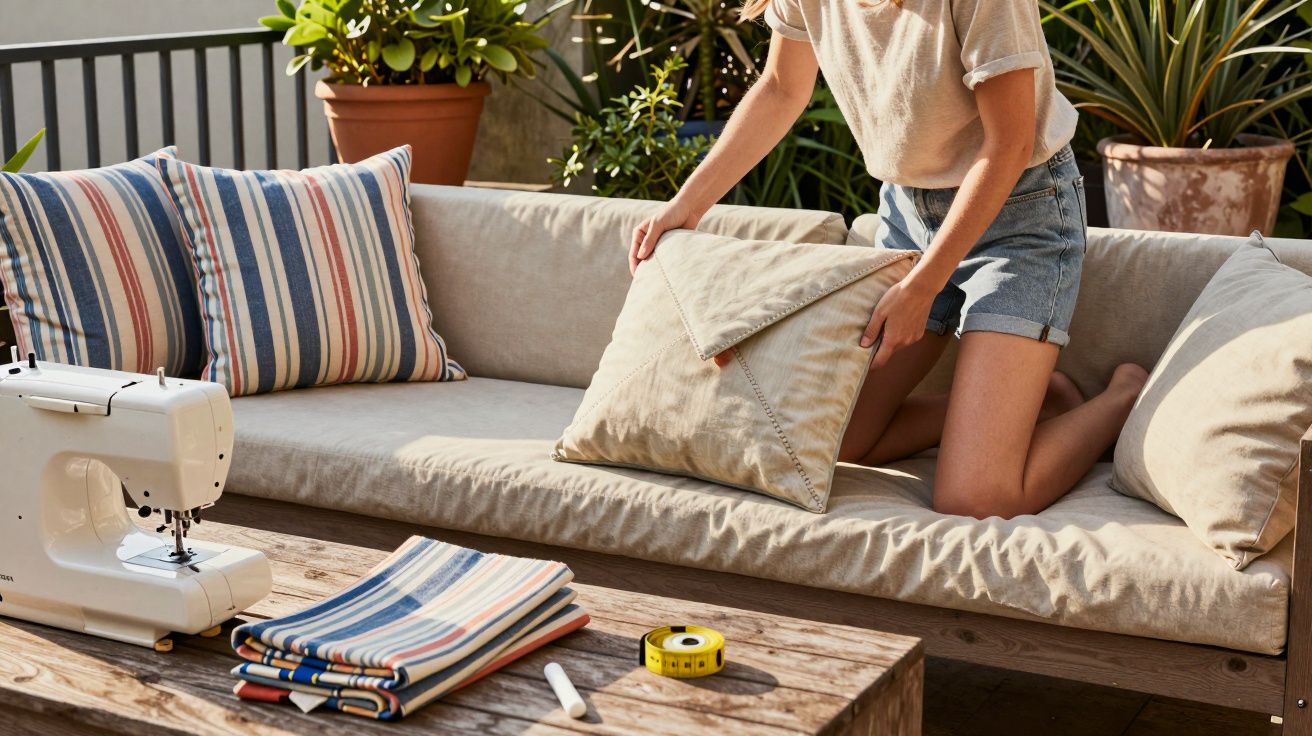
Many people bin their old seat pads the moment the fabric fades or the seams start to give way. Yet the real value is almost always in the foam insert, which is often still perfectly sound. Think it through and you can save a significant amount of money, cut down on waste, and give your outdoor space a quick refresh-using a straightforward sewing method that beginners can manage.
Why you shouldn’t throw away your old terrace cushions
Grease marks from barbecues, sun-bleached colours, seams under strain-after a few summers, plenty of terrace cushions look past their best. The obvious move is to buy replacements, but that’s usually the wrong conclusion.
In most cases, the foam inside is still in excellent condition: it supports properly, springs back, and hasn’t split. What fails first is the textile cover. If you reach for a bin bag at this point, what you’re really throwing away is money.
Replacing old cushion covers instead of buying new cushions often saves around £35–£70 per pad.
There’s also the wider impact: every new purchase means fresh manufacturing, additional transport, and more waste. Repairing, upcycling, and reusing are increasingly the norm-outdoors included. Re-covering terrace cushions fits that mindset neatly: you keep what works and give it a completely new look.
The brilliant fix: an envelope-style cover
At the heart of this approach is an envelope cover. Think of it as a cushion case with an overlapping back-similar to a classic pillowcase, but without a zip.
Why this pattern is so practical for terrace cushions
- no zip to jam, corrode, or seize up outdoors
- no buttons to rip off or create pressure points
- tension is carried by the side seams rather than a small fastening
- the cover comes off and goes back on in seconds
Outside, zips and buttons have a hard time of it: sun, rain, temperature swings, and the constant strain of sitting and lounging all take their toll. The envelope cover avoids these weak points entirely. It relies purely on fabric and two straight seams.
An envelope cover is one of the most rewarding sewing projects: simple to cut, hard-wearing, and ideal for the garden.
Step by step: how to work out your fabric
You don’t need a complicated pattern-just a tape measure, scissors, fabric, and a sewing machine (hand sewing also works; it simply takes longer).
Basic shape for a square cushion
Always start with the size of your foam insert. Example: 60 × 60 cm.
- Width of the fabric rectangle: cushion width + about 3 cm seam allowance
→ for 60 cm, that’s roughly 63 cm - Length of the fabric rectangle: 2 × cushion length + about 20 cm for the overlap
→ for 60 cm, that’s roughly 140 cm
This gives you an overlapping closure of around 15 cm, which keeps the foam securely inside the cover and stops it gaping open when someone drops into the seat.
Sewing in four straightforward steps
- On the two short ends (these will form the opening), fold the edge over once and stitch it down-this creates neat, clean hems.
- Lay the fabric flat with what will be the outside facing upwards.
- Fold both ends in towards the centre so they overlap by about 15 cm-this overlap is your “envelope”.
- Stitch the side seams on the left and right, around 1.5 cm from the edge; then turn the cover right-side out.
Now simply slide the foam insert in through the back opening. The fabric will sit smooth, and the overlap will hold the filling in place.
Terrace cushion envelope covers: a practical lounge-area makeover in one afternoon
A common situation: a pallet-style lounge on the patio still has firm foam pads, but the old covers are scratched, faded, and in places worn right through.
If you buy ready-made replacement covers, the cost can climb so quickly you’re not far off the price of a sizeable chunk of a new garden lounge set. With fabric off the roll, the maths changes dramatically:
- robust outdoor canvas per metre: typically far cheaper than buying individual cushions
- time required: an afternoon, even for multiple seat pads
- result: looks like new and can be matched to your terrace style
Freshly covered seat pads make an outdoor area look instantly tidier and more premium-without buying new furniture.
What to look for in fabric for outdoors
Standard decorative fabric from a craft shop usually isn’t up to terrace-cushion life. It tends to fade faster, fray more easily, and doesn’t cope well with constant use. You’ll get a better outcome with a purpose-made outdoor canvas or similar outdoor fabric.
Good outdoor fabrics usually have these qualities
- a noticeably dense feel (not flimsy or drapey)
- strong lightfastness, meaning UV resistance
- high abrasion resistance for frequent sitting and sliding
- ideally water-repellent or quick-drying
The envelope cover already eliminates common failure points because it doesn’t rely on metal parts or poppers. Choosing a fabric with a bit of structure helps the edges and seams stay crisp and tidy after several seasons.
Extra tip for longevity: if your cushions live in full sun, consider UV-resistant thread (often sold for awnings and outdoor upholstery). It’s a small upgrade that can prevent the stitching failing before the fabric does.
A simple trick against damp from below: build in a protective layer
A big problem with many terrace cushions is moisture coming from underneath. Pallets, timber slats, or stone flags can hold cold and damp. Foam absorbs that moisture and dries slowly-bringing mould risk with it.
A simple, almost free add-on helps: sew a protective inner layer onto the underside of the cushion cover.
Suitable materials include:
- an old tablecloth with a coated backing
- a shower curtain you no longer need
- leftover pieces of oilcloth
You can stitch or tack these onto the underside of the cover to form a barrier between the terrace surface and the foam. Moisture seeps in far more slowly, the core stays dry for longer, and the cover is easier to dry out.
Adding a protective layer on the underside noticeably extends the cushions’ lifespan-and costs next to nothing.
How complete beginners can get started
If you’re not yet confident with a sewing machine, begin with a single trial cushion. Old bed linen is ideal for testing the concept before you cut into pricier fabric.
Helpful beginner pointers:
- measure twice before you cut
- start with a simple straight stitch
- allow about 1.5 cm seam allowance
- choose needles and thread suited to thicker fabrics
Once you’ve made the first couple of covers, you’ll quickly develop a feel for proportions and how tightly the fabric should sit. After that, you can re-cover your terrace set bit by bit.
Mistakes you’ll want to avoid
These common pitfalls are easy to sidestep:
- Too little overlap: if the back overlap is only minimal, the cover can gape under load. About 15 cm is a reliable guide.
- Fabric that’s too thin: it may save money up front but tears sooner. Outdoors, quality pays off.
- Sewing without pre-washing: some cotton fabrics shrink after washing. Wash first, then cut.
One more practical consideration: if your foam insert is especially thick, check that your overlap still sits flat once the cushion is filled. If it feels tight, add a little extra length to the rectangle so the back closure remains secure without strain.
Value beyond the terrace
The envelope-cover method isn’t only for terrace cushions. It works just as well for kitchen bench pads, dog beds, seat pads in a campervan, or dining chair cushions. Once you’ve got the hang of it, you can use offcuts, mix patterns, and swap covers seasonally to suit your mood.
You’ll also find it changes how you relate to your belongings. Instead of replacing, you improve, tailor, and reuse. With a few hours’ work, some fabric, and a surprisingly everyday sewing idea, a stack of “old” terrace cushions can become a modern, individual seating area again.



Comments
No comments yet. Be the first to comment!
Leave a Comment