
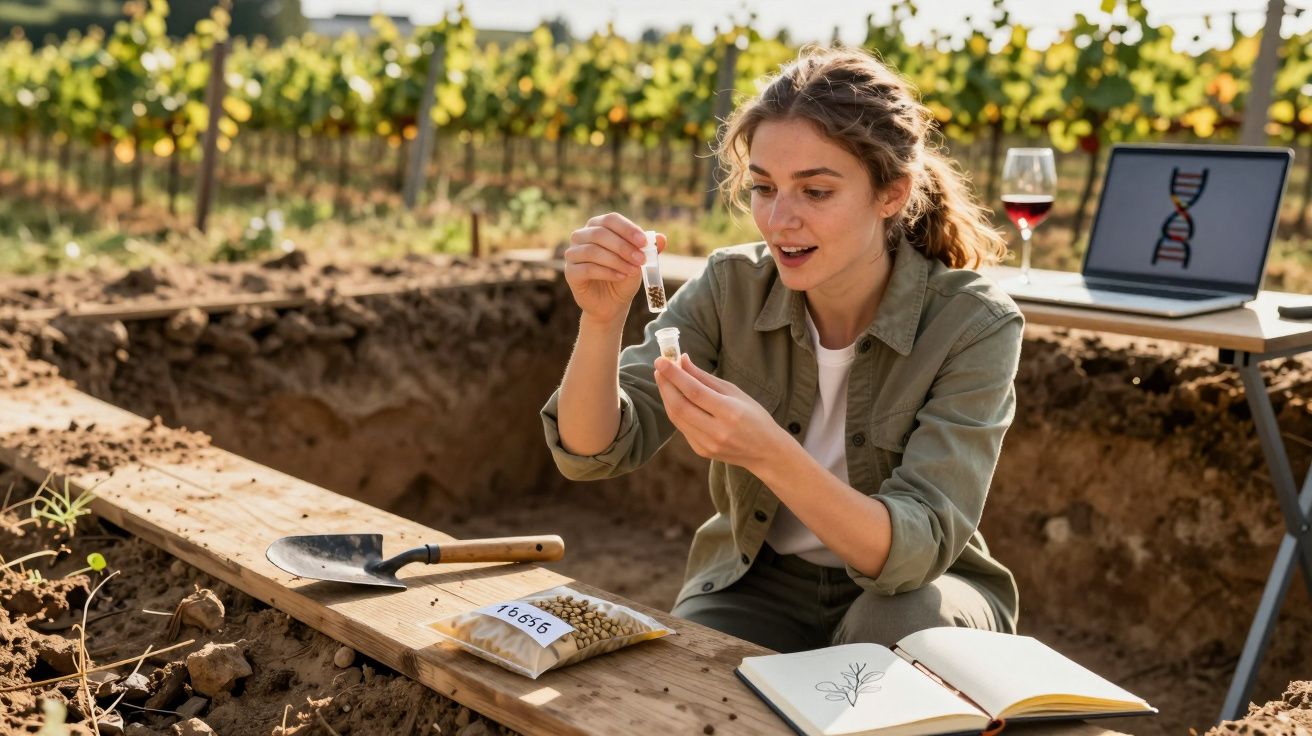
What looks like rubbish to an archaeologist can turn out to be a scientific windfall. In Valenciennes, researchers recovered grape pips from a medieval hospital latrine-and those tiny remains show just how directly today’s wine tastes are linked to the Middle Ages. One variety takes centre stage: Pinot Noir, one of the most important grapes in the modern wine world.
A 15th-century latrine and an unexpected breakthrough
The discovery could be lifted from a medieval mystery: archaeologists excavate the remains of a hospital toilet area in Valenciennes. These latrines were not merely places of privacy; they also acted as convenient dumping grounds for kitchen scraps and leftover food. That particular cocktail-human waste, food remains and household rubbish-created a damp, oxygen-poor environment that can preserve organic material remarkably well for centuries.
From this pit, a team working internationally retrieved 54 grape pips. The collection spans an extraordinary timeframe, reaching from the Bronze Age (around 2300 BC) through to the 15th century. One pip from the late medieval period proved especially striking: its genetic signature is, for all practical purposes, a match for today’s Pinot Noir vines.
The DNA indicates that the Pinot Noir in today’s glass comes directly from a vine line already growing in northern France 600 years ago.
DNA evidence: Pinot Noir then and now
To make the comparison, the scientists applied palaeogenomics-methods designed to extract and analyse very old DNA. Despite centuries underground, enough genetic material remained to compare the medieval pip with modern grape varieties. The conclusion was clear: the medieval grape sits genetically in almost the same line as the Pinot Noir now cultivated from Burgundy to Baden.
The find supports two key points:
- Pinot Noir was already being deliberately cultivated in northern France around 600 years ago.
- The variety has maintained an exceptionally stable genetic line across many centuries.
Medieval written sources had hinted at such practices, but without genetics much of it remained conjecture. Here, the evidence is biological-found not on a desk, but in a toilet shaft.
How growers have preserved grapes for centuries
For wine lovers, one of the most intriguing implications is what the study reveals about vineyard practice. It suggests that by at least 600 years ago, growers were relying on a technique that is still fundamental today: clonal propagation via cuttings.
What clonal propagation actually means
Rather than raising new vines from seeds, growers take shoots from an existing plant and plant them as cuttings. The result is a genetically identical vine, which helps preserve a desired flavour profile with minimal change over generations.
Analysis of the ancient pips indicates that this approach was already widespread in the Middle Ages-and may have been used even earlier, perhaps as far back as the Iron Age (roughly 625–500 BC). When combined with historic texts, the DNA work paints a picture of wine production that was highly intentional and tightly managed long before industrialisation.
| Period | Significance for viticulture |
|---|---|
| c. 2000 BC (Nîmes region) | Wild vines, the roots of later winemaking |
| From c. 500 BC (Var region, southern France) | First deliberately cultivated vines, influenced by Greek settlers |
| Roman period | Intensified trade and the movement of grape varieties across Mediterranean regions |
| Middle Ages (including Valenciennes) | Consistent cultivation of Pinot Noir and systematic clonal propagation |
One additional reason latrines matter to science is that they act like time capsules for everyday life. Alongside grape pips, such deposits can also preserve other seeds and food traces, offering a more grounded picture of diet, supply networks and seasonal eating-even in specialised settings such as hospitals.
From the Bronze Age to Burgundy: how wine took hold in France
By dating and comparing pips from the Valenciennes latrine and other sites, the researchers reconstructed a long prehistory of French viticulture. The oldest genetically assignable samples still connect to wild vines near Nîmes some 4,000 years ago.
Later, with Greek settlement along the Mediterranean coast and the founding of Marseille, purposeful viticulture gained momentum. Archaeological evidence-such as amphorae recovered from ports and settlements-shows wine quickly becoming a major trading commodity. Vines, containers and know-how travelled around the Mediterranean, carrying new tastes and techniques with them.
A Roman-era blend of local and imported vines
By the Roman period, northern France was firmly tied into extensive trade routes. Genetic results from the pips indicate that vines from Spain, the Balkans, the Caucasus and the Near East reached Gaul. These introductions then crossed with local wild vines.
The outcome was a genetically diverse pool of grapes, helping many regions develop vines that were resilient and adaptable. Pinot Noir’s survival as one of the most stable lines over the long term may owe something to that extended era of crossing and selection.
Roman-era European viticulture functioned like a vast open-air laboratory, where growers spent centuries selecting the hardiest and most appealing combinations.
Pinot Noir: from monastic gardens to a global icon
Today, Pinot Noir is among the most widely planted grape varieties worldwide and is closely associated with places such as Burgundy. This study suggests its success is not a modern accident, but part of a long, near-continuous tradition.
The Valenciennes pip links the 15th century-an era shaped by the final stages of the Hundred Years’ War and figures such as Joan of Arc-with today’s leading estates. In purely practical terms, people living then could have eaten or drunk grapes from the same vine line that underpins modern Pinot Noir wines.
What the Valenciennes Pinot Noir evidence means for drinkers
It can be surprising to see how durable taste can be. Many food fashions shift year by year, yet wine often follows a different pattern: growers protect and maintain grape lines that have proven their worth over generations.
- Pinot Noir’s style-often fine-boned, red-fruited, with a characteristically elegant acidity-remained valued for so long that growers kept it genetically consistent.
- That continuity helps explain how certain wine regions acquired such enduring reputations.
- Traditional techniques such as clonal propagation underpin many modern quality strategies in the vineyard.
A further implication concerns authenticity and heritage. As genetic datasets improve, palaeogenomics may strengthen how regions document long-established grape lines-supporting conservation decisions and, potentially, reinforcing the historical narratives behind famous vineyards.
What “palaeogenomics” and “clonal vine” really involve
Palaeogenomics may sound like science fiction, but the basics are straightforward: researchers extract minute traces of DNA from ancient bones, plants-or, in this case, grape pips. Sensitive instruments read the fragments, and software reconstructs and compares them against modern genomes.
For grapevines, that can answer questions such as: Where did a variety originate? What stresses and diseases has it survived? How closely is it related to other known grapes?
Clonal propagation, already in use in the Middle Ages, brings clear advantages-but also trade-offs:
- Benefit: flavour and quality can be kept consistent over long periods.
- Benefit: growers can target specific traits, such as ripening time or cold resistance.
- Risk: reduced genetic diversity within a vineyard can increase vulnerability to newly emerging diseases.
What a toilet pit can tell us about wine’s future
Finds like the Valenciennes latrine are more than an amusing footnote for wine enthusiasts. They help explain how vines have adapted over millennia to climates, soils and disease pressures. In an era of climate change, older genetic lines-or overlooked historical crossings-may contain valuable traits, such as improved heat tolerance or stronger resistance to new pests.
So when you swirl a glass of Pinot Noir today, you are not only tasting the product of modern cellar techniques, but the outcome of selection spanning thousands of years. Those 600-year-old pips from a medieval hospital toilet make that continuity unusually tangible-and show how closely past and present can sit together, even in what first looks like waste.




Comments
No comments yet. Be the first to comment!
Leave a Comment