
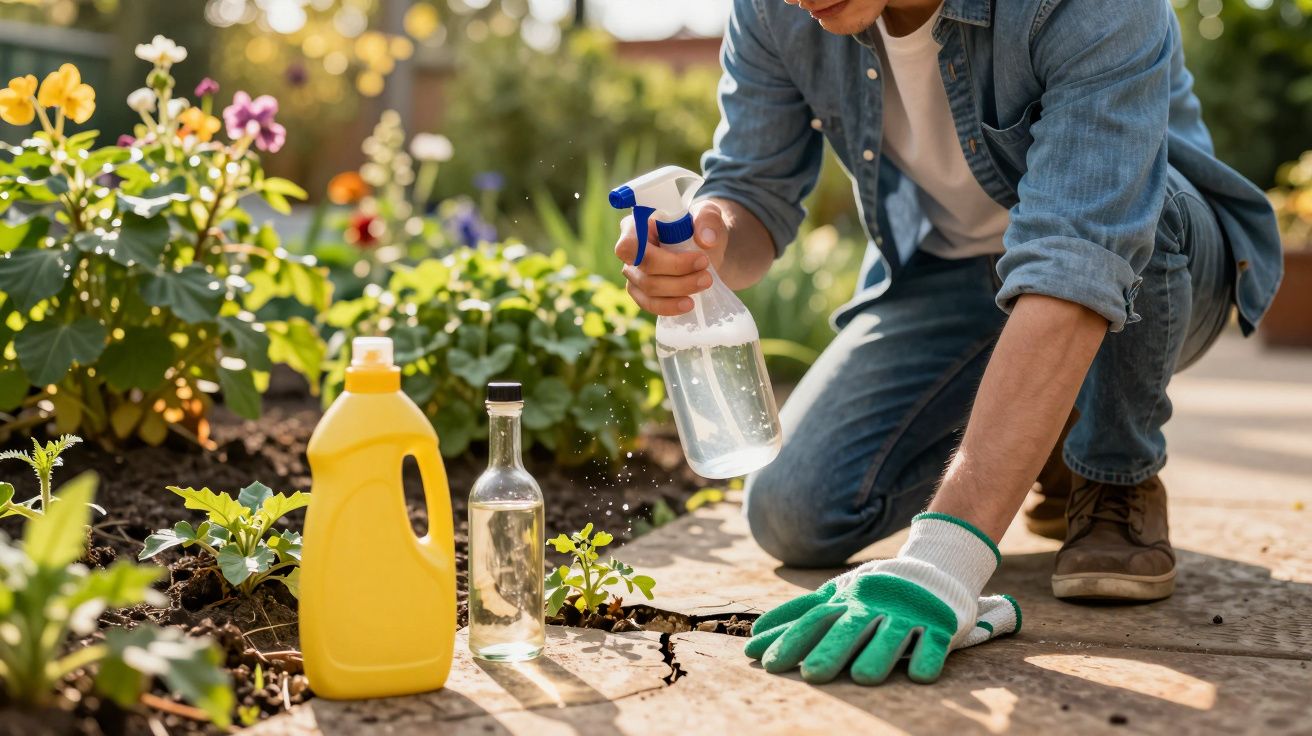
Online and in gardening forums, a “hack” is currently doing the rounds that sounds almost too good to be true: a squirt of washing-up liquid in your watering can or spray bottle is said to dry out annoying weeds in no time. Plenty of people combine it with vinegar and report visible results within a few hours. But how much of that is genuine - and at what point does the mix start harming your soil, your plants and the wider environment?
Why so many people end up disappointed with vinegar
For years, vinegar has been touted as a “natural” alternative to chemical weedkillers. On the surface the logic seems sound: the acid attacks the leaves, they yellow, wilt and collapse. Visually, the area can look tidier very quickly.
That quick tidy-up is also the problem. In many cases the roots in the ground are barely affected. The plant then grows back soon after - often just as strongly, if not stronger. If you keep re-spraying, you’re not only stuck with a never-ending job, you’re also repeatedly pouring more acid onto the same spot.
Gardening publications have long pointed out that vinegar mainly damages the above-ground parts of a plant and rarely delivers lasting control against deep-rooted species. Tough clumps of grass or dandelions between paving stones commonly return again and again, creating a frustrating “repeat cycle”.
Vinegar can make weeds disappear to the eye, but it usually doesn’t tackle the underlying cause in the soil.
Washing-up liquid in the garden: what it actually does for weeds
This is where washing-up liquid enters the picture. Many gardeners add a small splash to a vinegar-and-water spray, or even to plain water. The idea comes from agriculture, where so-called wetting agents are used to help spray solutions stick to foliage.
Washing-up liquid contains surfactants. These reduce the surface tension of water. You’ll recognise the effect from everyday life: instead of beading up and rolling off, water spreads out more evenly and lifts grease more effectively. On plant leaves, the same thing happens - the liquid coats the surface rather than forming droplets.
In practical garden terms, people use washing-up liquid because:
- the spray solution clings to leaves for longer
- it spreads more evenly across the leaf surface
- treated leaves dry out faster
- the short-term “hit” from vinegar or salt can feel stronger
Even so, washing-up liquid is not a weedkiller in its own right. It tends to act more as a behind-the-scenes booster for other ingredients, with only limited direct impact on a plant’s metabolism.
Common washing-up liquid “recipes” - and where they go wrong
Across many gardens, home-made mixes are now shared almost like secret potions. A typical version looks like this:
- 1 litre of water
- 250 ml of vinegar
- 15 ml (1 tablespoon) of washing-up liquid
Some people replace some (or all) of the water with vinegar. Others add salt to “supercharge” the mixture. It’s then sprayed on warm, dry days directly onto the plants - mainly targeting the leaves.
The immediate effect is hard to deny: within hours many plants start to show stress. Leaves lose firmness, develop blotches, then turn brown and brittle. In paving joints and on gravel paths, the surface can look “cleaned” very quickly.
The fast wow-factor makes it easy to overlook the long-term damage the mixture can cause.
Where vinegar + washing-up liquid mixtures cause trouble in the garden
Vinegar and washing-up liquid feel harmless because they’re household staples. In a garden setting, however, they can create problems many people don’t anticipate:
- Pressure on soil life: surfactants and high acidity can stress earthworms, fungi and bacteria that help keep soil fertile.
- Damage to ornamentals: even light spray drift can scorch leaves on roses, perennials or young plants.
- Corrosion risks: strong vinegar solutions can attack certain metals, such as fence fixings, edging and hardware.
- Soil salting from added salt: salt can degrade soil structure over time and leave areas effectively hostile to plant growth.
For that reason, many garden specialists suggest that if you use such mixes at all, you keep them strictly to fully mineral surfaces - for example block-paved drives, gravel paths or patio joints. Lawns, borders and any area near ornamental planting should remain off-limits.
One additional concern is runoff. On hard surfaces, sprays don’t stay put: rain can wash residues into drainage channels and, from there, into watercourses. That matters because surfactants and acidity can be harmful to aquatic life even at relatively low concentrations.
The legal and environmental grey area (UK context)
A detail that often gets missed: vinegar and other household products are not generally authorised as plant protection products or weedkillers. They’re formulated for kitchens and cleaning - not for broad outdoor application.
In the UK (and across Europe), products used specifically to control unwanted plants are expected to meet regulatory standards. Approval processes examine effectiveness, risks and environmental impact. Home-made mixtures based on vinegar, washing-up liquid and salt do not go through that scrutiny.
Just because something comes from the kitchen doesn’t automatically make it safe for soil, water and small wildlife.
What keeps weeds under control long term (without kitchen chemistry)
If you want fewer weeds over time, the most reliable approaches are still the traditional ones. They take more effort, but they’re more sustainable and far easier to control.
Mechanical methods that genuinely work
Simple tools often achieve more than people expect:
- Patio/joint scraper: ideal for paving; reaches roots close to the surface.
- Hoe or draw hoe: effective in beds and along paths; slices weeds just below the soil surface.
- Hand pulling: particularly strong on young weeds, especially when the soil is slightly damp.
The key is frequency. Tackling weeds regularly - rather than once a season - reduces the amount of seed returning to the soil, which noticeably lowers the pressure the following year.
Thermal methods
Weed burners and infrared tools briefly heat plant cells so they rupture, after which the plant wilts. On paved areas this can be a sensible alternative, provided you take fire safety seriously and use it considerately around neighbours, fences and dry planting.
A low-tech option that some gardeners use on paving is boiling water. It can be effective on tiny seedlings in joints, though it still needs care around desirable plants and it won’t solve deep-rooted regrowth on its own.
Smothering and covering: prevention in borders
In beds, weeds are far less persistent when the soil isn’t left bare. Common approaches include:
- organic mulch such as bark, woodchip or straw
- ground-cover plants that fill gaps and shade the soil
- weed-control membrane beneath gravel or decking
Less light reaching the soil means fewer seeds germinate. If you’re redesigning, it also helps to plan paths and edging so they’re easy to keep tidy.
A further preventative step for paving is maintaining the joints. Re-filling gaps with an appropriate jointing material and keeping edges firm reduces the spaces where wind-blown seed can settle and take hold.
If you still want to try washing-up liquid mixes: how to reduce the risk
Despite the downsides, plenty of gardeners will still experiment on a small scale. If you do, a few precautions can reduce the chance of unwanted damage:
- Use it only on small, clearly defined areas of stone, gravel or concrete.
- Keep concentrations low: less vinegar and washing-up liquid, more water.
- Do not add salt.
- Never spray in windy conditions to prevent drift onto borders.
- Apply on a sunny, dry morning so the surface dries quickly.
If you notice unwanted effects - such as discolouration on nearby plants or strongly smelling puddles - stop immediately and switch to other methods.
Why patience is often the best weed strategy
A lot of garden frustration isn’t caused by one particular weed clump, but by the expectation that everything should stay permanently spotless. In reality, paving joints, gravel and bed edges rarely remain completely “weed-free”.
If you accept that a few passes each year with a joint scraper, a hoe or a burner are part of normal maintenance, you gain more control over what ends up in your soil - and how healthy your garden stays over the long term. Washing-up liquid from the kitchen might feel like a short-term “secret weapon”, but in practice it’s a supporting additive with side effects, best used (if at all) very deliberately and sparingly.






Comments
No comments yet. Be the first to comment!
Leave a Comment