
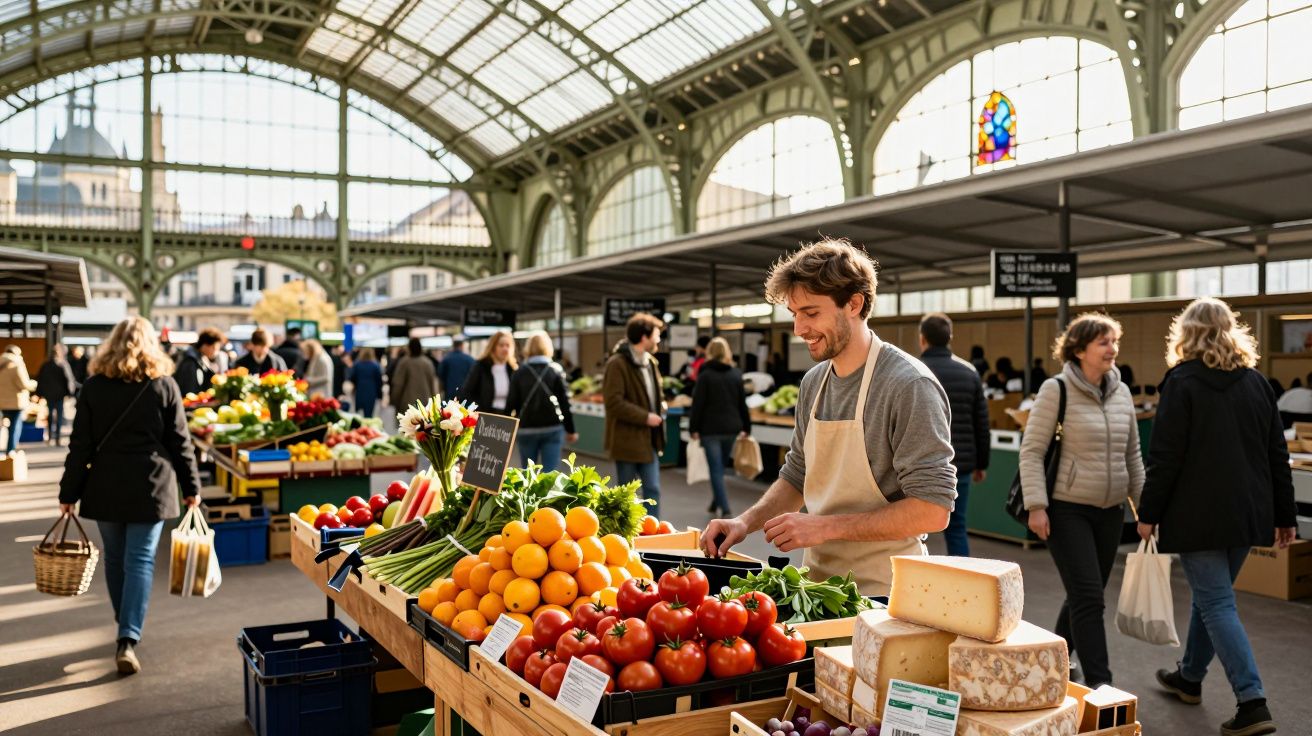
Paris usually brings the Eiffel Tower, the Louvre and perhaps the grand department stores to mind. Far fewer visitors realise that, just north of the capital, there is a covered market that ranks among the region’s most striking trading places - not only for its scale, but for its long lineage and its refreshingly no-nonsense, down-to-earth atmosphere.
Saint-Denis Market Hall: only 15 minutes from central Paris - where it is and how to find it
The market hall sits in the heart of Saint-Denis, in the department of Seine-Saint-Denis, immediately north of Paris. From central Paris, it’s a short Metro ride towards the Basilica, followed by a brief walk. Within minutes you’re standing in front of a solid stone-and-brick frontage with three wide entrances.
The building occupies the area between Place du 8-Mai-1945 and Rue Gabriel-Péri. All around it, a tight web of small shops, snack bars, bakeries and cafés runs into one another. On market days the neighbourhood feels like a continuous live scene: stalls, crates and handcarts, voices in dozens of languages, plus shopping trolleys and pushchairs threading through the crowd.
If you come on a market day, be ready for the fact that the market has long since spilled out onto the streets surrounding the hall itself.
The market hall keeps traditional opening days: Tuesday, Friday and Sunday. Sunday, in particular, draws heavy footfall. Before you set off, it’s worth checking the current opening times published by the City of Saint-Denis, as public holidays and building works can prompt changes.
From a medieval trading fair to a 19th‑century iron structure
Commerce on this site goes back centuries. In the Middle Ages, the famous Lendit fair took place here - a seasonal wholesale market that drew merchants from many parts of Europe. At the time, this area outside Paris was a major hub for goods moving through the region, long before supermarkets or online shopping existed.
By the end of the 19th century, the city decided to anchor that tradition in a modern form. In 1893, the large market hall was built: a metal-framed construction typical of the era, designed by the city architect Victor Lance. The roof is carried by three longitudinal naves, with the widest measuring about 15 metres.
The metal framework was wrapped in a skin of natural stone from Eurville and Burgundy bricks. Along the street, the period style is unmistakable: a rigorously ordered façade with neo-classical echoes, structured around three monumental entrances. Even then, the interior was designed to prioritise light and ventilation - a clear step up from the darker, makeshift markets that had preceded it.
Refits, glass and brighter trading conditions for sellers and shoppers
Over the decades, the hall has been repeatedly adapted to meet new needs. In the early 1980s, it underwent a significant refurbishment led by the Atelier d’urbanisme et d’architecture, working with the celebrated constructor Jean Prouvé. Among other changes, extra canopies were added to weatherproof the transitions to the surrounding outdoor areas.
A second major intervention arrived in 2008. The canopies added in the 1980s were removed again, and in many places the original metal slats were replaced with glass. Since then, the building has felt notably more open: in daylight, the sun catches the colours of vegetables, fruit and fish counters. For traders and visitors alike, the sense of space shifted - less like a warehouse, more like a true market atmosphere.
Today: up to 25,000 people per market day
In its current form, the market hall is among the busiest markets in the Greater Paris area. On peak days, as many as 25,000 people pass through its aisles. Around 300 traders hold permanent pitches, ranging from long-established family businesses to newer specialists focused on trending products.
The choice is broad, yet it doesn’t feel anonymous. Many shoppers return to the same stalls week after week, know the sellers by first name, and ask for items to be selected, reserved or put aside. Typical sections include:
- Exotic and local fruit and vegetables
- Spices, dried herbs and teas sold in large sacks
- Butchers and fish stalls with fresh produce for everyday meals
- Cheese stands featuring farm products and unpasteurised varieties
- Bakers and pâtissiers with artisan breads and pastries
- Stalls serving ready-to-eat dishes from a range of national cuisines
Walking the aisles can feel like a culinary journey from North Africa to the Middle East and on to Asia - without ever leaving the Paris region.
Outside the hall, cafés, tea rooms and grill stands have clustered around the entrances, rounding out what the stallholders offer. Many people pair their shopping with a quick meal or a coffee on the square in front of the building.
What to expect when you visit
This is not a pristine “gourmet temple”. It’s loud, close-packed and, at times, chaotic - an everyday market where locals come to do a serious weekly shop. At busy times you will be shoulder to shoulder with people navigating the aisles with bags, boxes and pushchairs. For many travellers, that is exactly the point: it shows a side of the region that feels far less polished than the tourist districts in the centre.
A few practical tips make the experience easier:
- Best times: If you prefer breathing space, arrive early, particularly on Tuesdays and Fridays.
- Cash: Many stalls take card payments, but not all. Small notes and coins are handy.
- Carrying your shopping: A small foldable trolley or a sturdy fabric bag quickly proves its worth - purchases can get heavy.
- Respect: Ask before photographing people, especially on the busiest market days.
A useful extra to know: getting around and staying comfortable
The simplest approach is to travel light and keep valuables secure, as you would in any crowded urban market. Wear comfortable shoes: between the hall and the surrounding street stalls, you may cover more ground than expected. If you have mobility needs, aim for earlier hours when the aisles are less congested and moving through the entrances is easier.
Historic surroundings: basilica, old town and everyday life
Just a short walk from the hall stands the famous Basilica of Saint-Denis, the burial place of many French kings. Plenty of visitors combine the church with a market wander, creating an unusual day out: Gothic architecture in the morning, then the scent of spices and the sound of traders calling out prices.
The area around the market also reflects the social reality of the department: lively streets, neighbourhoods shaped by migration, and visible contrasts between historic buildings and modern infrastructure. Spend a little time here and you’ll see how strongly the market functions as a meeting point - for regulars, families, commuters and visitors from elsewhere in the region.
Suggested half-day itinerary around Saint-Denis Market Hall
A straightforward plan is to start with the basilica when it opens, then walk over to the market hall for late-morning shopping and lunch at one of the nearby grill stands or cafés. If you’re buying perishable items, keep food safety in mind and bring an insulated bag, particularly in warmer months.
Added value for the region: everyday provisioning and a cultural meeting place
Beyond its appeal to visitors, the market plays a highly practical role: it supplies the surrounding area with fresh food that is often comparatively good value. Many residents rely on it because it provides an alternative to the standard supermarket shop and because the experience is shaped by direct conversation with traders.
At the same time, the market mirrors the diversity of the wider area. Between olive sellers, couscous caterers, traders specialising in Asian herbs and classic French bakers, a small-scale cultural exchange unfolds daily. Look closely and you can read, in miniature, how the Greater Paris area has changed over recent decades.
What travellers from German-speaking countries can get out of it
For visitors from Germany, Austria or Switzerland, the market hall can be an energising counterpoint to the usual Paris itinerary. It offers:
- A realistic glimpse of everyday life in the capital’s northern hinterland
- Late-19th-century architecture reminiscent of Paris’s historic market halls
- A wide range of specialities that work well as gifts - from spice blends to long-life sweets
- A practical alternative to expensive delicatessens in the centre
If you’re travelling with children, it’s wise to avoid the most crowded peak times, as the aisles can become very tight. For photography fans, the mix of metal structure, glass, steam from food stalls and colourful displays provides plenty of subjects - no filter required.
Terms and background worth knowing
In France, the word “halle” often refers to large, covered market buildings from the 19th century. Many have disappeared or been heavily remodelled. The Saint-Denis site is one of the larger examples of this type in the region, and it still conveys clearly what these buildings were meant to be: functional yet civic-minded infrastructure for trading food.
The medieval Lendit fair - the first source of the area’s economic importance - was more than a market. It concentrated currency exchange, flows of goods and social connections in one place. In its own, everyday way, the modern market hall continues that principle on a smaller scale: people from many neighbourhoods and countries of origin come together to buy, sell, eat and talk - and, almost incidentally, to keep one of the region’s most distinctive halls alive.



Comments
No comments yet. Be the first to comment!
Leave a Comment