
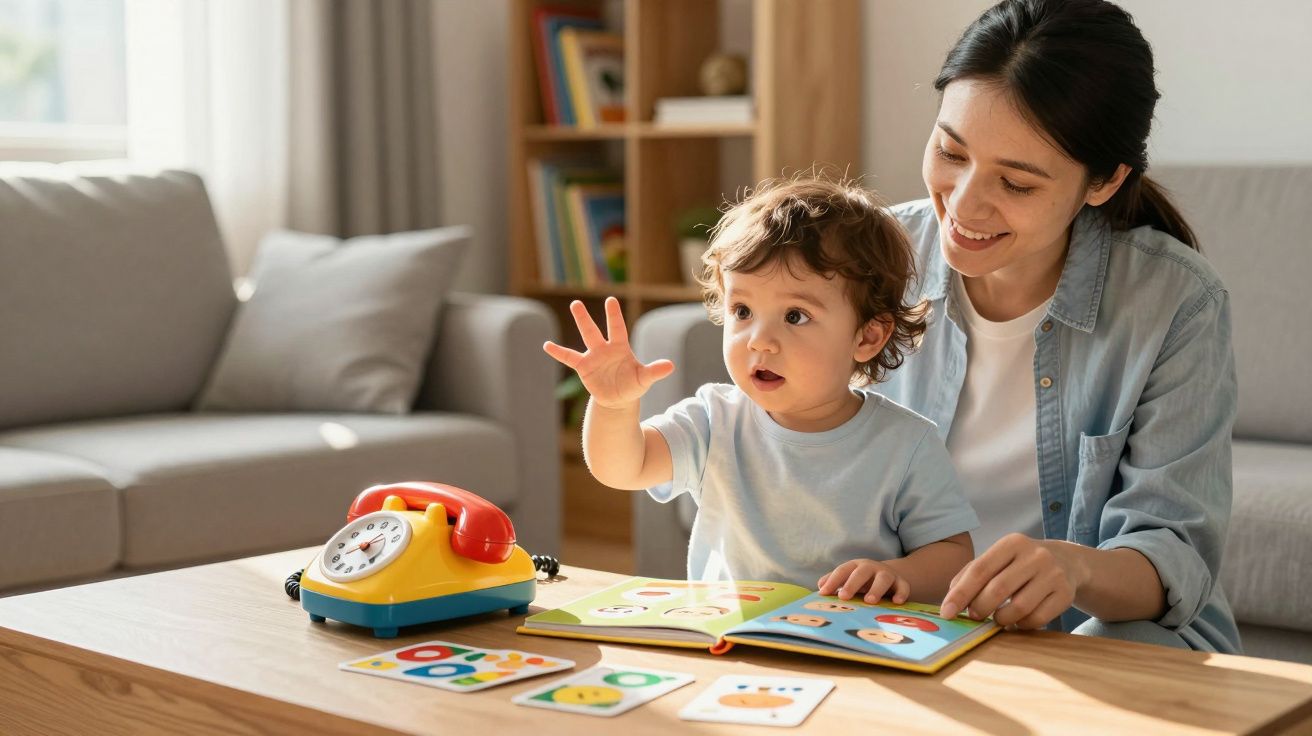
New research from the Netherlands suggests that from around the age of two, children can already anticipate whose turn is next in a conversation. Rather than politely waiting for a clear pause, they pick up on tiny linguistic cues-and often shift their gaze to the next speaker while the current speaker is still talking.
How toddlers “read along” in conversation (turn-taking in a Dutch study)
Researchers tracked how toddlers watched animated dialogues between two Dutch speakers. On screen, the adults took turns with short lines that were clearly designed to invite a response from the other person.
Using eye-tracking cameras, the team examined where children looked-and, crucially, when they moved their eyes. The key question was timing: did the child look to the next person during the ongoing utterance, or only after the speaker had finished?
Children often looked towards the person who was expected to answer before the sentence had even ended.
This indicates that toddlers are not passive, waiting for each statement to finish and only then reacting. Instead, they listen actively, interpret information, and form a prediction: “Now it’s the other person’s turn.” That ability sits at the heart of smooth, natural turn-taking in conversation-for adults and children alike.
Questions pull children’s attention towards the listener
Questions played a clear role. As soon as an utterance was shaped like a question, children’s gaze moved far more strongly towards the likely responder than it did for ordinary statements.
- Question forms redirected attention to the listener much more often.
- The likelihood of a predictive look was more than five times higher for questions than for statements.
- One small word could amplify the effect even further.
When a question began with the pronoun “you” rather than “I”, it was apparently crystal clear to children that the other person was being addressed. In those cases, toddlers looked to the next speaker 2.7 times more often in time.
In other words, children are highly sensitive to fine-grained linguistic signals. They do not only recognise “This is a question”, but also: “This question is aimed at the other person.” That sensitivity helps conversations run without long, awkward pauses.
When toddlers start predicting conversational turn-taking
To pinpoint when this skill emerges, the researchers followed children aged one to four years. They wanted to know whether all children can “read between the lines” equally well, or whether there are clear age-related differences.
The one-year-olds in the study showed few signs of using such cues. They mostly responded only once the speaker had genuinely finished. From around the age of two, the pattern shifted markedly.
From a child’s second birthday onwards, they become noticeably better at anticipating turn changes-and by four years old, they do so with striking reliability.
So what develops is not only vocabulary. Children also learn the social timing of conversation: when a contribution is complete, when they are being addressed, and when it is their opportunity to speak.
Learning to talk also means learning to time pauses
This social rhythm shapes much of everyday interaction. Someone who joins in at the right moment seems attentive and engaged. Someone who regularly responds too early or too late can quickly be perceived as rude or hesitant.
For children, that means building two abilities in parallel: they learn words and grammar, and they learn to interpret conversational timing. Each supports the other.
| Age | Handling conversational turn changes |
|---|---|
| 1 year | Usually reacts after the utterance ends; little prediction |
| 2 years | Starts using questions and cues; first predictions appear |
| 3 years | Predictive gaze shifts become much more frequent and earlier |
| 4 years | Turn-change prediction closely resembles the pattern seen in older children |
When language develops more slowly: Developmental Language Disorder (DLD)
The study also included children with Developmental Language Disorder (DLD). These children find it difficult to learn and use language confidently, even though their hearing and general intelligence are within the typical range.
A central finding was that they had grasped the basic rule that “a question is followed by an answer”. In principle, they recognised that someone else is now due to speak.
Children with Developmental Language Disorder (DLD) could also predict turn changes-however, they did so more slowly than their same-age peers.
The difference showed up in timing. Many children with DLD shifted their gaze to the next speaker only after that person had already started talking. That leaves less time to prepare an answer internally. In real-life conversations, this can make them more likely to hesitate, stall, or come in late.
Why every second matters in conversation
Conversation typically runs without long pauses. Adults often respond within fractions of a second. To achieve that, the brain begins planning a reply while the other person is still speaking.
Among typically developing children, the study found that same pattern: they oriented towards the next conversational partner early and gained extra milliseconds for planning. Children with DLD missed that head start more often.
The researchers emphasise that children with DLD do understand the turn-taking rule. The challenge appears to lie more in processing speed. For parents and professionals, this is an important reminder not to misread slower responses as lack of attention or lack of interest.
The hidden workload: listening, planning, speaking
In conversation, listening is only half the job. At the same time, the brain is working out: What will I say next? How should I structure the sentence? Which words fit? Even small increases in complexity can slow things down.
Earlier research shows that children answer simple questions faster than longer, more complex ones, and that longer answers require more planning time. That is precisely when clear early cues-signals that say “you’re up next”-can help.
Clear questions that start with a verb and address “you” directly can make turn-taking easier for children.
Linguist Imme Lammertink recommends exactly this: adults should address children more directly and phrase questions so it is obvious who is meant to answer. That gives especially uncertain children an advantage, allowing them to prepare their response internally.
What parents and early years practitioners can do
The findings translate well into day-to-day life. Small adjustments when speaking with toddlers can make a real difference:
- Make the addressee explicit: rather than “Who wants the ball?”, say “Do you want the ball?”
- Use questions instead of running commentary: involve children actively (“Would you like more juice?” rather than “There’s more juice.”)
- Use eye contact: look at the child when you expect an answer-this reinforces the spoken cues.
- Keep sentences short: especially with younger children, several brief questions can work better than one long, complex sentence.
- Show patience: do not treat delayed answers as “not listening”; allow the child that extra moment.
For children with DLD, these consistent patterns can act as valuable practice. Each successful question–answer exchange strengthens their sense of timing and role-switching.
A note on prosody and everyday noise (additional context)
Beyond words like “you” and grammatical question forms, real conversations also include prosodic cues-intonation, rhythm, and stress patterns that signal whether a turn is likely to end. In busy homes and nurseries, these cues may compete with background noise and overlapping speech, which can make turn-taking harder for young children and particularly challenging for those who process language more slowly.
This is one practical reason why calm, face-to-face interactions-even brief ones-can be disproportionately helpful: they make timing cues clearer and reduce the load on attention and processing.
How robust are the findings?
The study used drawn scenes and tightly scripted dialogues rather than messy real family life with background noise, interruptions, and multiple speakers. That control makes effects easier to measure, but everyday conversations are more complex.
In addition, the sample size was limited, and different eye-tracking camera systems were used to record the eye movements of different groups. The researchers argue that large screens and clear visual targets make the results sufficiently comparable. Even so, larger studies using real family interactions are still needed.
Despite these limitations, the overall picture is clear: toddlers do not simply wait until it is completely quiet. They use subtle linguistic cues to anticipate who will speak next-and in doing so, they build the foundations for fluent turn-taking surprisingly early.
Key terms explained
Turn-taking is the structured alternation of conversational roles: one person speaks while the other listens, then they swap. In daily life this changeover happens so quickly and effortlessly that adults barely notice it-children have to learn it.
Developmental Language Disorder (DLD) is a persistent difficulty with language acquisition without an obvious external cause. Affected children may struggle with vocabulary, sentence structure, and retrieving words, even though they have typical hearing and otherwise age-appropriate development.
In practical terms, children with DLD often benefit from clear, predictable conversational routines. The more unambiguous the adult’s signal of “it’s your turn now”, the easier it is for the child to join in-and the more they can practise the rhythm of conversation as part of everyday life.






Comments
No comments yet. Be the first to comment!
Leave a Comment