
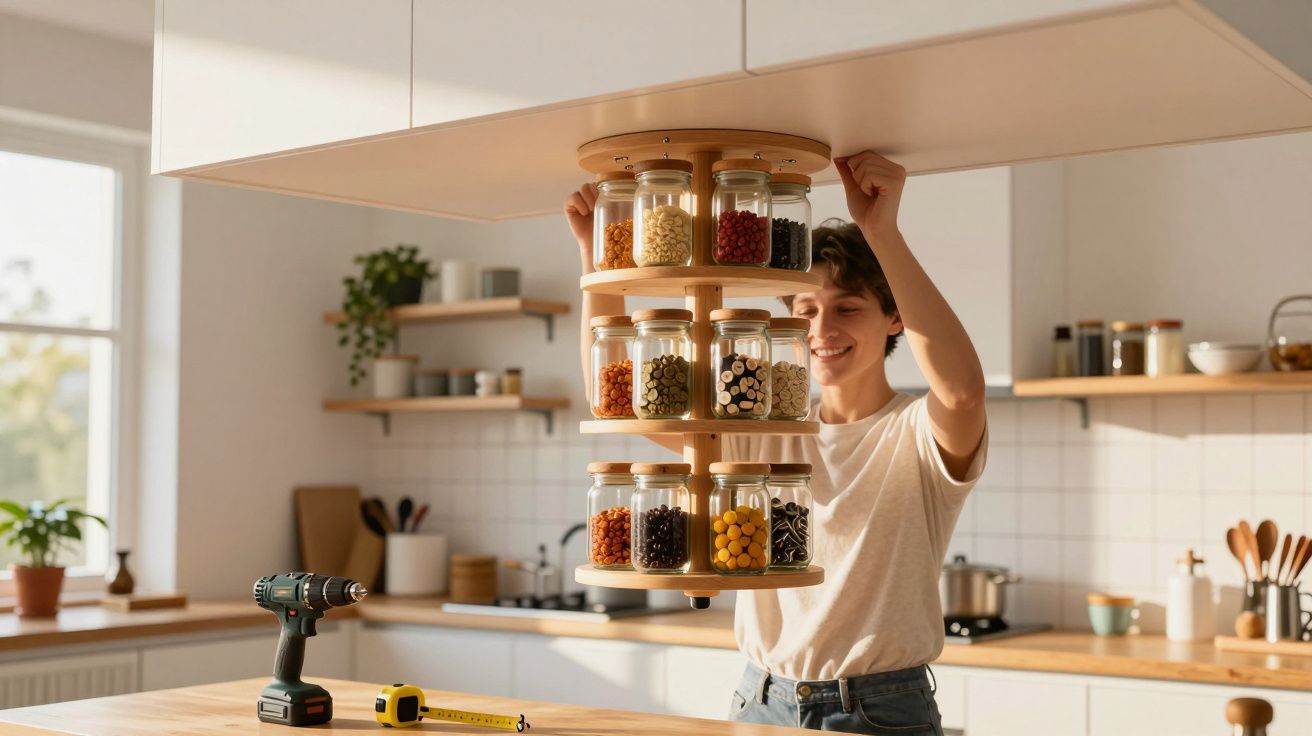
In many homes, you’ll find a familiar scene: open spice sachets, missing elastic bands and loose screws scattered about, creating a small-parts mess rather than proper order. This is especially frustrating in compact kitchens or studio flats, where every centimetre matters. A simple, clever solution using recycled mini jars turns the usually wasted space under cupboards into a rotating storage system that frees up drawers and keeps odds and ends under control for good.
How a rotating jar block turns hidden space under cupboards into storage
The concept is almost disarmingly simple, yet incredibly effective. Small screw-top glass jars-such as old jam, mustard or spice jars-hang upside down from their lids, which are fixed to a wooden strip. That strip becomes a rotating jar block: it sits between two side supports and spins on an axle like a small roller.
Mounted beneath a wall cupboard, under a shelf, or even directly on a wall, the jars sit neatly above your work surface rather than filling up drawers.
Instead of overstuffed drawers, your small items are neatly sorted, fully visible, and floating right where you need them.
Each jar twists off from underneath with a simple turn. Screw it back on and it locks securely into its lid again-nothing slides, nothing tips over, and that dead zone beneath cupboards suddenly becomes genuinely useful storage.
Materials and tools: what you’ll need for the mini jar trick
To build this suspended organiser you only need a modest set of supplies, most of which you can pick up from a DIY shop-or salvage at home:
- small screw-top glass jars (for example, jam, mustard, spice jars)
- a rectangular wooden strip to act as the rotating block
- two additional pieces of wood for the side supports
- wood screws for fixing lids and mounting the unit
- a sturdy metal bolt or coach bolt to serve as the axle
- a drill with suitable drill bits
- sandpaper or a sanding block
- wood stain or paint (optional, for appearance and protection)
Make the two side supports slightly longer than the jars are tall. That clearance is what lets the block swing freely without knocking into the surface below. Choose the wooden strip length based on how many jars you want to hang-12, 16 or 20 is common. The strip should be just a little wider than the jar lids so the lids sit firmly, while still leaving enough room to grip and twist the jars comfortably.
Step by step: build a swinging jar shelf (rotating jar block)
1) Prepare and protect the wood
Start by sanding all wooden surfaces until smooth. Ease any sharp edges so you don’t catch your hand later or end up with splinters. If you want it to blend into a kitchen, workshop or office, apply stain or paint. Once dry, the finish helps the wood cope better with grease, dust and humidity.
2) Mark out the lids and screw them in place
Lay the wooden strip in front of you and mark the lid positions in pencil. Keep spacing consistent, making sure:
- there’s enough gap for your fingers between neighbouring jars
- the lids sit in from the edges so nothing overhangs
Screw a lid onto each mark. One central screw is often enough, but if the metal is thin, two smaller screws usually hold more securely. The lid must be fixed tightly-if it’s loose, the jar can spin without unscrewing properly.
3) Fit the axle so the block rotates smoothly
Drill an axle hole through both side supports. Those holes should be very slightly larger than the bolt so the block rotates easily. Drill the matching hole through the wooden strip too, but here you want a snug fit so the strip doesn’t wobble around the axle.
Push the bolt through the first side support, then through the wooden strip, and out through the second support. Add washers if needed, then tighten nuts. Fasten the nut at the wooden strip firmly, but leave the outer nuts tight enough to remove slack while still allowing the block to rotate freely.
4) Mount under a cupboard, shelf, or on the wall
Before filling any jars, test the unit empty. If the rotating jar block turns smoothly and stays in place, fix the side supports to the underside of a wall cupboard, beneath a shelf, or directly to the wall.
Use strong screws, and if you’re mounting into plasterboard, use appropriate wall plugs. Remember the weight of filled glass jars-build for stability rather than “just enough”. Only once everything is secure should you fill the jars and screw them into their lids.
What the mini jars are good for-far more than just spices
Kitchen organisation above the worktop
In the kitchen, the best position is usually directly over your prep area. Each jar can hold spice blends, dried herbs, cake decorations, or dry goods such as sesame seeds, chia seeds or stock powder. With a small twist of the rotating storage block, everything comes into view-no more rummaging in the back of a drawer.
A handy finishing touch: label the bottoms of the jars (which face downwards) using a permanent marker or small stickers so you can read what’s inside at a glance.
Craft corner and hobby room storage
If you sew, scrapbook or make jewellery, you’ll know how quickly beads, sequins and buttons multiply. Hanging jars let you divide that mountain of tiny items into sensible categories, for example:
- beads sorted by colour
- buttons sorted by size or material
- sequins, rivets, eyelets and small decorative stones
Your work surface stays clear, while the jars become an attractive display. Because they’re transparent, you can also see immediately what’s running low.
Home office and children’s room
Over a desk, these suspended jars keep everyday office bits from vanishing into a “miscellaneous” drawer: paper clips, elastic bands, drawing pins, erasers and USB sticks are all easy to spot and grab.
In a child’s room, the same idea works for small collectible figures, marbles, model-making components or magnetic game pieces. If you like the look of a coordinated system, you can paint different rotating jar blocks in different colours-one per category.
Workshop, cellar and garage storage
This is where the system often shines most, because small hardware is notoriously hard to keep sorted. Mini jars are ideal for:
- screws grouped by length and head type
- wall plugs sorted by diameter
- nuts, washers, nails and specialist fixings
Mounted above a workbench or under a wall shelf, everything stays close at hand and off dusty surfaces. If you do regular DIY projects, the time saved searching for parts can be surprisingly significant.
Practical tips, safety, and advanced variations for the rotating jar block
Although the build is straightforward, a few details make it safer and more satisfying to use. Glass is heavier than plastic, but it’s durable and you can see the contents instantly. If your wall cupboard is lightweight, consider fixing a narrow timber batten securely to the wall first and mounting the system to that, rather than relying solely on the cupboard base.
Also avoid filling jars right up to the rim-especially with spices or dusty materials. When you twist jars on and off, overfilled contents can spill. Keep jar threads and lids clean so the jars seat properly and hold securely.
If you enjoy tinkering, you can mount two or more rotating jar blocks side by side, or stagger them slightly so specific jars are easier to reach. In rooms with higher ceilings, a second row behind the first can work well-rotate the rear row forward only when needed.
Extra idea: keep it hygienic and easy to maintain
Because the jars sit above work areas, it’s worth planning for cleaning. A washable finish on the wood helps, and it’s sensible to dedicate certain jars to food-only use. Every so often, remove the jars and wipe the lids and underside of the block-this prevents grease build-up in kitchens and dust accumulation in workshops.
Sustainability bonus: make the organiser part of a reuse routine
This project is a practical way to reuse packaging you already have. If you standardise jar sizes over time-saving the same type of jam jar, for example-you’ll find it easier to swap contents around, replace damaged lids, and keep the overall look consistent.
The underlying principle remains the same even if you change the containers: screw-top plastic tubs or magnetic tins on a metal strip can follow the same “move small parts upwards” logic. Either way, you reclaim worktop and drawer space, keep everything visible, and make daily life feel far less chaotic.




Comments
No comments yet. Be the first to comment!
Leave a Comment