
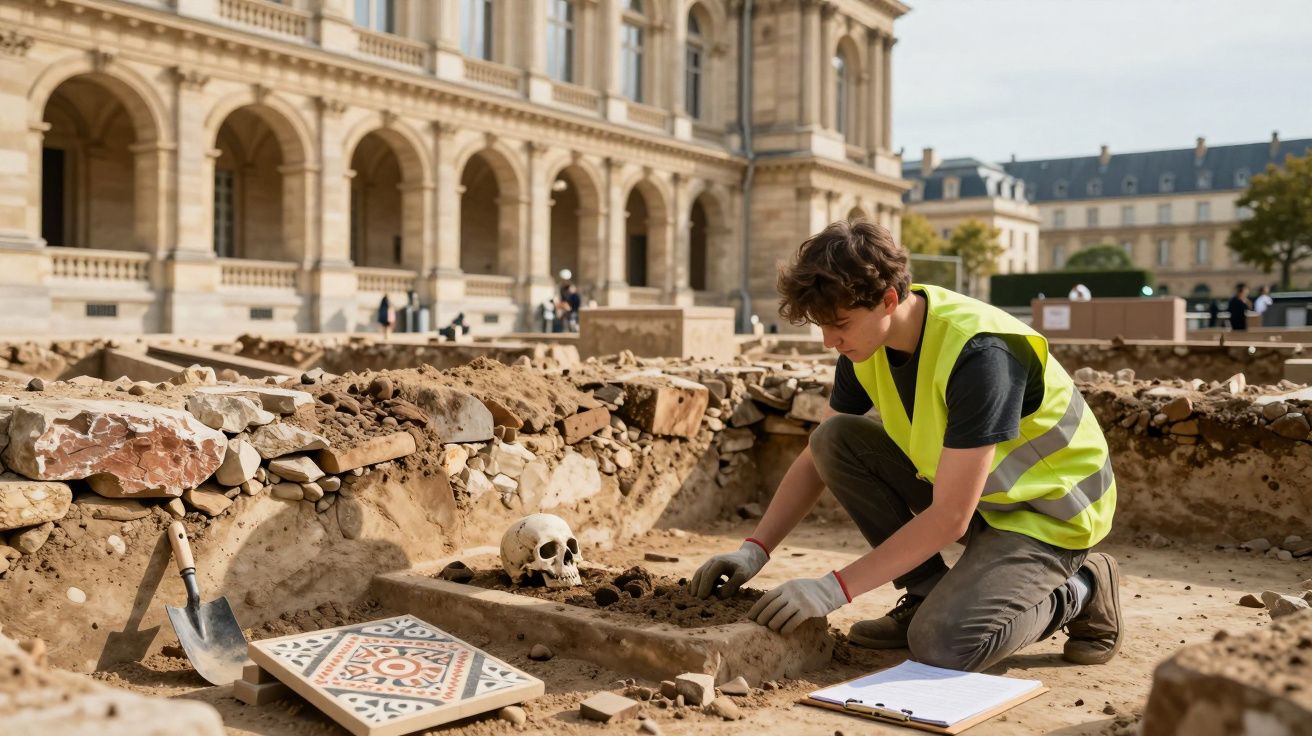
While builders were due to arrive for a major refurbishment at the Paris Palace of Justice on the Île de la Cité, the first people on site were archaeologists. What initially looked like a standard pre-build check rapidly turned into a small archaeological sensation: beneath the paving of these venerable court buildings lay traces of a city that has been continuously rebuilt, reshaped and reimagined for almost 2,000 years.
The Palace of Justice on the Île de la Cité: a courthouse built on a historical powder keg
The Palace of Justice occupies the Île de la Cité, one of Paris’s oldest settled areas. Today, courtrooms, the police prefecture and the Sainte-Chapelle sit side by side. For many Parisians, the location evokes long queues outside hearings, major terrorism trials, and landmark cases that have marked French history.
Yet the ground below told a very different story. Between August and November 2025, archaeologists from the City of Paris and the French research institute Inrap carried out preventive excavations. In France, this kind of work is required ahead of large construction projects so that any remains can be recorded and safeguarded before building begins.
In just over 100 square metres, an unexpectedly dense cross-section of almost two millennia of urban history emerged: from the early Roman period through to the modern era.
The team focused on the Cour du Mai, the Palace of Justice’s ceremonial courtyard. Exactly where heavy machinery is expected to operate, fragments of floor tiles, old masonry and even burials were found tightly clustered together-often only a few centimetres below today’s surface.
The enigmatic ancient wall line beneath the Cour du Mai (Palace of Justice)
A massive structure in the shadow of the courtrooms
Among the most striking discoveries was a substantial masonry base that took shape as the layers were opened. The foundation is about 3 metres wide-far too large for an ordinary house, and also excessive for a simple retaining wall.
Archaeologists suspect it may belong to the late antique fortifications erected around the Île de la Cité between the 3rd and 5th centuries CE. At that time Paris-then Lutetia-faced political upheaval, raids by Germanic groups and internal unrest. Across the Roman world, many towns contracted into smaller, more defensible cores and invested in thick protective walls.
If the defensive nature of the wall is confirmed, historians will have to redraw the accepted course of the city wall on the Île de la Cité-an awkward revision to a research model that has been stable for decades.
Around this wall segment, the excavation also revealed about twenty pits and postholes, as well as six inhumation burials. Together, these traces suggest more than a bare defensive line: they point to a zone used in multiple ways-perhaps a strip between wall and buildings where people lived, worked, and buried their dead.
Even earlier evidence from around the turn of the era
The surprises did not stop with late antiquity. Deeper layers produced features dating to around the transition from the 1st century BCE to the 1st century CE, when Lutetia was shifting from a Gallic settlement to a city shaped by Roman influence.
Archaeologists recorded ditches, small hollows and early occupation traces. These modest-looking remains are invaluable for reconstructing how early Paris organised space: where routes ran, where workshops may have stood, and which parts of the island were first taken into use.
- Late antique wall line (3 m wide)
- At least six burials in the immediate vicinity
- Roughly twenty pits and postholes
- Early settlement traces dating to around the turn of the era
Medieval splendour beneath rubble from a catastrophic fire
Burnt layers and royal tiles
The excavation uncovered far more than Roman remains. Immediately above the ancient layers sat thick deposits of debris, likely linked to the major rebuilding after the devastating fire of 1776. Large parts of the old royal palace were destroyed, and later phases of the present-day justice complex rose in its place.
Within this churned mass of demolition material, archaeologists found large quantities of carreaux historiés-decorated floor tiles dating to the 13th and 14th centuries. Many show lilies, the heraldic emblem of the French kings, as well as animal motifs. Comparable tiles are known from the Louvre’s Cour Carrée, where they have long been regarded as rare evidence of courtly interior design.
The tiles from the Palace of Justice demonstrate that the Île de la Cité in the High Middle Ages was not only a political hub, but also a setting for lavish interior architecture.
In addition, the outline of a medieval cellar was identified. This basement likely belonged to buildings of the Capetian royal palace that once stood on the island. Notably, the room does not appear on historic plans-meaning the dig refines (and corrects) previous assumptions about the palace precinct’s exact layout.
A place of law that began as a royal court
Many people now associate the Palace of Justice with hearings, barristers and security checks. In the Middle Ages, however, the site functioned first and foremost as a royal residence. The Capetians lived here before political power gradually shifted towards the Louvre and later palaces.
The discoveries align neatly with that transformation: royal decorative tiles and prestigious interior spaces, followed by heavy modern-era demolition layers, illustrate how the island was repeatedly rebuilt to serve new roles-from medieval royal centre to the modern machinery of justice.
Eleven graves between the walls of justice
One of the most compelling elements is a small burial group. In total, eleven skeletons were uncovered in the Cour du Mai area. These are inhumations without lavish grave goods-plain burials laid out close together.
Their precise date is still uncertain. The next step is to date the bones and carry out an anthropological assessment covering age at death, biological sex, potential disease, and indicators of injury or malnutrition. Such work can reveal everyday pressures and living conditions within past communities.
| Item | Possible indications |
|---|---|
| Number of graves | 11 |
| Interpretation | A small cemetery or the edge of a larger burial zone |
| Body position | Clues to religious practice or local burial customs |
| Bone analyses | Evidence for diet, illness, and physically demanding work |
Placing these graves within a densely built centre of power raises further questions. Are they early medieval burials from a period when the island had a stronger religious character? Or do they represent a brief, pragmatic use of open ground for burial before new buildings were erected above?
What happens next for the discoveries
A second excavation campaign and documentary research
The work completed so far covers only part of the site. A second campaign is planned for spring 2026 in another sector of the Palace of Justice. That area could yield further stretches of the presumed city wall, additional cellars, or more burials.
At the same time, post-excavation analysis begins in laboratories and archives. Pottery, tiles, masonry and human remains will be dated, conserved and compared. Historians will review old plans, building records and written sources to link the evidence to known events-such as construction phases of the royal palace or the aftermath of the 1776 fire.
Only by combining excavation data, laboratory results and archival research can a reliable reconstruction of the Île de la Cité’s development be produced-from Roman settlement to today’s judicial centre.
One further aspect will be deciding how the refurbishment project can proceed while respecting the newly identified archaeology. In practice, that can involve redesigning foundations, documenting and then reburying elements for protection, or-where feasible-integrating remains into the building’s long-term heritage management plan.
Why these finds make Paris’s story feel new again
Paris can seem exhaustively studied: guided tours, museums and school lessons often imply that every chapter is already mapped out. The Palace of Justice discoveries argue otherwise. Even in the city’s core, previously unknown walls, rooms and burials can still come to light.
For researchers, this is an invitation to re-test established models. If the route of the late antique wall shifts, interpretations of threats, flooding pressures, and the city’s footprint in that period may need adjustment. A newly recognised cellar can also reshape ideas about how spaces were used, how access routes worked, or how supplies moved within the royal precinct.
For urban planning, the implications cut both ways. Major projects in the historic centre can face delays when significant remains are exposed. Equally, new discoveries open opportunities for public engagement-temporary displays, on-site interpretation panels, or digital reconstructions that allow residents to encounter familiar places in unfamiliar ways.
A practical constraint unique to this location is that it sits within an active institutional complex with tight security and continuous activity. That reality can limit working hours, access routes and storage, making careful scheduling-and clear communication between archaeologists, contractors and authorities-particularly important.
How non-specialists can make sense of discoveries like these
Terms such as “preventive archaeology” and “demolition levels” can sound opaque. Preventive archaeology is simply the principle of excavating before construction starts, rather than after a digger accidentally tears into a wall. The goal is to record and understand what is there without bringing a project to a total halt.
The frequently mentioned “demolition layers” are, in effect, historic rubbish heaps. When a palace was redesigned after a fire, broken roof tiles, shattered floor tiles and charcoal-rich debris were dumped into pits or spread out to reshape ground levels. Analysing those layers carefully can reveal earlier materials, building standards and even changes in interior fashion.
Visitors to Paris can already see similar processes elsewhere: in the archaeological crypt museum on the forecourt of Notre-Dame, parts of the Cluny baths, or the underground remains beneath the Louvre. What has now been uncovered at the Palace of Justice belongs to the same family of evidence-just in a part of the city most tourists never enter.
In the longer term, digital modelling could make these new discoveries visible without permanently opening sensitive areas. One plausible approach would be an augmented-reality view: a visitor points a smartphone at the Palace of Justice and an app overlays the Roman wall, medieval cellar spaces and burial locations. A complex that appears closed and opaque at street level would become legible-revealing Paris as it truly is beneath the paving: a layered city where every construction project carries the potential for an archaeological reunion with the past.






Comments
No comments yet. Be the first to comment!
Leave a Comment