
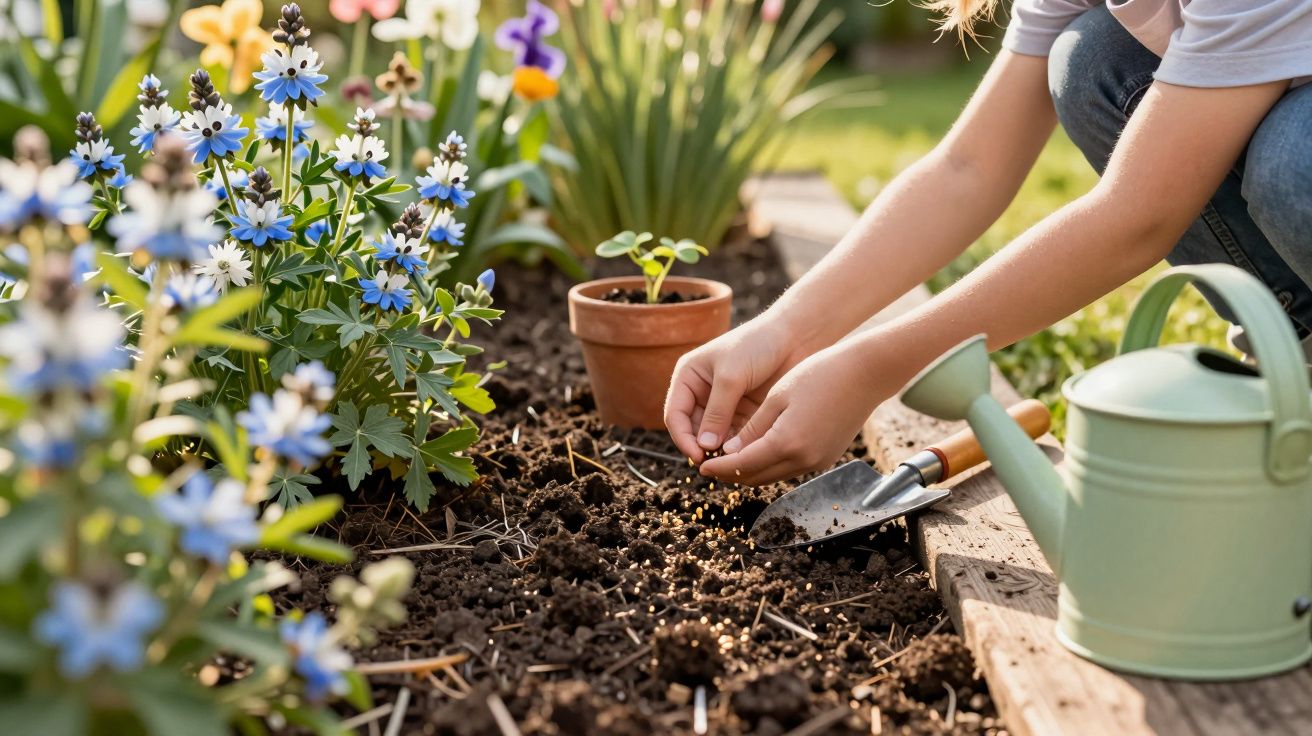
While many borders still look bare and a little gloomy in March, this is exactly the moment to lay the groundwork for a surprisingly flower-filled summer. One hardy annual, with a delicate wildflower feel, can make beds, paths and even the vegetable plot look effortlessly lively right through to late summer.
The flower that does most of the work: Nigella damascena (love-in-a-mist / “Jungfer im Grünen”)
The plant garden professionals rave about is Nigella damascena, commonly known in English as love-in-a-mist (and in German as “Jungfer im Grünen”). It has the charm of a meadow wildflower paired with the refinement of a cottage-garden perennial. Its airy, star-shaped blooms sit above fine, threadlike foliage that looks like a soft green veil.
Typically, it reaches 40–60 cm in height. Colour options run from pale blue and white through to gentle pink shades. That slightly accidental, “tousled” appearance is exactly why it’s so popular in naturalistic and romantic planting schemes.
Sow Nigella damascena in March and you can expect an almost uninterrupted ribbon of flowers from mid-June to late August-often even longer.
A major advantage is its toughness: it’s one of those robust annuals that grow quickly, cope well with ordinary garden soil, and forgive the sort of mistakes beginners often make. That’s why it’s widely recommended as a perfect starting point for anyone wanting more colour without turning gardening into a full-time job.
Why March is the ideal time to sow
As March progresses, the soil begins to warm and prolonged hard frosts become less common. That in-between period suits Nigella damascena perfectly: the seeds don’t need summer heat, but they do appreciate ground that’s cool and fresh rather than icy.
- Sowing in March: flowering usually begins from mid-June
- Flowering period: until late August, and in mild weather into September
- Ideal for: gaps in borders, mixed beds, cottage gardens, and wildlife-friendly/naturalistic gardens
Many gardeners notice the same pattern: for a while it looks like nothing is happening-then, a few weeks later, a previously dull strip of soil suddenly fills with a light blue or white “mist”. That pleasant surprise is often what earns love-in-a-mist a permanent place in the seed tin.
How to sow Nigella damascena (step by step)
The best part is that you don’t need a greenhouse or fiddly seed trays. Direct sowing outdoors works beautifully.
1) Choose the right spot
Sun is best. A fully sunny position produces sturdier plants and more flowers. Partial shade is possible, but flowering is often a bit reduced.
Soil should be loose and free-draining. Love-in-a-mist strongly dislikes waterlogging. In most gardens, normal soil is perfectly adequate-there’s no need for any specialist compost.
2) Prepare the soil
A few minutes spent prepping the bed pays off later:
- Remove weeds thoroughly
- Loosen the soil and break up large clods
- On very poor soil, work in a little well-rotted compost
The finer the surface texture, the more evenly the seeds tend to germinate.
3) Sow correctly and water gently
Scatter the seed over the surface. Nigella damascena is a light-germinator, so it should not be buried deeply. A very thin dusting of soil or fine compost is more than enough.
Press the area down lightly with your hand, then water using a fine spray. A strong jet can easily wash the seed out of place.
Key tip: avoid sowing too thickly. Dense patches can look lush at first, but the plants weaken each other and produce fewer flowers.
The most common mistake: plants set too close together
A lot of gardeners sow heavily because they’re worried about bare patches-but it often backfires. When seedlings stand like a carpet, they compete for light and nutrients, leading to spindly stems and smaller blooms.
Once seedlings have formed several true leaves, thin them out. The sweet spot is 20–25 cm between plants. If you want especially bold, airy clumps, you can even leave 30 cm.
| Spacing | Effect in the border |
|---|---|
| Under 15 cm | Too crowded; competition; smaller flowers |
| 20–25 cm | Balanced, airy clumps; lots of flowers |
| Up to 30 cm | Fewer plants, but especially striking individual clumps |
Thinning can feel harsh, but it’s worth it: the remaining plants grow stronger and keep flowering for noticeably longer.
Keeping love-in-a-mist flowering for most of the summer
Once established, Jungfer im Grünen / Nigella damascena is largely self-sufficient. In a typical summer, it only needs watering during prolonged dry spells-constant irrigation isn’t necessary.
To extend flowering as much as possible, remove spent blooms regularly. That way, the plant puts its energy into producing fresh buds rather than forming seed.
Snip off faded stems, and you’ll be rewarded with weeks of new flowers-one of the simplest ways to stretch the season.
Extra tip for even longer colour (succession sowing)
If you want a longer display than a single sowing can provide, add a second, lighter sowing 3–4 weeks after the first (still directly outdoors). This staggers flowering times and can help keep the “mist” effect going later into summer, especially in beds that otherwise fade after early-season bulbs.
Cutting for the vase (and what to pair it with)
Nigella damascena also works well as a cut flower. The fine stems generally last around 10 days in a vase-sometimes longer if you change the water regularly.
It looks particularly good combined with:
- Ornamental grasses
- Baby’s-breath (Gypsophila)
- Small-flowered roses
- Other meadow-style summer flowers such as cornflowers or cosmos
Self-seeding: let the garden lend a hand next year
By late summer, the plants develop attractive seed pods. If you leave some in place, you often get a bonus the following spring: the pods dry, split open, and the seed drops to the soil, creating a new generation.
Over time, this produces a gently naturalised, lively look. If you’d like more control, cut off some pods and allow only a few to ripen in the best spots.
Decorative seed pods for arrangements (added idea)
Those balloon-like pods also dry well. If you cut them when they’ve coloured up but before they fully split, you can hang them somewhere airy to finish drying-then use them in dried arrangements or simply enjoy them as a structural feature in the border.
Where Nigella damascena looks best
Despite its delicate appearance, love-in-a-mist is more versatile than it first seems. It suits romantic borders, but it can also work in modern planting if used with intention.
- Threaded between roses, it softens rigid planting and adds movement.
- In the vegetable garden, it fills gaps after early crops and attracts pollinating insects.
- In gravel or dry gardens, it creates a gentle contrast against stone.
- In pots on balconies and patios, it reads like a miniature wildflower meadow.
Used alongside other summer flowers, it can create strong effects: with bright yellow coreopsis (tickseed) you get a lively contrast; with pastel snapdragons you get a softer, playful look.
What beginners should know
For families, Nigella damascena is a brilliant teaching plant: it clearly shows how a flower turns into a seed pod-and how those seeds become new plants. The rounded pods look like tiny sculptures.
One important note: even though the seed heads are decorative, this is not an edible plant-it’s grown purely for ornament. If you have pets, it’s sensible not to let them chew on discarded bouquets, even though serious poisoning is uncommon.
If you start gardening late in the year, autumn sowing can also work in some areas: a portion of the seed overwinters in the soil and germinates in spring. However, March sowing remains the most reliable route to a long, flower-rich summer.
In the end, love-in-a-mist offers a rare combination: minimal effort, maximum impact, and a naturally informal look. Sow a packet in March, and by high summer you can sit back and watch a border that looks artfully planted-without the hard work.




Comments
No comments yet. Be the first to comment!
Leave a Comment