

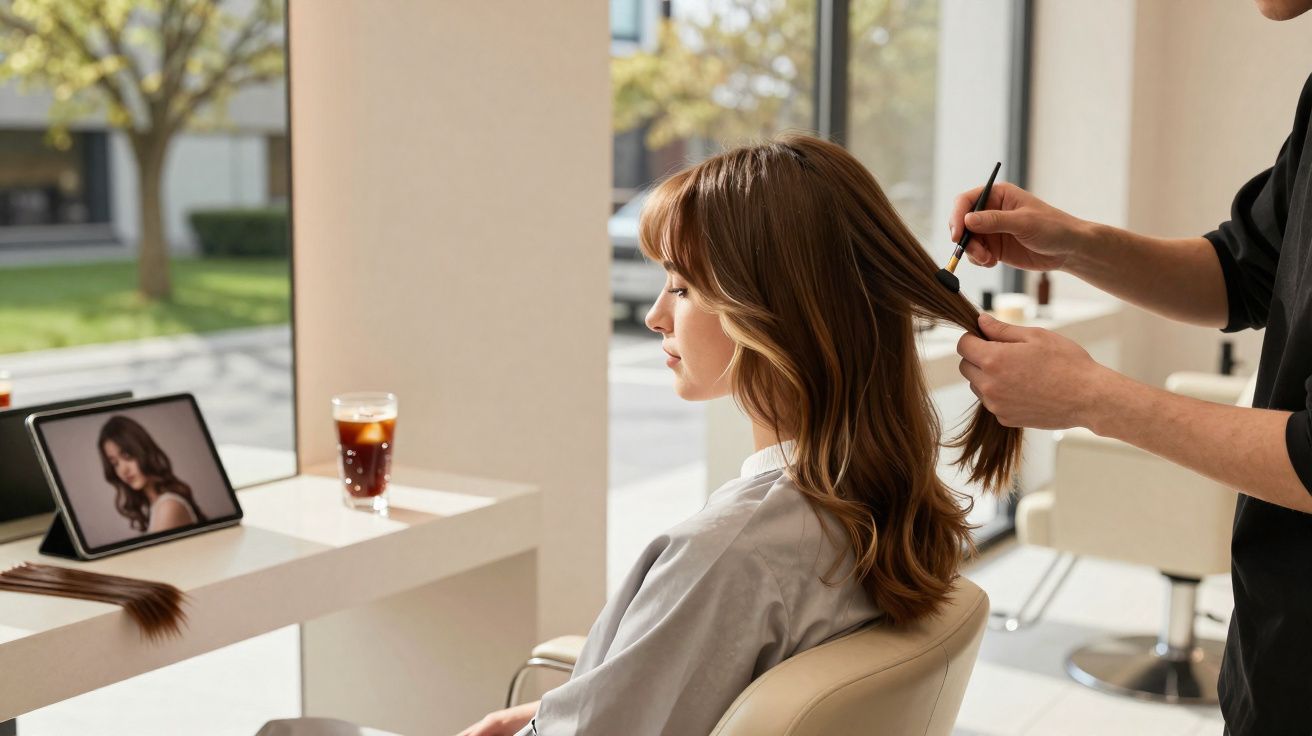
“If I come in every three weeks,” she said, “my hair will grow quicker, won’t it?” The stylist paused. In the mirror, she caught my gaze with the expression hairdressers reserve for a myth they’ve heard a hundred times before lunch.
Through the salon window, people rushed by: some with sleek, glossy blow-dries, others with frizzy topknots thrown up at 7 a.m. Different looks, same mission-longer, healthier hair, and they want it yesterday. Somewhere along the way, the belief that frequent haircuts make hair grow faster became a quiet little superstition: repeated in bathrooms, passed around in group chats, and offered up as parental wisdom long after the science stopped agreeing.
The strange thing is that the more often we chop, the easier it is to miss what’s actually going on at the root.
Why we still believe haircuts make hair grow faster
Step into a local salon on a Saturday and you’ll hear a familiar line: “Just a tiny trim-I’m growing it out.” It’s usually said with optimism, as if those half-centimetre clippings on the floor are going to send instructions to the scalp to hurry up.
The idea feels sensible because we borrow “proof” from other places. You prune plants and they come back fuller. You shave and the stubble can look darker or thicker. So our brains join the dots-even when the dots don’t belong together.
Biology tells a different story. Hair growth begins under the skin, inside the follicle, where new cells form and push the strand outwards. Once hair emerges from the scalp, it’s essentially dead material. Scissors never reach the living part, which means snipping the ends cannot send a message back upstream to speed anything up.
And yet the myth hangs on because what you see after a haircut can look like progress: cleaner ends, a sharper shape, more swing and movement. In the mirror, it reads as “healthier”, and “healthier” can be mistaken for “growing faster”.
If you ask around, you’ll hear variations of the same anecdote. Someone decides to get serious about length, books trims every three to four weeks, and swears their hair flew past shoulder length quicker than ever. A 2023 survey by a UK haircare brand found that nearly 60% of women think regular cuts speed up growth-figures like that don’t appear out of thin air.
Comparison adds fuel, too. A friend turns up six months later with seemingly endless waves; when you ask what she did, she says, “Honestly, I just cut the ends a lot.” Genetics, hormones, stress levels and nutrition rarely make the story. The haircut becomes the hero. Online, the message is even louder: “Trim every month for faster growth” performs far better than “your follicles follow your genes”. One sells hope; the other sounds like revision.
The crack in the logic shows up when you look closely at what trims actually do. Cutting the tips won’t increase growth rate, but it does remove split ends. That matters because split ends can creep higher up the hair shaft, causing breakage further along. Less breakage means you keep more of the length you’ve already grown.
So hair doesn’t genuinely grow faster after a cut-it simply lasts longer. You’re not making the engine more powerful; you’re sealing the leaks. That’s why it can feel as though your hair is growing quicker when you maintain it: the growth rate stays the same, but you lose less of it.
Haircuts and hair growth: what really makes hair look longer and healthier
If you want hair that looks longer and healthier, the most useful shift is to stop trimming by the calendar and start trimming by the condition of your ends. For one person, that might mean every 8 weeks; for another, it could be every 4 months. The aim is to remove splits while protecting as much healthy length as possible-think of it as pruning damage, not policing growth.
When you regularly get rid of wispy, splitting ends, your hair can fall in one stronger-looking line. It reflects light more evenly, the hemline looks fuller, and the length you already have stops disappearing into a thin, see-through fringe. A micro-trim of 0.5–1 cm now can save you from needing a dramatic 5 cm chop later. It’s less satisfying in the chair, perhaps, but over a year it’s the gentle maintenance that protects the centimetres you care about.
Practically speaking, the “every six weeks” rule can be a trap for anyone focused on length. If your hair grows roughly 1–1.25 cm per month and you’re cutting 2 cm each visit, the maths is brutal-you’re close to wiping out your gains. Plenty of people sit at the same length for years and blame their age or hair type, when the real culprit is how much is being taken off each time.
Emotionally, it’s easy to see why the habit sticks. Rituals feel grounding. A standing appointment can feel like you’re taking charge: you sit down, the cape goes on, and it seems like an investment in “future hair”. On a rough week, a fresh cut can genuinely feel like a reset. The problem starts when that ritual turns into a superstition that quietly works against your goal-walking in wanting longer hair and walking out having sacrificed a month of growth yet again.
On a hard day, a fresh cut can feel like a small act of self-respect. That’s true. The key is matching that feeling to what your hair actually needs, rather than what the myth taught you to expect.
Here’s one extra piece that often gets missed: hair doesn’t grow in a steady, linear way in every season of life. The follicle cycles through growth and rest phases, and factors like illness, major stress, hormonal shifts and certain medications can affect what you see months later. A trim won’t “fix” a slowed cycle-but a consistent, gentle routine can help you avoid breakage while your scalp does what it needs to do.
It can also be worth checking whether the issue is breakage rather than growth. If your roots are growing but the ends keep snapping, it will look as though nothing is happening. That’s when focusing on split ends, moisture balance, and how you handle your hair day-to-day often makes a bigger visual difference than any aggressive trim schedule.
How to support growth without falling for the “more cuts = faster hair” myth
A useful way to think about this is to swap “how often should I cut?” for “how well is my hair surviving?” Start by noticing your baseline: when do your ends begin to feel rough, catch more easily, tangle quicker, or look frayed on close inspection? For some people it’s around week 10; for others it’s month 5. That’s your real trim rhythm-not a fixed four- or six-week rule.
Then treat your ends like delicate fabric between appointments. Detangle gently, dry with a soft towel (or a cotton T-shirt) instead of vigorous rubbing, and smooth a small amount of leave-in conditioner over the last few centimetres. A low-friction pillowcase, looser styles, and avoiding tight elastics all help you keep your true length. None of this makes hair grow faster-it simply stops you throwing away what you’ve already grown.
Most people aren’t “bad at growing hair”; they’re up against quiet, daily damage. Brushing too aggressively when you’re late. Doing a quick straighten without heat protection. Going to bed with soaking wet hair twisted into a tight bun. These small habits cause splits and snaps in the oldest, most fragile part of the strand-the ends. Then you look in the mirror, see no progress, and blame (or worship) the scissors depending on the day. Let’s be honest: almost nobody gets every single habit right every day.
We’ve all had the moment of scrolling through old photos and thinking, “How did my hair used to grow so quickly?” Usually, it isn’t that time has suddenly changed your biology overnight. More often it’s lifestyle, stress, hormones, or simply how you’re treating your hair now. A kinder routine can improve visible length more than an overzealous trim timetable ever will.
“Cutting the ends doesn’t send a memo to the roots,” laughs London trichologist Dr Hannah Reed. “What regular trims really do is protect your investment. If growth is the money you earn, avoiding split ends is how you stop spending it without noticing.”
To make it easier to act on, here’s a quick recap you can screenshot before your next salon visit:
- Ask your stylist how much genuinely needs to come off-in centimetres, not “just a tidy-up”.
- If length is the goal, try to cut less than your average growth between appointments.
- Watch your ends rather than the date: rough texture and white-dotted tips usually mean it’s time for a trim.
- Put scalp health, nutrition and gentle handling ahead of appointment frequency.
- Remember: regular trims keep hair looking healthy; they don’t speed up growth at the root.
Rethinking what “progress” looks like in the mirror
There’s something freeing about accepting that your hair has its own quiet pace, and it won’t suddenly double its speed just because you book more salon time. When you stop chasing acceleration, you can start prioritising preservation. That’s how you break out of the loop of “trim, wait, trim, complain”, wondering why your hair won’t cross the same invisible line down your back.
Once you drop the myth, better questions take its place. What does stress do to your hair across a year? What changes if you sleep more, drink more water, or eat a proper lunch instead of grazing on crackers at your desk? How does your hair respond when you stop yanking through knots and spend two extra minutes detangling gently? None of these are magical hacks. They’re unglamorous, consistent habits that your follicles can actually respond to over time.
Next time you sit in the chair and say, “I’m growing it out,” you can mean it differently. You might request a micro-trim instead of a general “clean-up”. You might decline that extra centimetre “to neaten it” because you understand the maths of your own growth rate. You may even walk out with less hair on the floor-and more control over what happens at the root.
You don’t need to lecture anyone. Myths like this tend to fade through quiet evidence, not arguments. Someone will notice your hair finally reached the length you’ve wanted for years and ask what changed. The answer won’t fit into a catchy slogan. It’ll be something like: fewer unnecessary cuts, more respect for what’s already growing, and a smarter way of judging “progress” in the mirror.
| Key point | Detail | Why it matters to you |
|---|---|---|
| Haircuts don’t speed growth | Hair growth happens at the follicle, not at the ends | Helps you avoid wasting time and money on false promises |
| Regular trims prevent breakage | Removing split ends helps you keep the length you grow | Makes hair look longer, thicker and healthier over time |
| Habits beat frequency | Gentle care, nutrition and scalp health matter more than monthly cuts | Gives you practical steps for real, visible progress |
FAQ
- Do frequent haircuts make hair grow faster? No. Hair growth speed is controlled by your follicles and genetics, not by how often you cut the ends. Trims mainly help you keep the length you’ve already grown.
- How often should I cut my hair if I want it to grow? Many people do well with trims every 8–12 weeks, or whenever the ends start splitting or feeling rough. The goal is to remove as little as necessary, not to cut as often as possible.
- Why does my hair seem longer after regular trims? Stronger, healthier ends break less, so your hair can reach greater lengths without thinning at the bottom. That creates the impression of faster growth even though the rate is unchanged.
- Can skipping trims damage my hair? If you leave it too long, split ends can travel up the strand, which increases breakage and may force you to cut off more length later. Occasional trims help protect the rest of your hair.
- What actually helps hair grow better? Balanced nutrition, good scalp care, stress management, gentle styling and heat protection all support the follicles. Those are the levers that truly influence how your hair behaves over time.




Comments
No comments yet. Be the first to comment!
Leave a Comment