
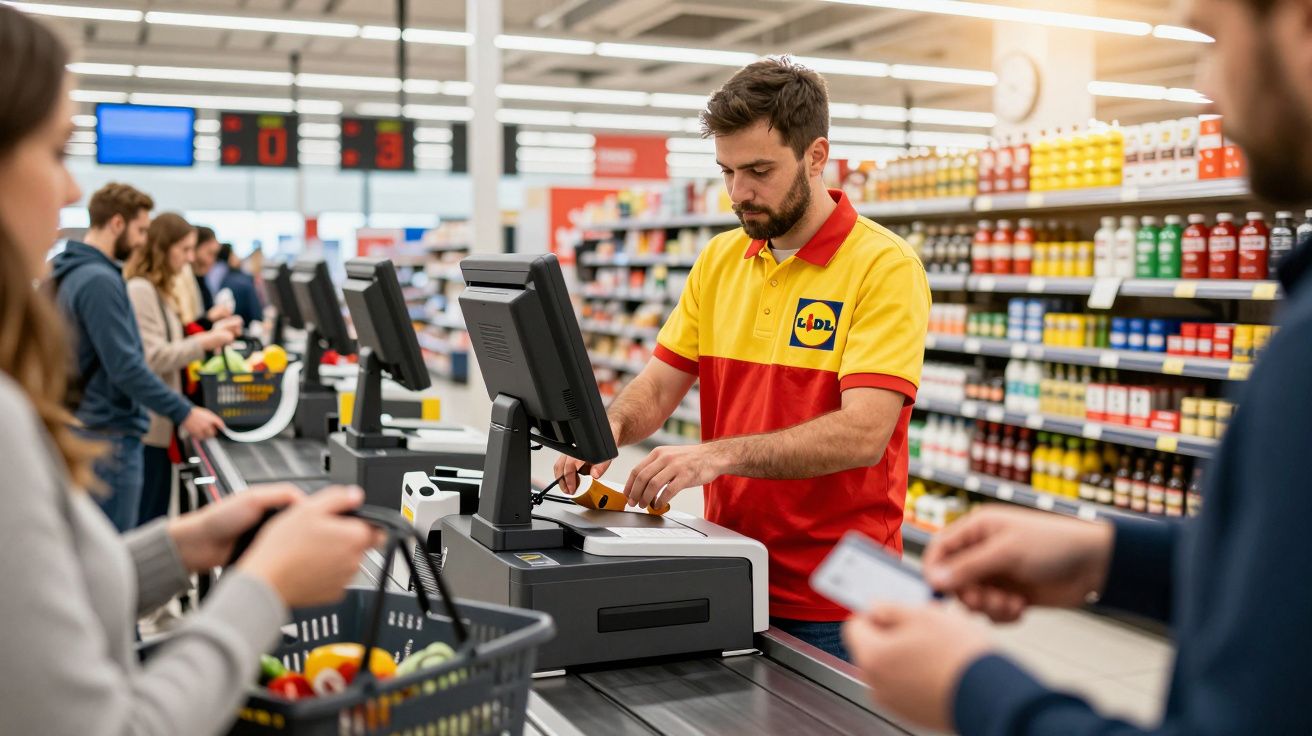
Behind that pace sits far more than simple time pressure.
Plenty of shoppers leave the store with bulging bags and a slightly raised heart rate. Your mind is still on the last beep, while your trolley is already rolling towards the exit. It can feel random, almost chaotic - but in reality it follows a carefully engineered system that ties commercial targets to psychological effects.
How Lidl turns speed into a business strategy
Lidl operates using a hard discount model. Prices are kept low, margins are tight, and the turnover in-store has to be correspondingly high. Every second a checkout can shave off increases the number of customers moving through the shop - and reduces staffing costs per basket.
In hard discount, every second at the till matters: high scanning speed replaces expensive advertising and time-intensive service.
For that to work reliably, Lidl designs its stores to be extremely consistent. If you know one branch, you can navigate most others straight away - and that consistency is even more valuable for staff than it is for customers.
- A very similar floor plan in almost every branch
- Short routes between aisles, stockroom and checkout
- Fewer products overall, but higher volumes of each
- Standardised routines for nearly all tasks
As a result, checkout work runs close to autopilot. Team members don’t need to pause and think about where items are, what the next step is, or how to respond in common situations. That saves mental effort - and makes the famously brisk tempo possible.
Technology as a turbocharger: the “Triple-Scan”
A key building block is the scanning setup. Lidl uses what’s often described as a Triple-Scan system: scanners can read barcodes from multiple sides of an item. At the same time, Lidl’s own-brand packaging typically uses larger barcodes and frequently prints them in more than one position.
Large, repeatedly placed barcodes - paired with scanners that read from three sides - reduce handling and push the items-per-minute figure sharply upwards.
The practical outcome is simple: staff rarely need to rotate products, they have to “re-try” scans less often, and they lose less time to awkward “problem items”. Experienced operators can reach 30+ items per minute, with peaks edging towards 40.
| Aspect | Typical supermarket approach | Hard discounters like Lidl |
|---|---|---|
| Scanning speed | noticeably lower, less standardised | around 29–32 items per minute as a target |
| Barcode design | largely dependent on manufacturers | enlarged, strategically positioned barcodes |
| Store layout | individual, often more complex | near-identical, optimised for speed |
| Service focus | more time per shopper, more add-ons | minimal service, throughput first |
Aldi runs a very similar model. The message there is that staff should work “as efficiently as possible” to keep prices down. At the same time, employees are also taught to match pace to the customer - at least in theory. In day-to-day reality, performance pressure often sets the tone.
A checkout mind trick: short run-off, long queue - and Lidl’s pace
Technology alone doesn’t fully explain why the experience feels like a constant sprint. A second lever is aimed directly at perception: checkout design.
Behind the scanner at Lidl there’s only a very short section of belt, followed by little to no staging space. While the cashier keeps scanning, items pile up at record speed. For many people, that triggers a clear thought: “I can’t keep up.”
The limited space after the scanner is designed to create urgency - not in the cashier, but in the customer’s head.
Most people respond in the same way: they toss items quickly back into the trolley rather than packing neatly. And if you don’t, you feel the queue behind you as pressure. Nobody wants to be the slow one who holds up the rhythm for everyone else.
How social pressure sets the tempo
This effect has a name: social pressure. We unconsciously calibrate our behaviour to what we believe the group expects. The line behind us, the glances, the silent sigh you think you hear - it all speeds up your movements even when no one says a word.
The faster the cashier works, the more it can feel like your “fault” if you can’t match it. Many shoppers report switching almost reflexively into a kind of sport mode at a Lidl checkout, even if they felt relaxed minutes earlier.
That pressure creates a speed standard for employees too. Anyone who scans more slowly is visible, reduces throughput, and may attract criticism. Some cashiers say they can’t reach the same pace while seated and therefore prefer to stand - even though, from a health and ergonomics perspective, the opposite is often advisable.
Why this pace fits Lidl - and where the downsides sit
From a company point of view, the logic is straightforward. Faster checkouts mean:
- more customers processed per hour
- shorter average waiting times
- fewer staff needed for the same turnover
- a consistently low-cost structure
Hard discounters don’t compete with atmospheric music, extended advice, or heavily dressed displays. They compete on efficiency in almost every detail. High checkout speed matches that brand promise: quick, functional, no frills.
The trade-offs are felt most by two groups: staff and more sensitive customers. For workers who spend many hours on tills, the job can mean repetitive high-speed movements, minimal pauses, and constant noise. The strain on joints, concentration and nerves is noticeably higher than in a calmer supermarket setting.
On the customer side, the feeling that you must “perform” hits some people harder than others - for example parents with children, older shoppers, or people with mobility limitations. For them, the end of the shop can become a stress point rather than a routine step.
A related factor is that many retailers track speed metrics closely (items per minute, voids, rescans, queue length). Even when targets aren’t openly discussed on the shop floor, the awareness that performance is measured can intensify the pace - and can make staff less willing to slow down for someone who clearly needs a moment.
How to stay calmer at a Lidl checkout
Even in a tightly managed environment, a few simple habits can keep your pulse down and bring order to your own routine.
If you bring your own plan to the till, you’re less likely to be steered by the scanner’s pace.
- Put heavy items on the belt first: drinks, flour and tins at the front; lighter items like fruit, yoghurt and bread towards the end. That way, the trolley naturally forms a stable base.
- Pack “deliberately unsorted”: move items briskly into the trolley without trying to organise everything. Sort properly at the packing shelf or in the car.
- Have payment ready: keep your card, phone or cash in hand before the final item hits the scanner.
- Give yourself permission to take a beat: remind yourself that nothing catastrophic happens if it takes 20 seconds longer. Packing slightly slower doesn’t break the entire system.
These steps alone usually reduce the sense of frenzy. With a small, repeatable checkout ritual, the speed feels less personal - more like background noise than a demand.
One extra practical tip that often helps: use the divider bars strategically. If you place a divider behind your items early and keep your basket/trolley positioned so you can reach everything smoothly, you reduce the awkward “last-second shuffle” that tends to spike stress.
What terms like “hard discount” really mean
“Hard discount” can sound abstract, but it refers to very concrete operating principles. Retailers such as Lidl and Aldi cut the number of product lines, lean heavily on own brands, spend less on decoration and service, and instead invest in logistics and operational efficiency.
The result is that lower costs in buying, staffing and store fit-out allow lower shelf prices. Many people notice only the saving - not how much they themselves become part of the system, for instance by adapting to the checkout tempo.
A simple scenario that makes the mechanics obvious
Imagine two identical shops, each with a basket of 60 items. In the first case, the cashier scans 20 items per minute; in the second, 32.
- Option A: roughly 3 minutes of scan time, enough space to pack, minimal pressure.
- Option B: just under 2 minutes, a rapid-fire chorus of beeps, and a stack of shopping building fast.
Objectively, the difference is a little over a minute. Subjectively, many people experience Option B as “continuous fire”, while Option A feels normal. That gap in perception is exactly what the model makes use of: the time saving is fairly small, but the impact on behaviour and stress levels is huge.
Once you recognise the mechanism, it’s easier to stay composed at the Lidl checkout. The beep storm loses some of its bite when you realise the pace isn’t aimed at customers personally - it follows an economic script, and with a bit of preparation and calm, you can sidestep much of its effect.


Comments
No comments yet. Be the first to comment!
Leave a Comment