
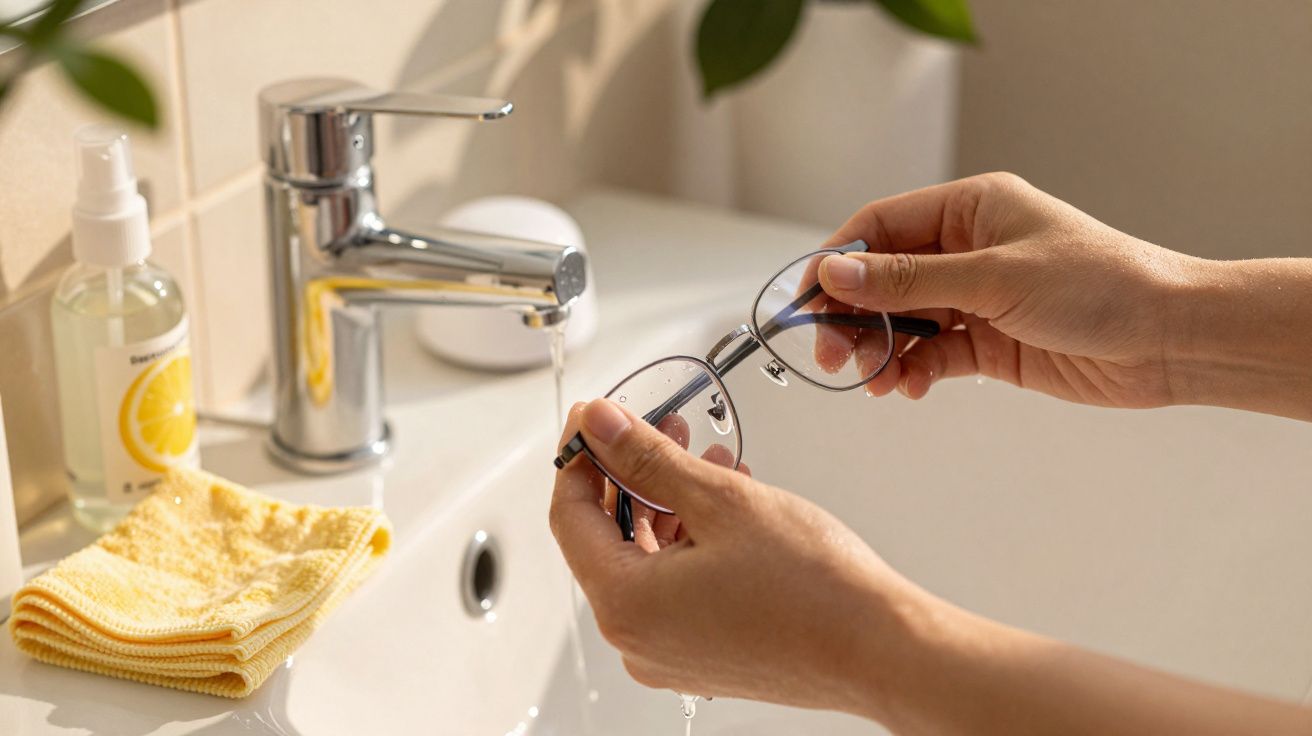
Five straightforward habits can help prevent scratches and costly damage.
Spectacles are no longer just a vision aid; they’re an expensive everyday essential. Anti-reflective coatings, blue light filters, varifocal lenses and tinted lenses all add value-and they’re precisely the features that can suffer if you clean them the wrong way. If you’re still rubbing your lenses with kitchen roll or a T-shirt, you risk dull, scratched lenses and poorer vision. The good news is that a few easy changes can keep your spectacles noticeably clearer for longer.
Why most cleaning habits damage spectacles
Many people instinctively grab whatever is nearby: a tissue, a paper towel, a sleeve or a scarf. A quick wipe and you assume the job’s done. In reality, that brisk rubbing can act like ultra-fine sandpaper on the lenses.
Even tiny grains of dust or sand trapped in paper or fabric can grind permanent micro-scratches into the coating.
There’s another issue: very hot tap water and harsh household cleaners can attack the surface treatment on lenses. Anti-reflective layers, hard coatings and blue light filters may lift, cloud over or develop patches. The same applies to non-prescription sunglasses-these are often coated as well.
Cleaning mistakes to stop immediately
- Cleaning with paper tissues or kitchen roll
- Rubbing your spectacles with a jumper, T-shirt, scarf or jacket
- Rinsing under very hot water
- Using window cleaner, multi-purpose cleaner or nail varnish remover
- Dry-wiping dusty lenses without rinsing first
Cutting out these common habits is a major step towards scratch-free spectacles. Next is getting the cleaning routine right.
How often should you actually clean your spectacles?
Many people only clean their lenses once their view feels noticeably hazy. A short, regular routine works better.
- Daily: Remove dust and fingerprints with a microfibre cloth, especially in the evening.
- Every few days: Wash properly with water and mild washing-up liquid or mild hand soap.
- After heavy exposure: After sport, gardening or cooking, rinse your spectacles straight away.
- Every few weeks: If needed, use an ultrasonic cleaner at home or ask your optician for an ultrasonic clean.
If you’re around lots of dust, building work, or flour (bakery or kitchen environments), rinse your lenses more often so grit can’t settle.
1) Water plus mild washing-up liquid or hand soap: the foundation
In day-to-day life, you usually don’t need pricey specialist sprays. A simple combination of cool to lukewarm water and a mild cleanser is enough in most cases.
Do it like this:
- Wash your hands thoroughly so you don’t transfer grease or dirt onto the lenses.
- Hold the spectacles under cold to lukewarm running water-never hot.
- Put one drop of mild, grease-cutting washing-up liquid or a mild hand soap on your fingertips.
- Gently massage the lenses and frame with your fingertips, including the nose pads and the ends of the arms.
- Rinse well until no soap residue remains.
- Pat dry carefully with a clean, soft cloth.
Opticians often recommend this method because it’s effective, inexpensive and usually safe for most coatings. Another benefit: it reduces smears and can help lower the tendency for lenses to fog up for a while.
2) A microfibre cloth for spectacles beats paper when you’re out and about
For quick touch-ups during the day, a microfibre cloth is the best option. Its fine fibres lift grease, dust and fingerprints without attacking the lens surface.
Microfibre traps dirt rather than just pushing it around-protecting the coating and keeping your vision crisp.
What matters with a microfibre cloth:
- Use only soft, lint-free microfibre cloths.
- Store it in a case or small pouch so it doesn’t pick up grit.
- Don’t cram it into a pocket with other textiles where it can collect dust and sand.
If you’re caught without a microfibre cloth, a clean, smooth cotton cloth can work in a pinch-such as a fresh, plain cotton handkerchief with no texture. Rough fabrics (especially anything woolly or denim-like) are a no-go because the fibres are too abrasive.
Don’t forget the frame: spectacles need more than lens cleaning
Plenty of people polish the lenses and ignore everything else. Yet nose pads, hinges and arm tips collect skin oils, make-up, hair spray and sweat. It’s not just unsightly; in extreme cases it can contribute to skin irritation.
Regularly wipe:
- The bridge and nose pads
- The inside of the arms
- The hinge area, where dust often gathers
A few seconds each day is usually enough to keep your spectacles hygienically clean.
3) Wash the microfibre cloth regularly
A dirty cloth simply rubs built-up grime straight into the lens coating. Many people use the same cleaning cloth for months without washing it-then wonder why fine scratches keep appearing.
If the cloth looks grey, feels greasy or smells odd, you’re putting that dirt directly onto the lenses-scratches become far more likely.
Care for your cloth properly:
- Machine-wash regularly at 30–40 °C.
- Avoid fabric conditioner-it coats the fibres with a film.
- Air-dry; don’t blast it in a tumble dryer on high heat.
- Replace it at least once a year (sooner if you clean your spectacles frequently).
If you clean your lenses several times a day, washing the cloth weekly is ideal. Keeping a spare cloth is useful too-particularly for travel, the office or the car.
4) Making lenses shine with a vinegar cleaner-carefully
Household vinegar can cut grease and leave glass surfaces gleaming. Some people also use it for spectacle lenses in a highly diluted form. The key is the correct ratio and whether your specific coating tolerates it.
| Mixture | Note |
|---|---|
| 50% water, 50% clear household vinegar | Put into a spray bottle; use sparingly |
| A few sprays onto the lenses | Spread with a microfibre cloth and buff dry |
Before trying vinegar cleaner, check any paperwork from your optician or ask in-store whether vinegar is compatible with your exact lenses. Some high-tech coatings are more sensitive.
What professionals generally advise against:
- Window glass cleaner
- Multi-purpose kitchen cleaners
- Acetone or nail varnish remover
- Methylated spirits or other aggressive solvents
These products may contain ingredients that can damage plastics and coatings, leaving lenses dull, streaky or discoloured.
5) Ultrasonic cleaner: professional-level care at home
Many opticians use ultrasonic devices to clean spectacles thoroughly and hygienically. Compact home ultrasonic cleaner models are now widely available and much more affordable than they used to be.
Ultrasound cleans where cloths can’t reach-inside hinges, between frame and lens, and around tiny screws.
How it works:
- The device has a small tank filled with water and a suitable cleaning solution.
- Your spectacles sit in a basket insert so they don’t rest directly on the metal base.
- When switched on, high-frequency sound waves create microscopic bubbles.
- The bubbles collapse at the surface and dislodge dirt from tiny crevices.
Many units clean in under a minute. This approach is particularly helpful for:
- Heavily soiled nose pads
- Spectacles exposed to lots of make-up or hair spray
- Frames with many small gaps and intricate designs
- Cleaning jewellery at the same time, such as rings or chains
Always check the instruction manual for which solutions are approved, and ask your optician if you’re unsure. Some natural materials-such as certain horn or wooden frames-may not be suitable for ultrasonic cleaning.
The real risks of scratched and dirty lenses
This isn’t only about appearance. Scratched or constantly smeared lenses can contribute to headaches, faster fatigue when reading and less confident vision in traffic.
Fine scratches are particularly deceptive: you may barely notice each one, but together they scatter light much more. In glare from low sun, headlights or bright backlighting, that scattering creates reflections and makes seeing feel significantly more tiring.
Another factor is behavioural: badly smudged lenses tempt you to rub more often and more forcefully-usually with whatever is to hand. That vicious circle gradually wears away the coating even further.
Practical everyday tips for living with spectacles
A few small habits can keep your spectacles clearer for longer:
- Store your spectacles in a rigid case, not loose in a handbag or rucksack.
- Never place them lens-side down on a table.
- When cooking or frying, keep a little distance from the hot pan so oily mist doesn’t settle on the lenses.
- At the hairdresser’s or when colouring hair, take your spectacles off if possible to avoid chemicals reaching the lenses.
- For sport, use a sports strap or dedicated sports spectacles to prevent slipping and scratches.
It also helps to keep a clean microfibre cloth in each place you commonly need one-handbag, desk drawer and car. That way you’re less likely to reach for a sleeve or a napkin. These small precautions cost far less than replacing lenses at the optician.
When to get help from an optician (and when replacement is the smarter choice)
If your anti-reflective coating starts to peel, your blue light filter looks patchy, or the lenses have a persistent haze that won’t wash off, home cleaning won’t fix it. An optician can assess whether the coating is failing, tighten hinges and screws, replace worn nose pads, and advise on lens replacement if scratches are affecting clarity-particularly for varifocal lenses where small imperfections can feel more disruptive.
Extra protection: small upgrades that reduce cleaning and wear
If you’re choosing new lenses, ask about modern hard coatings and hydrophobic/oleophobic finishes. These make fingerprints and water spots less likely to cling, so you clean less often and rub less-both of which reduce long-term wear. A well-fitted case and a couple of good microfibre cloths are still essential, but the right coatings can make daily upkeep much easier.
Spectacles are precision products. With sensible cleaning routines, you can use them for years without them turning dull-just a few minutes of care each week can mean clearer vision, fewer headaches and a more comfortable view through genuinely clean lenses.



Comments
No comments yet. Be the first to comment!
Leave a Comment